Post Construction Cleaning Meaning and What It Covers

Post-construction cleaning is the detailed removal of construction dust, debris and residue after the work is substantially complete and before occupants move in. It's the finishing step between a completed project and a space you can comfortably use.
Your new kitchen looks beautiful, but a hand across the windowsill comes away white. The bathroom mirror has a faint film, and dust keeps appearing around the door trim. For homeowners, renters and businesses in Kennesaw, Acworth and nearby communities, those details mean the project needs more than ordinary housekeeping.
Table of Contents
What Post-Construction Cleaning Means in Plain Terms
Think of routine cleaning as wiping the kitchen after dinner. Post-construction cleaning is closer to clearing up after someone worked with sawdust, drywall compound and adhesive near every drawer, ledge and window track.
Say your kitchen renovation is complete. The builder removes packaging and offcuts, but drywall dust remains above the cabinets, paint particles cling to trim, and adhesive traces mark the glass. Grout haze, sawdust and fine residue may also remain on floors, fixtures and ventilation components.
The U.S. General Services Administration's indoor environmental quality guidance identifies renovation-related dust particulates, volatile organic compounds and mold as potential concerns, and recommends construction or renovation flush-outs before use. A room's finished appearance doesn't tell you whether those concerns have been addressed.
From work site to usable space
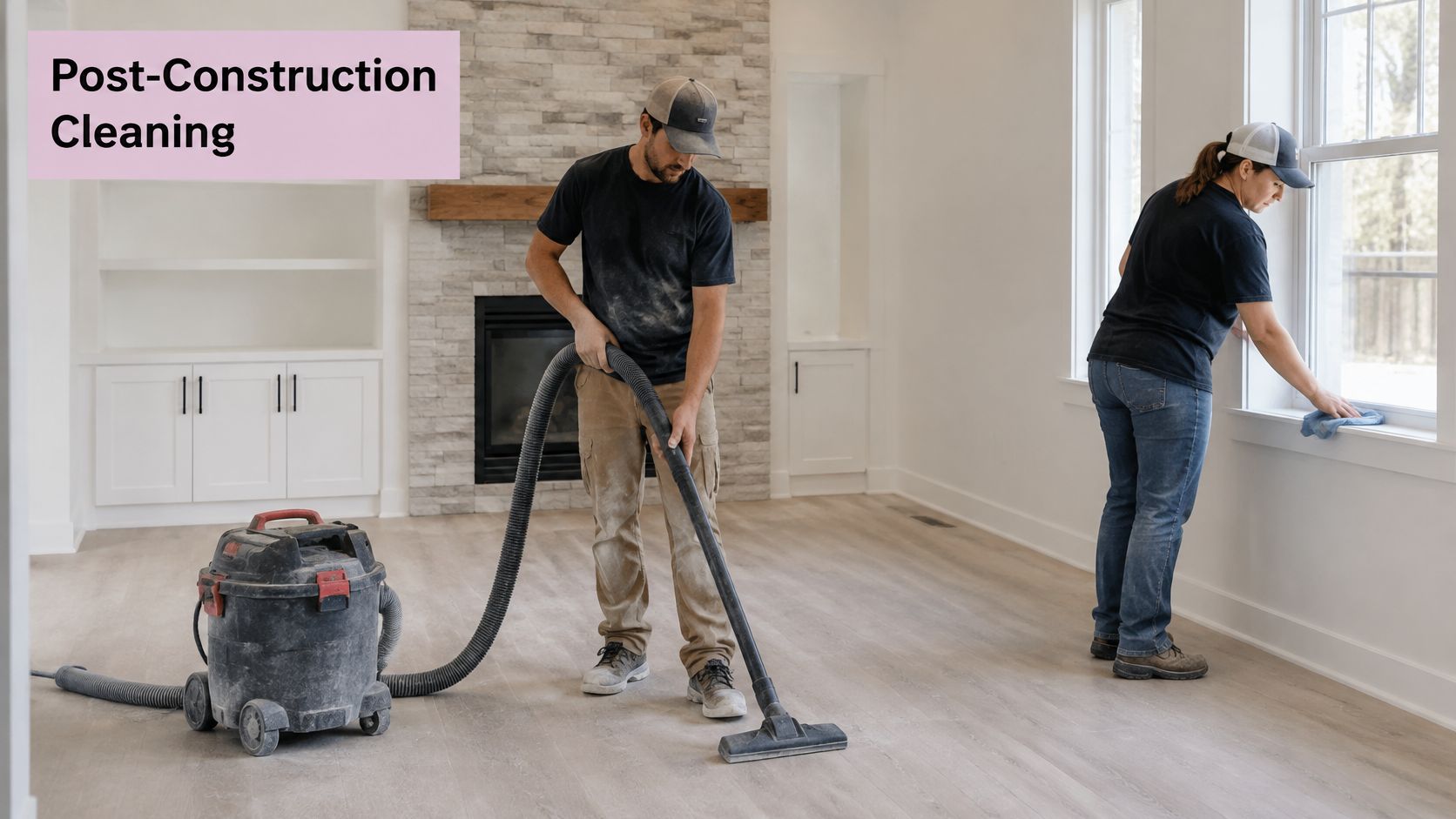
Walking through a room or restarting airflow can disturb particles that settled during construction. That's why the post construction cleaning meaning goes beyond making a room look tidy: it describes a controlled transition to everyday use.
Local job sites bring another practical challenge. Red clay tracked into homes in Kennesaw, Acworth and Cartersville can leave a film that ordinary dusting smears rather than removes. Loose material needs collection before the remaining film is washed from compatible surfaces.
Flawless Painting's advice on how to keep your home a sanctuary offers useful context for managing the disruption surrounding a project. Cleaning belongs in that handover conversation, not as an afterthought.
Scope first: A builder's rough cleanup and a cleaner's final detail work aren't interchangeable.
The builder usually handles bulk offcuts, packaging and larger debris. The final cleaning addresses fine dust and residue left behind. Confirm in writing whether a booking includes either or both; our post-construction work begins after contractors complete the work and remove construction debris.
How It Differs From Standard, Deep and Move-Out Cleaning
| Cleaning type | Main goal | Typical trigger | Dust and residue handling |
|---|---|---|---|
| Basic maintenance | Routine upkeep of a lived-in home | Regular recurring visits | Light dusting and surface wiping |
| Deep cleaning | Detailed top-to-bottom refresh | First visit, seasonal reset or special occasion | Built-up grime on accessible surfaces, rather than a construction-particle removal process |
| Move-out cleaning | Prepare an empty home for handover | Lease end or sale | Cabinets, appliances and baseboards; minor residue handled as incidental |
| Post-construction cleaning | Make a newly built or renovated space occupancy-ready | Work substantially complete and debris removed | Fine dust removed with HEPA vacuuming and damp wiping across floors, fixtures, accessible vent covers, glass and cabinet exteriors |
What was left behind, and by whom? That question matters more than whether the home looks generally dirty.
A household that needs bathroom upkeep and kitchen cleaning has a different problem from a household whose contractor just sanded drywall. Booking an ordinary maintenance visit after a remodel can leave both the resident and cleaner working from the wrong expectations.
Choose by the residue, not the room
A kitchen doesn't automatically need the same service every time. Cooking grease calls for degreasing; powder above cabinets after installation calls for construction-dust removal. Deep cleaning can address substantial accumulated grime, but the label alone doesn't establish a construction-specific scope.
Move-out cleaning answers another need: preparing an empty property for handover. A renter leaving a well-maintained apartment may need attention to closets, appliances and baseboards without needing construction cleanup. A landlord turning over a remodeled property needs to identify the renovation residue separately.
- Choose maintenance when people are living in the home and ordinary upkeep is the issue.
- Choose deep cleaning when accessible surfaces need a more detailed refresh.
- Choose move-out cleaning when the primary task is empty-home turnover.
- Choose post-construction cleaning when cutting, sanding, sawing or demolition left job residue.
Recurring maintenance and a one-time construction cleanup are separate bookings, even when both are needed at the same address. A recurring schedule shouldn't absorb a renovation project.
At Maid in America, we can recommend Basic maintenance, Top-to-Bottom Deluxe cleaning or selected add-ons based on the space and your priorities. We record special-care instructions in advance, so tell us which finishes are new and which rooms contractors used.
Hazards, Safety Limits and When to Stop Cleaning
Renovation dust isn't automatically ordinary household dirt. Its source determines whether a general cleaner should handle it at all.
Cutting, grinding, drilling or demolishing concrete, tile, masonry and stone can generate respirable crystalline silica. The UK Health and Safety Executive's sweeping and cleaning guidance warns that dry sweeping concrete dust can create high dust levels. Older painted surfaces, asbestos-containing materials, mold after water damage and chemical spills raise different concerns that can't be resolved by surface wiping.
Checks that change the cleaning plan
Before anyone starts, get clear answers from the contractor:
- Dust-producing work: Which materials were cut, sanded, drilled or demolished, and how was the work contained?
- Older painted surfaces: Were existing coatings disturbed, and was their composition assessed?
- Documentation: Are there applicable testing results, abatement records or clearance documents?
Consider an older bungalow in Acworth after kitchen demolition. If painted trim and unknown flooring layers were disturbed, the immediate question isn't which cleaner removes the film. It's whether qualified professionals have identified and controlled the potential contaminants.
Keep children, pets and pregnant people outside the work area during construction and cleanup. EPA guidance for homeowners concerned about lead dust calls for containment, protected surfaces, HEPA vacuuming and wet cleaning to keep contaminated dust from spreading.
When cleaning should stop
Stop ordinary cleaning when you encounter suspect materials, visible mold, an unidentified spill or potentially significant lead-paint disturbance without an appropriate assessment. Don't carry dusty tools or bags through occupied rooms while trying to sort it out.
Ventilation should follow the contractor's hazard-control plan rather than blowing dust toward other rooms. If you're handling known, nonhazardous heavy dust yourself, use suitable protective equipment, including a properly fitted respirator appropriate to the task. A face covering doesn't make unknown material safe to disturb.
A clean-looking surface is not a clearance certificate.
Post-construction cleaning is a readiness service. Testing, clearance and regulated abatement belong to appropriately qualified or licensed professionals; our cleaning role doesn't replace those functions.
Room-by-Room Post-Construction Checklist
Use this as a walk-through checklist, not a promise that every item belongs in every appointment. Reach, surface condition and the agreed scope determine what can be cleaned without damaging new finishes.
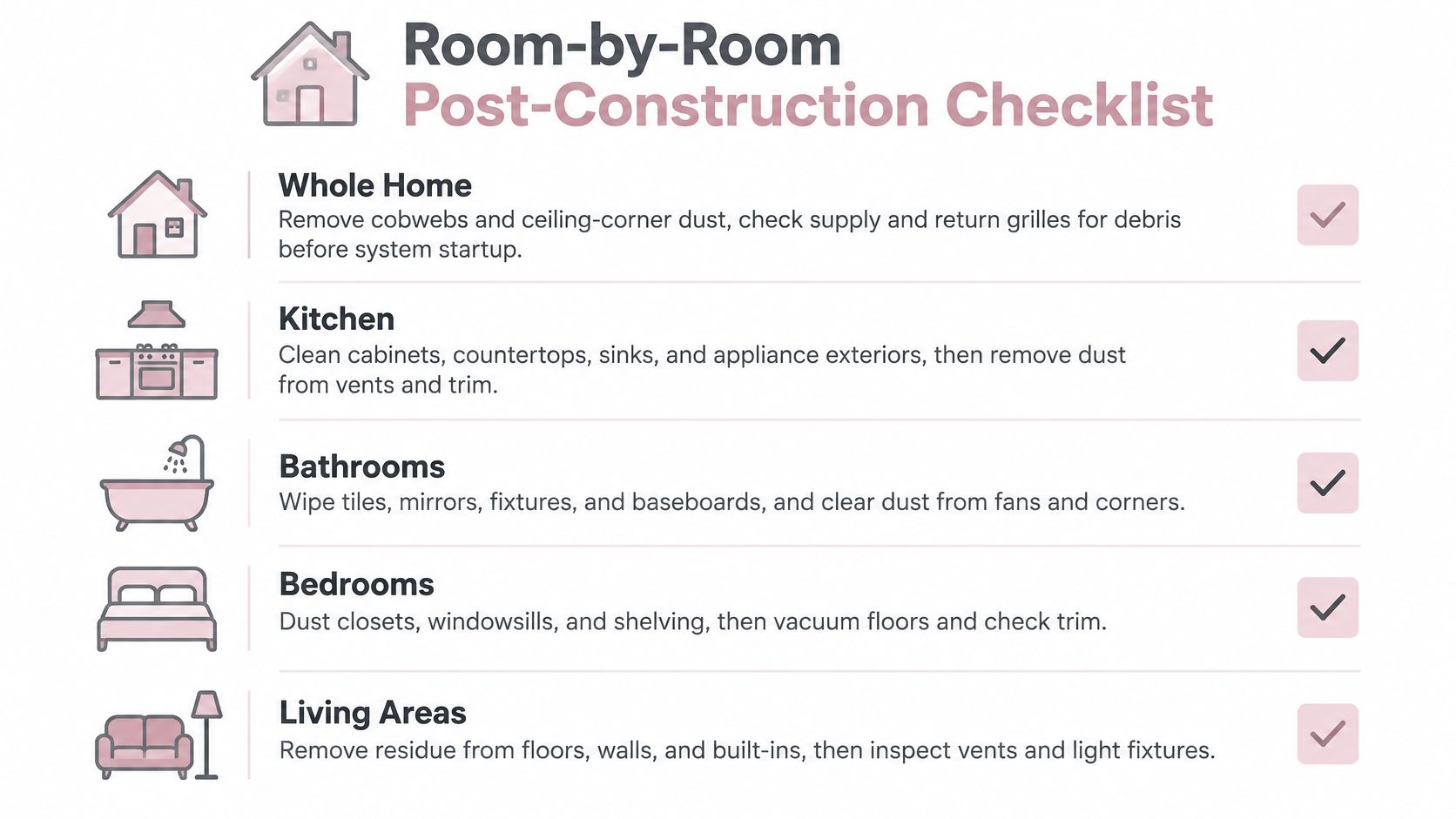
Whole home and living spaces
- Whole home: Remove cobwebs and ceiling-corner dust. Check supply and return grilles for debris before system startup, and wipe door frames, switches and outlet covers without introducing moisture into electrical openings.
- Bedrooms: Inspect closet shelving, windowsills, door tops and trim. Check corners where boxes or protective coverings concealed settled residue.
- Living areas: Detail accessible built-ins and light fixtures. Treat walls according to their finish and curing requirements rather than scrubbing fresh paint.
- Floors: Look for paint spatter, adhesive traces and grout haze under normal and angled light. Flag stubborn residue before using a scraper or chemical remover.
Kitchens, bathrooms and entry points
- Kitchen: Check cabinet exteriors and tops, drawer fronts, appliance exteriors, sink, faucet, backsplash and countertops. Cabinet interiors and the inside of an oven or fridge require advance agreement.
- Bathrooms: Inspect tile, tub and shower surrounds, vanity tops, fixtures, mirrors and grout lines. Don't confuse permanent grout discoloration or installation defects with removable dust.
- Windows and doors: Include sills, frames, tracks and reachable glass surfaces within the agreed scope. Clarify which sides of the glass are accessible.
- Entry, garage and mudroom: Inspect thresholds and baseboards where Georgia red clay and job-site mud entered. Confirm whether garage cleaning is included rather than assuming it follows from an entryway booking.
For a hypothetical house in Woodstock after drywall and flooring work, the entry, kitchen and bathrooms may need especially close attention because contractors repeatedly passed through them. Don't assume the room with the biggest renovation is the only affected room.
Finish the walk-through with a clean surface wipe and an inspection of edges, not just open countertops. Our post-construction cleaning checklist can help you organize the details before booking.
Confirm cabinet interiors, window tracks, appliance interiors, baseboards and any grout work in advance. We follow a detailed cleaning plan, and add-ons must be requested before the visit so the appointment reflects the work you need.
How to Run the Clean in the Right Order
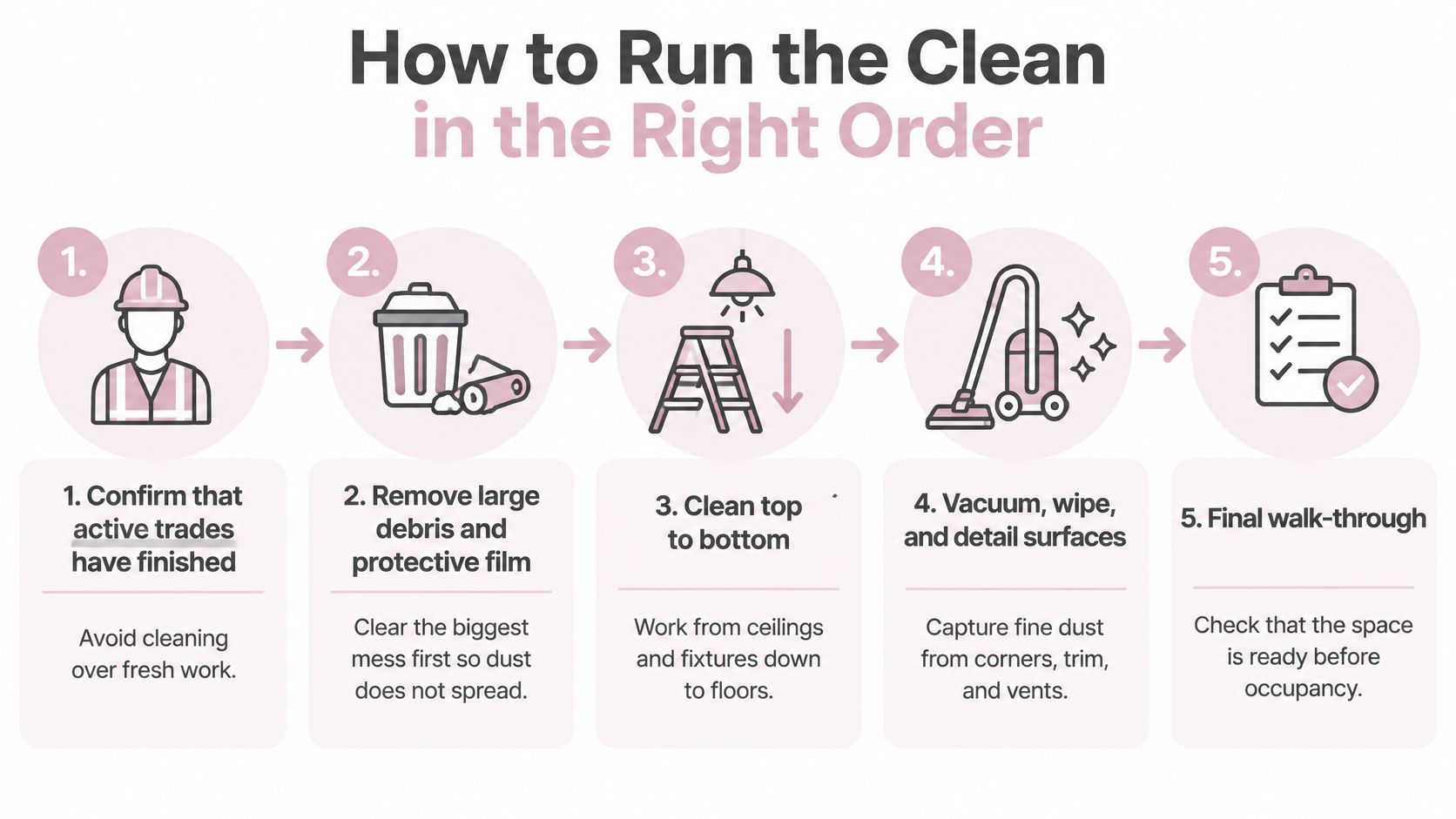
Order determines whether you capture dust or move it onto surfaces you've already finished. Prepare compatible cleaners, clean microfiber cloths, a properly maintained HEPA-filtered vacuum, crevice attachments and fresh mop materials before starting.
Capture loose dust before washing
- Confirm trades are finished and remove bulk material. Have the contractor remove debris and identify protective films that can safely come off. Cleaning around unfinished installation work leaves hidden residue and invites another pass.
- Coordinate HVAC operation. Have the contractor or HVAC professional establish appropriate isolation and register protection before dusty cleanup. Don't seal a running system's openings indiscriminately, because restricted airflow can create equipment problems.
- Start high. Address accessible ceiling corners, fan blades, cabinet tops and fixtures before lower surfaces. Anything dislodged should land in an area that hasn't received its final clean.
- HEPA vacuum dust reservoirs. Use suitable attachments on ledges, trim and accessible crevices without scratching finishes. Removing loose powder first keeps damp wiping from turning it into paste.
- Move toward the exit. Work from cleaner rooms toward dirtier areas. Keep dusty tools and footwear from crossing completed floors.
Detail, finish and verify
- Damp-wipe surfaces. Use microfiber on compatible horizontal and vertical surfaces, changing or rinsing cloths frequently. A loaded cloth spreads residue instead of collecting it.
- Clean glass and its edges. Detail sills and tracks before the final glass pass. Avoid abrasive pads or blades unless the surface manufacturer permits them.
- Finish floors. Use a solution suited to the flooring and fresh rinse water where appropriate. Change water when it turns grey rather than spreading it into the next room.
- Inspect the result. Check surfaces under normal and angled light. Re-clean missed areas before putting furniture and belongings back.
- Scope clarity: Our included tasks follow the selected service, with special requests recorded beforehand.
- Credentials: We're licensed, bonded and insured, and use carefully selected and trained cleaners.
- Continuity: One dedicated cleaner is usually assigned to a home rather than a large team, so clients often know their cleaner by name.
- Size and layout: More floor area increases coverage, while kitchens and bathrooms add fixtures and detailed surfaces.
- Dust level: Light paint touch-ups require a different effort from widespread drywall sanding or tile-cutting residue.
- Detail count: Cabinets, windows, tracks, trim and fixtures add work that floor area alone doesn't capture.
- Access: Parking, entry arrangements, stairs and stored belongings affect equipment movement and working space.
- Deadline: A tight move-in date leaves less scheduling flexibility and makes contractor coordination more important.
OSHA's construction silica guidance restricts dry sweeping or brushing when those methods could contribute to respirable silica exposure, with wet methods or HEPA vacuuming as feasible alternatives. Compressed-air blowdown can likewise lift settled particles back into the breathing zone; it isn't a shortcut for a final clean.
The practical acceptance test is no visible film on horizontal surfaces, no glass streaks, clean accessible HVAC registers and a finger wipe that comes away clean. These checks verify cleaning quality, not the absence of every hazardous substance.
Before booking, have the cleaning order included in the scope discussion. A clear sequence is more useful than a vague promise to clean everything.
Doing It Yourself Versus Hiring a Professional
| Project factor | Handle it yourself | Call a professional |
|---|---|---|
| Scope | One room after a paint touch-up | Whole home or several trades involved |
| Dust source | Light touch-ups with no sanding | Drywall sanding, tile cutting, concrete grinding or other silica-producing work |
| Building age | Post-1978 home with no disturbed painted surfaces | Pre-1978 home where more than six square feet of painted surface was disturbed, subject to EPA renovation requirements |
| Equipment | Owned HEPA-filtered vacuum and suitable protective gear | Professional HEPA equipment and trained personnel |
| Timeline | Flexible schedule with room for another pass | Tight move-in, listing or handover deadline |
| Accountability | You own the result and missed areas | Licensed, bonded and insured service with a defined checklist |
DIY the light, known-material cleanup. Hire out the heavy work, and send hazardous-material questions to qualified specialists.
The EPA requirements linked in the table generally apply to covered renovation, repair and painting work, including certified contractors and lead-safe practices. The threshold isn't permission to treat smaller disturbances carelessly, and a newer building isn't automatically free of other hazards.
What professional help should resolve
A small paint touch-up with no sanding may need little more than careful surface cleaning. A multi-trade renovation demands more coordination, access and finish-specific judgment. Buying equipment doesn't resolve uncertainty about the dust's contents.
A renter preparing an otherwise clean apartment for move-out has a different assignment from a landlord preparing a remodeled house for new tenants. The landlord needs the contractor's closeout information before deciding what belongs in the final cleaning appointment.
Use our guide to choosing a post-construction cleaning company to organize the scope conversation. The useful questions concern exact surfaces, cabinet interiors, window tracks, supplies, credentials and who returns if ongoing service is planned.
Professional cleaning can remove agreed residue. It cannot certify a property as lead-free or hazard-free.
If a contractor hasn't resolved a suspected contamination issue, don't substitute a general cleaning appointment for that missing work.
Timeline and What Drives the Estimate
| Stage | Typical timing | Why it matters |
|---|---|---|
| Active trades finish | Once final coats and installations are complete | Cleaning earlier means repeating work |
| Ventilation purge | As directed by the project's ventilation plan | Helps clear airborne dust and fumes before the final clean |
| Post-construction clean | After the purge, or when coordinated with the project's ventilation plan | Removes settled dust while access remains clear |
| Final inspection | During the cleaning visit, under normal and angled light | Catches film, streaks and missed ledges before handover |
A project's ventilation plan may call for a purge before the final clean. Follow the contractor's instructions about ventilation and any duct work rather than treating one schedule as a rule for every property.
Why floor area isn't enough
A new build in Cartersville and a smaller but heavily renovated house in Marietta can require very different cleaning time. The smaller property may have more difficult residue, crowded access or more detailed surfaces.
Compare estimates line by line, not just by the total. Confirm whether accessible vents, window tracks, cabinet interiors and final inspection are included. Clarify whether the scope covers residue removal or correction of installation defects.
The post-construction cleaning cost guide explains the scope factors that affect estimates. A written time estimate is also useful: a limited renovation generally requires less work than a whole new build, but dust levels and detailed surfaces can change that comparison.
Request Your Free Post-Construction Estimate Today
For a useful estimate, share the affected rooms, project type, final-trade completion date, and move-in or listing deadline. Mention whether the work involved cutting, sanding, demolition, or disturbance of older paint, and whether contractors provided hazard-assessment information.
Maid in America serves homes, offices, and community amenities across West Georgia, including Kennesaw, Acworth, Woodstock, Cartersville, Marietta, Dallas, Hiram, and Powder Springs. The company is locally owned, licensed, bonded, and insured, and uses natural, low-odor cleaning products.
A clear plan before the visit
Each appointment follows a detailed cleaning plan. The cleaning professional reviews completed work before leaving the home, and any add-on tasks should be requested in advance. The written scope should make clear which surfaces and rooms are included.
For clients seeking continuity, Maid in America assigns the same experienced cleaner whenever possible. Share your priorities and handover date when requesting an estimate.
Maid in America offers post-construction cleaning after contractors have completed the work and removed construction debris. Visit Maid in America to request a free estimate online, or call 770-427-4448 with your project details and preferred handover date.



Maid in America provides reliable, personalized cleaning with natural products for homes, offices, and communities across West Georgia. Licensed, bonded, and insured, we’re locally and privately owned.
Get in touch with us today!
info@maidinamericaga.com