Deep Cleaning Meaning: What It Covers and How It Differs

Deep cleaning means a thorough, top-to-bottom removal of built-up dirt, dust and residue from every accessible surface, and it's not the same as disinfecting. If a fixed checklist defined a deep clean, why would a tidy Kennesaw home with pets, pollen and red clay at the door need a different scope than a vacant move-out in Acworth?
That's the gap in most definitions. The right scope depends on how much buildup has accumulated, which neglected areas can be reached, who's living there and what the visit needs to accomplish.
Table of Contents
What Deep Cleaning Means in Plain Terms
Deep cleaning means a thorough, top-to-bottom cleaning that removes built-up dirt, dust, grease and residue from every accessible surface, including the edges and corners routine cleaning skips.
Think of a weekly wipe-down like brushing your teeth each morning. It handles what you can see and reach easily. A deep clean clears the buildup underneath and around the edges, the film that forms slowly even in a cared-for home.
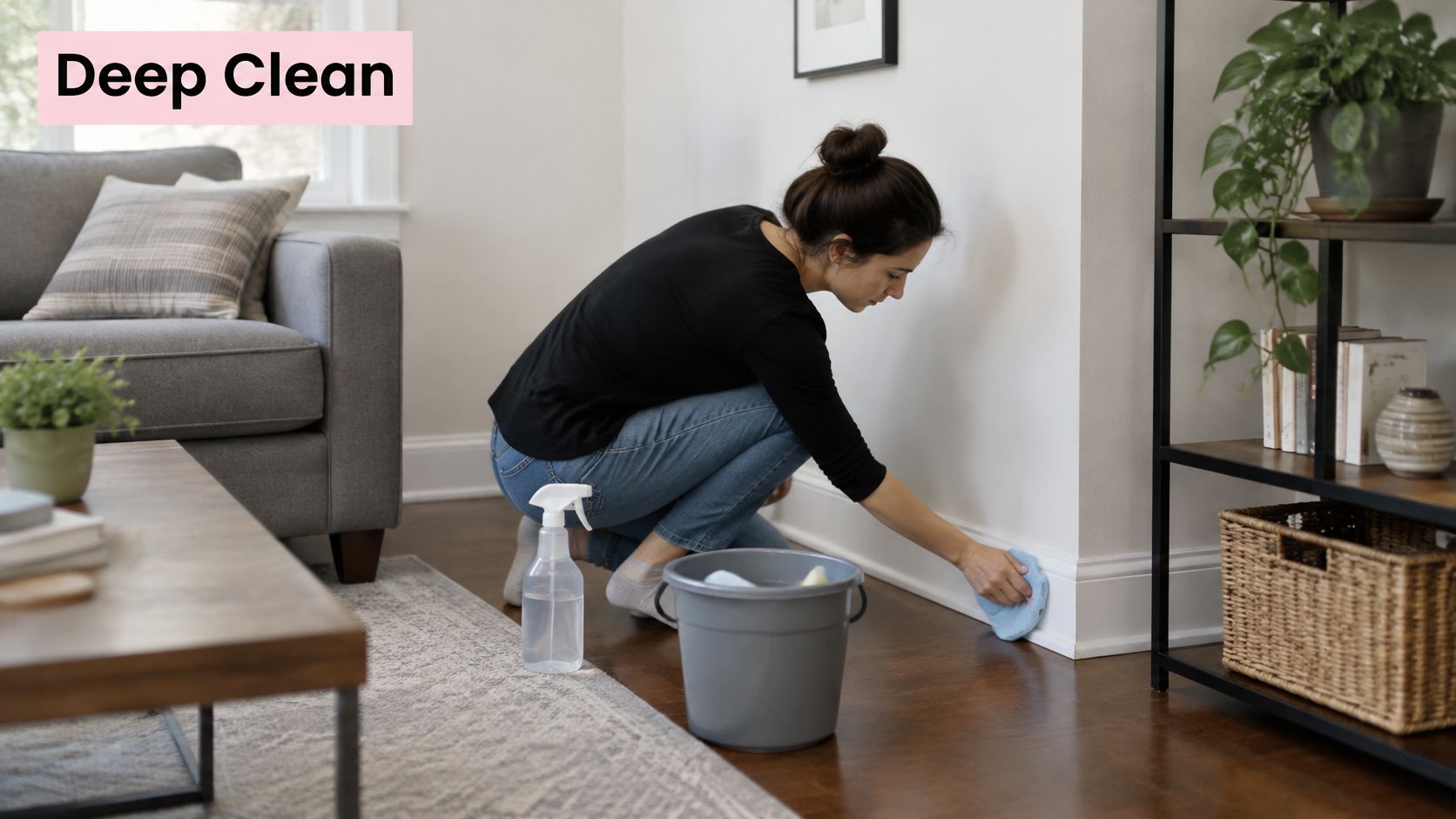
Cleaning, sanitizing and disinfecting aren't synonyms
The CDC home cleaning and disinfecting guidance defines cleaning as removing germs, dirt and impurities from surfaces through water, soap or detergent, and scrubbing. It distinguishes sanitizing, which reduces germs to levels considered safe under public-health standards, from disinfecting, which uses chemical products to kill remaining germs after cleaning. The CDC also advises cleaning surfaces before sanitizing or disinfecting them, because organic and inorganic material can interfere with those later processes.
That's the most important distinction for understanding deep cleaning meaning in a home. Deep describes how thorough the cleaning is, not how strong the chemicals are. A service can hand-wipe baseboards, cabinet fronts, fixtures and floors without claiming every surface was disinfected. If disinfecting is included, it's a separate step that should follow the product label and its intended use.
Three markers of a genuine deep clean
- It removes accumulated soil: Grease film, dust layers, soap scum and residue that routine passes leave behind are loosened and physically removed.
- It reaches neglected areas: Edges, corners, fixtures and hard-to-access surfaces get attention instead of another quick pass over open counters.
- It leaves rooms ready to use: Surfaces are wiped, dried and reset, not left wet or heavily scented to signal that work happened.
When any provider says deep clean, ask two plain questions. Which tasks are included, and is disinfecting part of the job or a separate request?
Deep Cleaning vs Regular Cleaning Side by Side
Deep cleaning vs regular cleaning at a glance
| Criteria | Regular cleaning | Deep cleaning |
|---|---|---|
| Purpose | Keeps a lived-in home maintained | Resets a home where soil has built up |
| Typical schedule | Weekly, biweekly, every three weeks, or monthly | First visit, seasonal reset, move turnover, or special occasion |
| Surfaces reached | Kitchens, bathrooms, floors, furniture, mirrors, and accessible surfaces | Same surfaces plus edges, fixtures, vents, window tracks, and neglected areas |
| Detail level | Dusting, wiping, and vacuuming of accessible areas | Full top-to-bottom reset with more time on built-up grime |
| Products | Natural, low-odor cleaners | Same natural, low-odor cleaners applied with more agitation on built-up soil |
| Scope set by | Standard service plan | Estimate based on the space's condition and your priorities |
Regular cleaning maintains a home that's already at a good baseline. Our standard service covers kitchens, bathrooms, floors, furniture, mirrors, trash removal and accessible surfaces, plus high cobweb removal and detailing of light switches and doorknobs. You can keep washable upholstery looking fresh between visits by following simple easy care for sofa covers, while our cleaner handles the room around it.
The mechanism is removal, not stronger chemicals
Deep cleaning extends that work to less-accessible places where dust, grease, skin oils and food residue collect. The CDC environmental cleaning guidance supports a simple sequence. Detergent loosens soil, then wiping, agitation, rinsing and controlled disposal physically remove it, ideally working from higher surfaces to lower ones and from cleaner areas toward dirtier ones.
That explains every row in the table. A deep clean takes longer because the cleaner reaches more surfaces and spends more time on each layer of grime. It doesn't require harsher products, and it doesn't promise a sterile home.
Rule of thumb: If your home needs a reset before maintenance can keep it up, book the deep clean first, then move to a recurring plan.
Recurring visits then protect that baseline weekly, biweekly, every three weeks or monthly. Without the reset, each maintenance visit works on top of old buildup and never quite catches up.
Room-by-Room Deep Cleaning Checklist
A useful checklist follows the buildup: what has collected, and which areas routine cleaning may not reach. The right scope depends on the home's condition and what the cleaning is for.
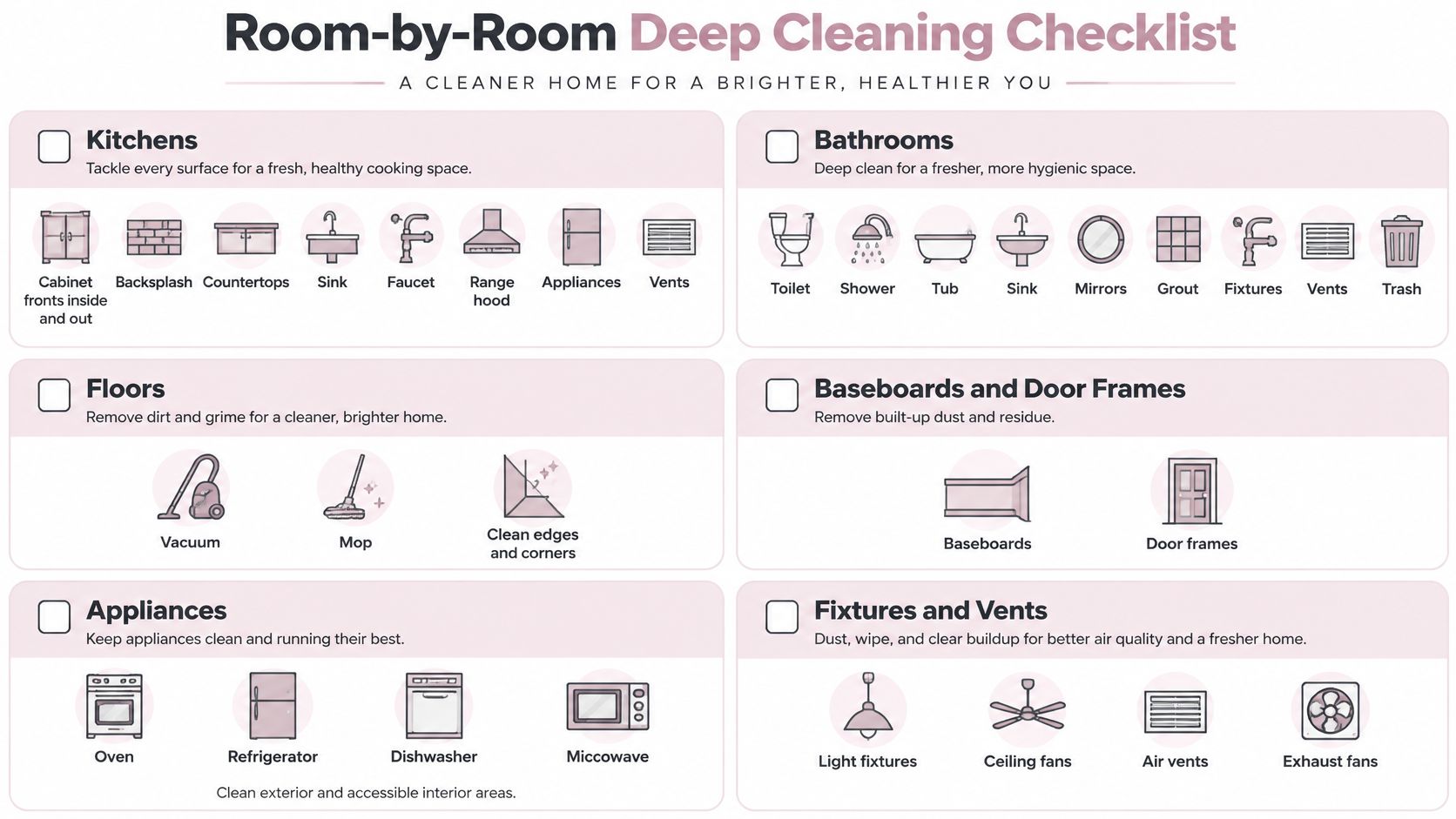
Deep-clean tasks by area
| Area | Typical deep-clean tasks | Why it matters |
|---|---|---|
| Kitchen | Cabinet fronts, backsplash, range hood, and appliance exteriors; cabinet interiors by request | Grease and food film can collect where routine wiping misses |
| Bathrooms | Grout lines, tub and shower surfaces, toilet base, and exhaust fan cover | Soap scum and moisture-prone spots need focused attention |
| Floors | Edges and areas under furniture vacuumed, then mopped with a flooring-appropriate solution | Dirt left in corners can dull floors |
| Baseboards and door frames | Dusting, wiping scuffs, and cleaning frames, doorknobs, and light switches | Dust and marks collect near floor level and on touch points |
| Appliances | Oven, fridge, and microwave interiors when arranged in advance | Interior residue may be hidden from view |
| Fixtures and vents | Ceiling fans, light fixtures, vents, and window tracks | Dust can collect on elevated fixtures and in tracks |
Work in the order a cleaner works
Start high, then work down. Dust ceiling fans, light fixtures, vents, and window tracks first, so loosened dust can be collected during the next steps. In the kitchen, give grease on the backsplash and range hood time to soften before wiping.
Bathrooms need focused attention on grout, tub and shower surfaces, the toilet base, and the exhaust fan cover. Then clean baseboards, door frames, doorknobs, and light switches. Finish by vacuuming floor edges and under furniture, followed by mopping with a solution suited to the flooring.
An item's inclusion depends on the service selected. Appliance interiors and other detailed tasks may need to be requested in advance so they can be included in the visit plan. A checklist can also help gym managers verify your gym's deep cleaning area by area rather than judging by appearance alone.
Why damp dusting matters
The EPA indoor particulate matter guidance identifies pollen, mold spores, pet dander, dust mites, skin flakes, and hair as biological particles that contribute to indoor particulate matter. It recommends vacuuming carpets and furniture weekly or more often, dusting with a damp cloth to limit airborne dust, and considering a HEPA-filter vacuum.
That approach can help manage settled dust on fans, vents, and upholstery. People with asthma or allergies should leave the room while vacuuming, since vacuuming can stir up dust temporarily.
Use the table to compare the tasks included in a quote. The listed areas make it easier to tell whether the scope addresses buildup and neglected spots rather than extending a routine visit.
When Your Georgia Home Needs a Deep Clean
How can you tell when routine upkeep is no longer enough? A deep clean makes sense when more soil has built up than regular maintenance can remove, or when the home needs attention in areas that are usually missed. The right timing depends on the home's condition, how it is used, and what comes next.
Triggers that call for a deep clean
| Trigger | Why buildup happens | When to book |
|---|---|---|
| First visit after months without regular cleaning | Dirt and dust have built up beyond what maintenance usually addresses | Before starting a recurring plan |
| Spring pollen season | Pollen and dust settle on fans, vents and baseboards | Late winter to early spring |
| Humid Georgia summer | Moisture and dust can leave surfaces feeling sticky or rooms feeling stale | Early summer, before guests arrive |
| Move-in, move-out or listing | An empty or mostly empty home needs a final clean before handover or listing | Before the walkthrough or handover |
| After renovation | Fine construction dust settles on accessible surfaces | After contractors finish and remove construction debris |
| Holiday hosting | Kitchens, bathrooms and guest areas may need more than a routine visit | Before guests arrive |
Georgia conditions that speed up buildup
Red clay comes indoors on shoes, paws and stroller wheels, then collects near entryways, floor edges and lower walls. Spring pollen adds a fine layer to fans, vents, sills and baseboards around Kennesaw, Acworth, Marietta and Woodstock. The center of a room may look clean while edges and less-reached surfaces still hold dust.
Humidity needs a separate check. The Georgia Department of Public Health indoor air quality brochure advises keeping indoor relative humidity below 60%, with an ideal range of 30% to 50%, because excess moisture supports indoor mold growth.
Cleaning can remove surface soil, but it cannot fix a moisture source. A reset may make condensation or damp spots easier to notice; ventilation or repairs address the cause.
A simple test before you book
Clean a room as you normally would, then check it again an hour later. If dust remains in neglected areas or surfaces still look dull, the home may need a more detailed reset rather than another routine pass. Residue returning quickly on glass, grout or fixtures can also point to buildup that regular cleaning has not addressed.
Use this guide to how often to deep clean your house to consider how household activity, pets and the season affect timing. The same test can help HOA managers assess clubhouses and shared amenities before busy rental periods.
Book a one-time deep clean when the home's condition or purpose calls for one. Afterward, choose weekly, biweekly or monthly maintenance based on the pace your household can sustain.
What Happens During a Professional Deep Clean and How Long It Takes
A professional visit follows an order for a practical reason. Dust falls downward, pretreated soil loosens while other work happens, and floors stay clean because they're finished last.
Three phases, twelve steps
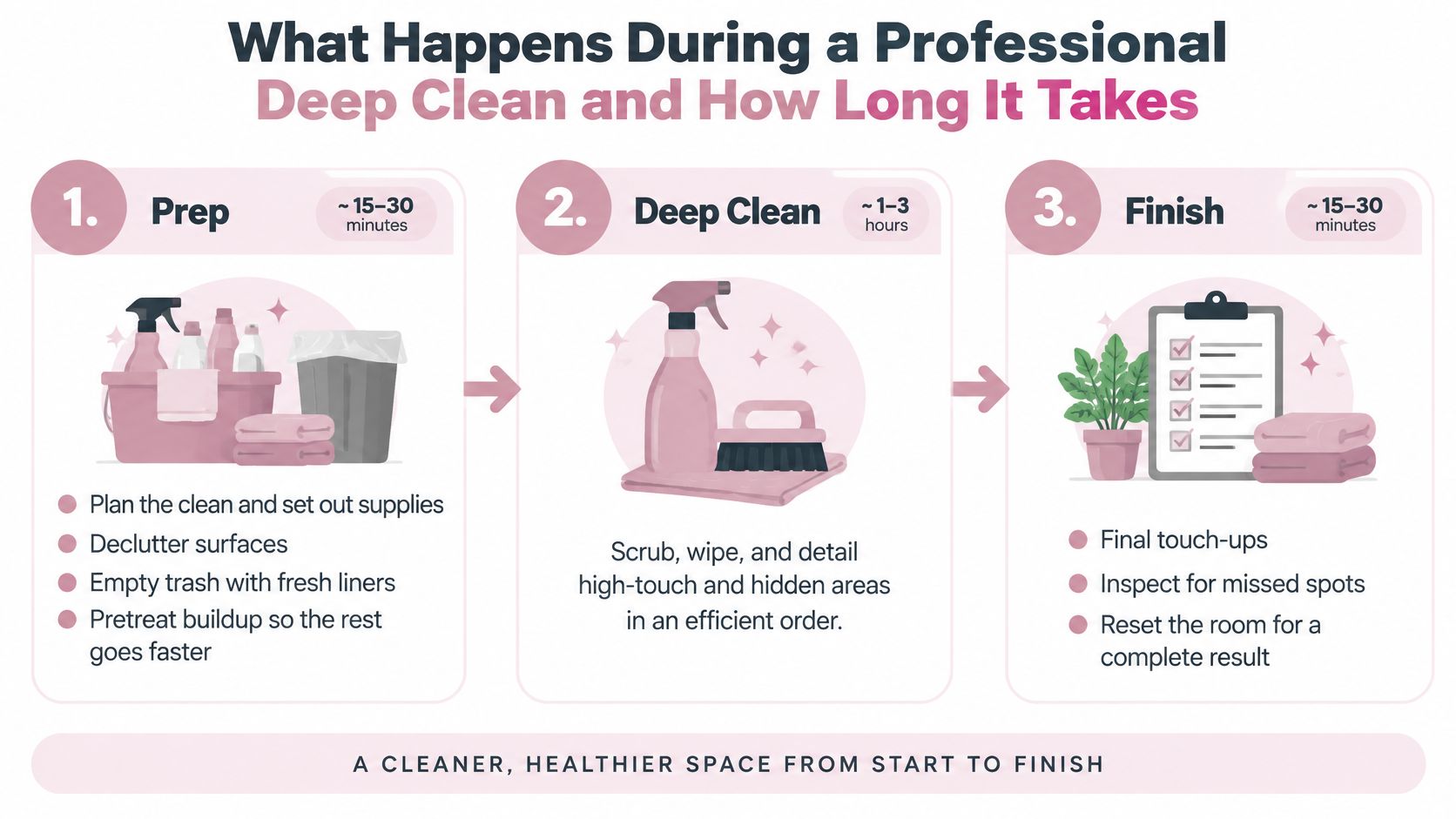
Our detailed flow has 12 steps in three phases, Prep (steps 1-4), Clean (steps 5-10) and Finish (steps 11-12).
- Prep: We plan the visit, set out supplies, declutter surfaces, empty trash with fresh liners and pretreat bathroom and kitchen buildup so scrubbing works faster.
- Clean: We do high and low dusting, hand dusting and wiping, washing and scrubbing, dry shine and polish, vacuuming, then mopping with the solution suited to your flooring.
- Finish: We make final touch-ups, check rooms against the agreed scope and reset each space so it's ready to use.
Vents get surface attention during this flow, but the ductwork behind them is a separate specialty. Homeowners concerned about what's inside the system can read about duct cleaning for healthier indoor air and decide whether that service belongs on a different schedule.
How long should you expect
No single duration fits every home. Size, condition, occupants, pets and add-ons such as inside the oven or fridge all move the time up or down, and add-ons must be requested in advance so we can plan for them. Your estimate sets a time window for your specific home instead of borrowing an average from someone else's.
Context helps explain why people hire help. In 2024, 45% of U.S. adults said spring cleaning takes three or more days, according to the American Cleaning Institute survey conducted by Wakefield Research.
At the estimate, confirm four things. Ask about scope, included tasks, add-ons and the expected time window.
What to Expect from a Maid in America Deep Clean
Maid in America is a locally owned cleaning company based in Kennesaw, Georgia. Its licensed, bonded, and insured professionals use natural, low-odor cleaning products. Service is available in communities across Cobb, Paulding, and Bartow counties.
One familiar cleaner, consistent visits
Whenever possible, Maid in America assigns the same experienced cleaner to a home. Familiarity helps maintain continuity from one visit to the next, while each appointment follows a detailed cleaning plan based on the selected service and the home's priorities.
The company's Top-to-Bottom Deluxe Cleaning provides detailed care for first visits, seasonal resets, special occasions, or homes that need more than routine maintenance. Residential options also include Basic maintenance, move-in and move-out cleaning, and occasional or special-event cleaning. Maid in America provides office and community amenity cleaning as well.
Request an appointment online at maidinamericaga.com or call 770-427-4448. An estimate can be shaped around your home's condition and priorities, so the recommended scope fits the space.
Request a Free Estimate for Your Deep Clean
Use your home's condition and priorities to decide what to request. A deep clean can reset areas that routine maintenance does not address; after that, a recurring plan can help maintain the result.
Maid in America can recommend Basic maintenance cleaning, Top-to-Bottom Deluxe cleaning, or selected add-ons based on your space and priorities. Deluxe Top-to-Bottom Cleaning provides detailed care for first visits, seasonal resets, special occasions, and homes that need more than routine maintenance. Included tasks depend on the service selected, and add-ons must be requested in advance. Read about what affects deep cleaning costs before requesting an estimate.
Gather these details first
- Rooms and size: Bedrooms, bathrooms, and approximate living area.
- Household details: Pets, children, and anyone sensitive to scents.
- Timing: When the home was last deep cleaned and what prompted another.
- Priorities and add-ons: Rooms that matter most, plus any requested oven, fridge, cabinet, interior window, grout, laundry, dish, or upholstery-vacuuming tasks.
Request an estimate from Maid in America online at maidinamericaga.com or by calling 770-427-4448. Share details about your home in Kennesaw, Acworth, or a nearby community so the recommended scope reflects its condition and your priorities.
Ready to request an estimate for a top-to-bottom reset? Visit Maid in America or call 770-427-4448 to discuss the areas you want cleaned.




Maid in America provides reliable, personalized cleaning with natural products for homes, offices, and communities across West Georgia. Licensed, bonded, and insured, we’re locally and privately owned.
Get in touch with us today!
info@maidinamericaga.com