Is Deep Cleaning Worth It? a Practical Home Guide

Deep cleaning is worth it when built-up dust, grime, and soil have outgrown routine upkeep, when a home is changing hands, or when a health-sensitive household needs a clean baseline. It's usually not worth the extra spend as a stand-in for regular maintenance in a home that's already kept on a steady schedule.
So why do so many homeowners book a top-to-bottom clean, admire their spotless baseboards on Friday afternoon, and wonder three weeks later where all that effort went? Conventional advice treats deep cleaning like a magic reset button that fixes a cluttered or dusty house for months at a time. In reality, a deep clean is a one-time baseline reset, not a maintenance plan, and booking one without a realistic plan for what happens next wastes money.
Knowing whether is deep cleaning worth it for your house, rental, or small office comes down to three practical factors: what has built up, how fast daily life puts it back, and which methods are used to remove it.
Table of Contents
- The Short Answer on Whether Deep Cleaning Is Worth It
- What a Deep Clean Actually Includes
- The Health Case for a Periodic Deep Clean
- Why the Method Matters as Much as the Deep Clean
- One-Time Reset or Recurring Service
- Household Situations That Benefit Most
- How to Choose and Brief a Deep Cleaning Service
- Deciding What Your Home Needs Next
The Short Answer on Whether Deep Cleaning Is Worth It
A professional deep clean pays for itself when soil, pet hair, grease, and settled dust have accumulated in the edges and crevices that weekly wiping skips. It also earns its keep during major transitions, like moving out, wrapping up a remodel, hosting family for the holidays, or setting a cleaner starting point for someone with asthma, allergies, or limited mobility. If your home is already cleaned every week or two and hasn't fallen behind, a standard maintenance visit keeps the same standard for less disruption.
More households are weighing this exact decision right now. According to Harris Williams' 2024 Home Services Survey, almost 90% of consumers in 2024 said they were as likely or more likely to hire a home-services provider than they were two or three years earlier. That same condition-first logic applies across home upkeep trades, as Professional Window Cleaning's 2026 cost guide illustrates when weighing whether specialized glass and sill cleaning justifies a dedicated booking.
Matching Your Home Situation to the Right Service
Because no universal calendar rule fits every household, the smartest way to decide is to match your home's current condition to the level of work it needs.
| Situation | Worth it? | Recommended service | Why |
|---|---|---|---|
| First clean or months since last thorough clean | Yes | Top-to-Bottom Deluxe | Built-up soil needs detail work routine cleaning skips |
| Moving in or out of a home | Yes | Move-in/move-out cleaning | Empty rooms expose cabinets, closets and appliance interiors |
| After a renovation or construction | Yes | Post-construction cleaning | Fine dust settles on every surface and in edges |
| After illness in the household | Yes, once | Deep clean, then recurring | Removes soil film before normal upkeep resumes |
| Hosting a holiday gathering | Often | Deep clean or targeted add-ons | High-traffic areas and guest spaces get a reset |
| Home with pets or heavy shedding | Yes, then recurring | Deep clean then weekly or biweekly | Dander and hair re-accumulate fast without upkeep |
| Household with allergies or asthma | Often | Deep clean with damp methods, then recurring | Targets dust reservoirs routine cleaning leaves |
| Busy commuter family with little time | Yes if upkeep lapsed | Deep clean then recurring | Restores baseline the family cannot maintain alone |
| Retiree aging in place | Often | Deep clean then recurring | Hard-to-reach areas become risky to clean personally |
| Already on weekly or biweekly service | Usually no | Keep standard cleaning | Maintenance already prevents the buildup |
| Lower-traffic home, tidy occupants | Rarely | Monthly or basic cleaning | Little accumulation to justify the extra detail |
Notice a pattern across that table. Condition, occupancy, shedding pets, and how long it's been since the last thorough clean should drive the recommendation, not a blanket pitch to deep clean every house on the block. Any reputable local cleaner should ask about those details before giving you an estimate.
What a Deep Clean Actually Includes
People often assume a deep clean just means scrubbing the same counters and floors a little harder. In practice, standard maintenance and deep cleaning target completely different layers of a home. Routine maintenance handles essential kitchens, bathrooms, floors, furniture, mirrors, accessible surfaces, and trash removal, while a deep clean reaches the edges, ledges, and fixtures where grime collects between visits.
Comparing Basic Maintenance Against Deep Detail Work
Here's where a thorough top-to-bottom visit goes beyond routine upkeep.
| Task area | Deep clean adds beyond standard cleaning |
|---|---|
| Baseboards | Detailed wash |
| Doors and frames | Detailed wash |
| Light switches and doorknobs | Sanitized plus surrounding detail |
| High cobwebs | Removed plus ceiling fan blades and vents |
| Floor edges and under-furniture reach | Full reach on edges and under furniture |
| Furniture and upholstery | Upholstery vacuuming when added |
| Cabinet exteriors | Detail cleaning or add-on |
| Inside oven or fridge | Add-on, requested in advance |
| Interior windows and door glass | Add-on |
| Grout | Add-on |
| Laundry and dishes | Add-on |
Those added areas aren't cosmetic filler. Baseboards, door frames, ceiling fan blades, air vents, and the strips of flooring under sofas act as catch basins for household buildup, and they're usually the first details a sharp-eyed houseguest, landlord, or homebuyer spots the moment they walk into a room.
Why Hidden Reservoirs Take Extra Time
Surface appearance and actual dust removal aren't the same thing. The U.S. Environmental Protection Agency's indoor environment guide highlights a federal evidence review noting that ordinary household cleaning products used on counters, floors, and bathrooms didn't reduce allergen levels measured in dust samples, and warns that cleaning can temporarily stir settled particles back into the air. Physical source removal matters far more than shiny countertops.
That's why the tools and sequence count during a deep clean. In its Care for Your Air indoor quality guide, the EPA identifies dust mites, mold spores, pollen, pet dander, skin flakes, and biological particles as indoor particulate pollutants, noting that dry dusting and conventional vacuuming can redistribute settled dust while damp wiping and HEPA-filtered vacuums capture it. Physical cleaning habits even shift what lives in household dust: a 2025 study published in Annals of Human Biology found that dusting (p = 0.006) and vacuuming (p = 0.011) were significantly associated with the composition of household bed-dust microbiomes.
Because a thorough visit moves methodically from high dusting down through hand-wiping, scrubbing, dry polishing, vacuuming, and floor-appropriate mopping, it takes noticeably longer than a standard clean of the exact same square footage. Scope also varies from one company to another, so always confirm which items are built into the base service and request add-ons like oven interiors, refrigerator shelving, grout work, or interior glass ahead of time so nothing gets assumed.
The Health Case for a Periodic Deep Clean
A tidy living room can still hold a surprising amount of airborne irritants. Every time someone walks across a rug, fluffs a throw pillow, or runs a dry duster over a bookshelf, settled dust lifts right back into the breathing zone.
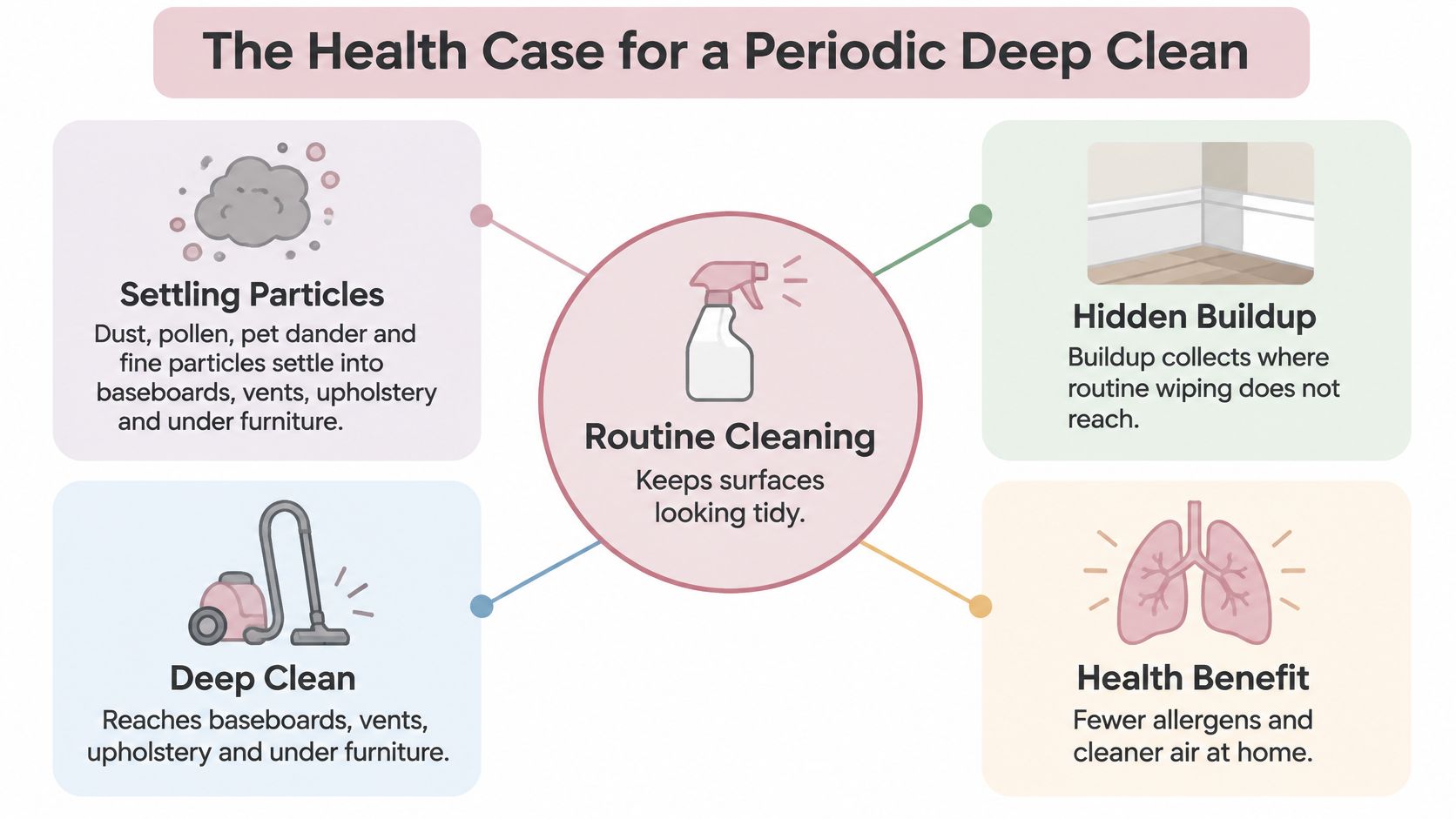
According to the U.S. Environmental Protection Agency's Report on the Environment, indoor pollutant concentrations can be as high as, or higher than, outdoor levels. That same report identifies dust mites, mold, pet dander, cockroach allergens, and particulate matter as common asthma triggers, and points out that children, older adults, and people with respiratory or heart conditions face higher vulnerability to poor indoor air quality. To counter that buildup, the agency recommends decluttering, damp-dusting, and vacuuming, while making clear that regular cleaning reduces, rather than eliminates, dust mites, pollen, and animal dander.
What happens to those particles once they lift off the floor explains why deep source removal pays off. The EPA's guide to indoor particulate matter explains that fine dust particles can travel deeper into the lungs, where exposure may decrease lung function or aggravate asthma, and recommends frequent cleaning, ventilation, damp-cloth dusting, and vacuuming carpets and upholstered furniture at least weekly. In a controlled study of homes with asthmatic children, detailed cleaning paired with cleaning education and hypochlorite-based supplies produced reductions in surface bacteria, airborne fungal spores, and dust-antigen levels alongside significant improvements in general-health measures compared with a control group. That study tested specific bleach-containing supplies and doesn't guarantee identical results from every cleaning visit, yet it reinforces a practical point: removing allergen-bearing dust supports a healthier home environment.
Deep cleaning is a targeted environmental reset, not a medical treatment. It works best alongside good ventilation, humidity control, clean HVAC filters, and prompt attention to moisture or mold.
How Georgia Pollen and Red Clay Speed Up Indoor Buildup
Homeowners in Kennesaw, Acworth, and across West Georgia deal with a faster buildup cycle than folks in drier climates. Thick yellow Georgia spring pollen drifts through open doors and coats window tracks, sills, and ceiling fans within days. Add wet-weather red clay tracked in on shoes and paws plus humid summer air that helps dust cling to baseboards and kitchen cabinets, and hidden reservoirs fill up fast.
For households with pets, young kids, or seasonal allergy flare-ups, clearing those neglected surfaces periodically makes day-to-day living noticeably more comfortable, even though no cleaning service can promise to prevent illness or cure allergies.
Why the Method Matters as Much as the Deep Clean
More chemicals don't equal a cleaner house. In fact, spraying heavy fragrances or indiscriminate disinfectants across every surface can turn a well-intentioned deep clean into a respiratory irritant, especially for children or anyone sensitive to odors.
A 2025 systematic review and meta-analysis found a significant association between household-cleaning-agent exposure and pediatric asthma, reporting a pooled odds ratio of 2.90 (95% CI 2.13 to 3.95). Because the underlying studies varied widely, that finding doesn't mean a single deep clean causes asthma, yet it underscores why product choice and technique matter just as much as elbow grease. Even products labeled "natural" or "green" aren't automatically risk-free if they carry heavy fragrance oils or get atomized into the air through trigger sprays.
Knowing the difference between cleaning, sanitizing, and disinfecting keeps you from paying for harsh chemical overuse. Guidance from the Centers for Disease Control and Prevention notes that dirt and organic soil film interfere with sanitizers and disinfectants, meaning soap, detergent, or an appropriate cleaner has to remove the grime first. The CDC recommends regularly cleaning high-touch points like doorknobs, light switches, handles, countertops, and faucets, while reserving disinfection mainly for times when someone is sick or at greater risk.
Five Questions to Ask Before Booking
Before anyone brings a caddy into your house, ask a few direct questions about how the work gets done:
- What products are used on surfaces? Look for low-odor, health-conscious solutions rather than strong bleach or synthetic perfumes on everyday woodwork and counters.
- Do you damp-wipe instead of dry-dusting or heavy spraying? Spraying solution into a microfiber cloth instead of misting the air keeps airborne residue down while trapping settled dust.
- How are high-touch spots handled? Confirm that soil is removed first and that any sanitizing step follows product label contact times rather than a quick wipe-and-go.
- How should we handle ventilation and kids or pets? Plan to crack windows or run exhaust fans during and after the visit, keep respiratory-sensitive family members out of rooms being worked on, and let damp surfaces dry before reoccupying.
- Can you adjust for asthma or sensitivities? Tell the cleaner up front about allergies, pets, or scent triggers so they can tailor products accordingly.
When a home hasn't had a detailed clean in a long time, the value comes from lifting old soil film off surfaces, not layering stronger fragrances over it.
One-Time Reset or Recurring Service
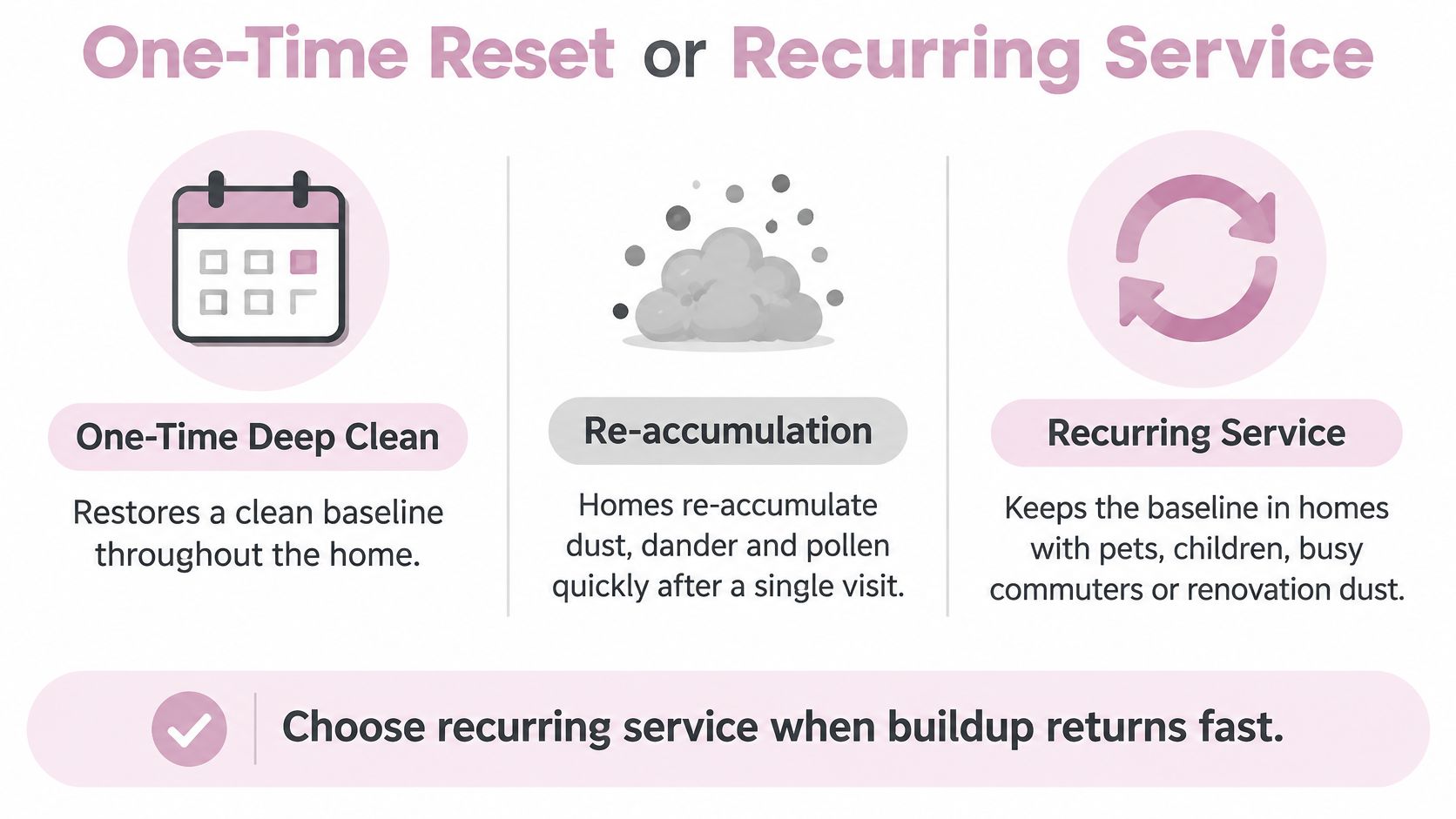
Here's the tradeoff most cleaning blogs gloss over: a deep clean restores your home to a clean baseline, but it does nothing to stop Tuesday through Sunday from happening. Homes with shedding dogs, school-age kids, busy commuters, or lingering renovation dust begin re-accumulating particles within days. If you pay for a single top-to-bottom reset and then let months slip by without upkeep, you end up right back where you started.
There's also an indoor air angle to consider. In a 2022 exposure study of 50 women, conventional bleach products, disinfecting wipes, and dish soap were associated with higher breathing-zone concentrations of several volatile organic compounds, with 75% of the highest measured VOC emissions coming from conventional products, while some green products still released fragrance chemicals of concern. Lighter, consistent routine upkeep prevents heavy grime from baking onto kitchens and baths in the first place, reducing the need for aggressive, multi-product scrubbing marathons.
Practical rule: If buildup is heavy or months have passed since the last thorough clean, start with a deep clean and step down to a recurring schedule. If your home is already maintained on a weekly or biweekly cadence, keep that schedule and add targeted detail work only when specific spots need it.
How to Pick Your Cadence
Weigh these six realities when deciding between a one-time booking and a recurring weekly, biweekly, every-three-weeks, or monthly plan:
- Occupancy and traffic: A household of five with sports gear and daily cooking builds soil much faster than a tidy two-person home.
- Pets: Heavy shedders leave dander on baseboards and upholstery quickly, making weekly or biweekly maintenance far more effective than sporadic resets.
- Time since the last thorough clean: A six-month lapse usually needs a reset first so routine visits can focus on upkeep instead of playing catch-up.
- Upcoming milestones: Moving, listing a home, or hosting out-of-town relatives justifies targeted detail work before the event.
- Available household time: Be honest about whether your family will realistically vacuum edges and scrub bath tile between visits.
- Seasonal timing: For how often you should deep clean your house, a helpful rule of thumb for homes that need periodic resets is once ahead of spring pollen season and once before holiday hosting, paired with recurring basic maintenance in between.
A deep clean isn't meant to be repeated every week. Size, current condition, desired frequency, and any add-ons all shape what a fair estimate looks like, so share how your household lives before choosing a plan.
Household Situations That Benefit Most
Abstract checklists are helpful, yet seeing how real home conditions play out across West Georgia makes the decision much clearer.

Pet Shedding and Tight Commutes in Kennesaw
Say a busy family in Kennesaw commutes daily down I-75 while two large dogs shed across the living room rug and sofa. Weekend quick-sweeps keep the main walkways clear, yet pet hair packs along floor edges, coats the lower baseboards, and settles under the sectional. Starting with a Top-to-Bottom Deluxe reset plus upholstery vacuuming clears out that embedded hair, and stepping down to biweekly recurring service keeps dander from taking over again.
Safe Aging in Place in Acworth
In Acworth, a retiree living independently keeps the kitchen counters neat every day, yet dust gathers on high ceiling fan blades, return vents, and upper door frames. Climbing a step stool to wipe cobwebs or scrub tub surrounds introduces a real fall risk. An initial deep clean followed by regular maintenance takes the hazardous reaching and bending off their plate without disrupting their routine.
Spring Pollen and Red Clay in Marietta
Every April in Marietta, fine yellow pollen drifts onto window sills and screened-porch doors while spring rain turns backyard soil into red clay tracked across entry tile and mudroom trim. Routine mopping can smear that grit into grout lines and corners. Scheduling a seasonal deep clean with targeted baseboard and window-glass add-ons resets the house right as pollen peaks.
Remodel Dust in Woodstock
After a kitchen renovation in Woodstock, the new quartz counters look sharp, yet fine drywall and sawdust settles inside cabinet hinges, across light fixtures, and along window tracks for days. Contractors are often stretched thin wrapping punch lists or relying on an answering service for contractors to juggle incoming jobs, so fine interior detailing falls to the homeowner. That residue needs post-construction cleaning, not a standard wipe-down.
Rental Turnovers in Powder Springs and Holiday Prep in Cartersville
When tenants vacate a Powder Springs rental, empty rooms immediately expose sticky pantry shelves, dusty closet rods, and baked-on oven spills. A thorough move-in/move-out cleaning coordinated right after the movers finish gets the unit ready for walkthroughs or listing photos. Meanwhile, a Cartersville home gearing up for Thanksgiving guests rarely needs an empty-house scrub, yet high-traffic living areas, guest bathrooms, and kitchen cabinet fronts benefit from a focused deep clean or targeted add-ons the week before company arrives.
How to Choose and Brief a Deep Cleaning Service
Once you decide a deep reset makes sense, the quality of your briefing determines whether you get real value for your money. Walking a provider through your actual priorities prevents surprises on cleaning day and keeps you from paying for tasks you didn't need.
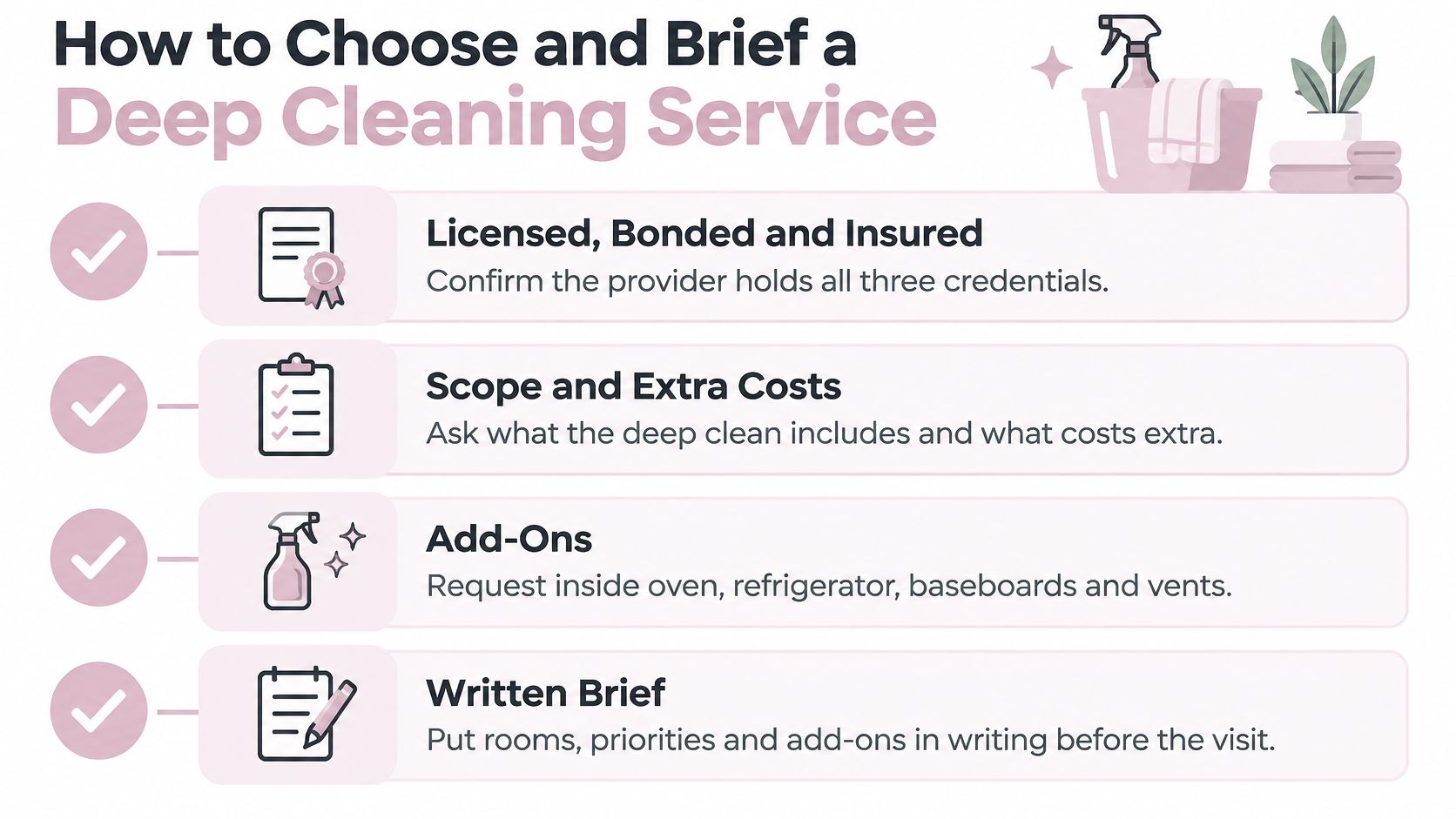
Bring this short checklist to your estimate call:
- Confirm credentials first: Verify that the company is licensed, bonded, and insured, and uses carefully selected, trained staff.
- Clarify exact scope and add-ons: Ask what comes standard in the deep clean and what's priced separately. If you want inside the oven or fridge, washed baseboards, cabinet detailing, interior windows, grout scrubbing, laundry, dishes, or upholstery vacuuming, put those requests on the work order before arrival.
- Ask about product safety and odor: Confirm whether low-odor, natural products are available and flag any household asthma, allergies, or scent sensitivities.
- Check who enters your home: Continuity matters. Having one dedicated cleaner assigned to your home instead of a rotating crew means someone learns your layout, remembers your delicate finishes, and builds trust over time.
- Give an honest condition brief: Share accurate square footage, number of pets, how long it's been since the last detailed clean, and your top two priorities. Understanding what drives deep cleaning cost helps you spot the difference between an estimate matched to your home's condition and a vague flat-rate guess.
Briefing Shared Spaces and Move-Out Projects
The exact same briefing habits pay off outside private homes. For small workplaces needing office cleaning or boards scheduling HOA clubhouse and community amenity cleaning, putting high-touch restrooms, kitchens, and glass entry doors in writing keeps shared spaces presentable for residents and staff. Realtors, property managers, and HOA managers across West Cobb often get the cleanest handoff by scheduling deep or move-out cleanings right after movers, carpet cleaners, pressure washers, or professional organizers finish their work so fresh dust isn't tracked back across finished floors.
Write down your top three priorities before the cleaner arrives. Clear expectations turn a good cleaning appointment into a great one.
Deciding What Your Home Needs Next
If months of buildup, a move, a renovation, a recent illness, or a health-sensitive household brought you here, a deep clean is worth the investment, especially when you follow it with a manageable maintenance plan. If your home is already on a reliable weekly or biweekly rhythm, stick with routine upkeep and add targeted detail work only where daily life leaves a mark.
At Maid in America, locally and privately owned by Vicky Bates, we help homeowners, renters, and businesses across Kennesaw, Acworth, Woodstock, Marietta, Dallas, Hiram, Powder Springs, Cartersville, West Cobb, and surrounding communities in Cobb, Cherokee, Paulding, Douglas, and Bartow counties figure out the right fit without upselling work you don't need. We can recommend a Basic maintenance cleaning, a Top-to-Bottom Deluxe cleaning, or selected add-on services based on the condition of your space and your priorities. One-time options include The Basics, Deluxe Top-to-Bottom Cleaning, Move-In & Move-Out Cleaning, Office Cleaning, and Post-Construction Cleaning, alongside flexible weekly, biweekly, every-three-weeks, and monthly recurring plans.
Cleaning pricing depends on the size and current condition of the home, the service selected, frequency, and any add-ons requested in advance, so every free estimate is matched to your actual house rather than a one-size-fits-all guess. We're licensed, bonded, and insured, hold a 4.9-star Google rating, were voted Best Home Cleaning Service by Around Acworth Magazine, and proudly partner with Cleaning for a Reason to provide free cleanings for cancer patients. Guided by our approach to "Add sparkle and shine with your health in mind," we use natural, low-odor products and typically assign one dedicated cleaner to your home so you get to know your cleaner by name.
Ready to see whether your space needs a full Top-to-Bottom Deluxe reset or steady recurring upkeep? Request a free, personalized estimate online at Maid in America or call 770-427-4448 to talk through your home's condition, priorities, and schedule with a local pro.


Maid in America provides reliable, personalized cleaning with natural products for homes, offices, and communities across West Georgia. Licensed, bonded, and insured, we’re locally and privately owned.
Get in touch with us today!
info@maidinamericaga.com