Difference Between Cleaning Sanitizing and Disinfecting
A parent wipes crumbs from the kitchen counter, sprays a disinfectant on the doorknob, and mops the bathroom floor with the same bottle. Everything smells fresh and looks bright, so it feels as if the home has received the same level of protection everywhere. But those three tasks may have different purposes, and using the wrong product or skipping the right step can leave you with wasted chemicals and misplaced confidence.
The difference between cleaning, sanitizing, and disinfecting becomes much easier once you stop treating the words as interchangeable. Cleaning removes soil, sanitizing reduces certain germs to a level considered safe, and disinfecting targets remaining pathogens with a higher level of germ inactivation. The right choice depends on the surface, the mess, who uses the space, and whether illness is present.
Table of Contents
- How do I choose a disinfectant?
- Can vinegar or hydrogen peroxide replace a disinfectant?
- How often should high-touch surfaces be treated?
- What about bleach and food-contact surfaces?
- When should I call a professional?
- Do I need to rotate products or choose paper towels?
Why These Three Words Get Confused
Product labels don't always make the distinction easy. A single aisle may contain all-purpose cleaners, sanitizing sprays, disinfecting wipes, bleach products, and concentrated solutions, while everyday conversation uses “clean,” “sanitize,” and “disinfect” as if they mean the same thing. The packaging may emphasize freshness, shine, or broad protection without explaining what the product is designed to do on a particular surface.
That creates three common problems. First, product categories overlap, even though their approved uses and germ claims may differ. Second, people use the vocabulary casually. Someone may say they “disinfected the kitchen” when they wiped away visible food residue, even though no disinfectant was used. Third, a shiny counter looks hygienic, but appearance alone doesn't tell you whether bacteria or viruses remain.
The three sources of confusion
A clean-looking surface can still need a more targeted treatment, while a visibly dirty surface isn't ready for sanitizing or disinfecting at all. Spraying antimicrobial product over grease, crumbs, body oils, or dust doesn't replace the physical work of removing that material.
The CDC separates the terms by purpose and measured effect. Cleaning physically removes germs, dirt, and impurities. Sanitizing reduces germs to levels considered safe by public-health standards. Disinfecting kills remaining germs on surfaces, with products held to a more rigorous effectiveness standard than sanitizers by the EPA. You can review the public-health framework in the CDC guide to cleaning, sanitizing, and disinfecting.
Practical rule: Start with the surface and the situation, not the strongest bottle under the sink.
This framework helps a homeowner decide what to do with a food-contact counter, a child's toy, a bathroom handle, or a shared office keyboard. It also helps a cleaning team avoid using a high-level chemical where routine detergent cleaning would handle the job. For larger workplaces, warehouses, or community facilities, a resource for comparing disinfectants for warehouses can help managers review product types and intended applications without assuming that every sanitizer and disinfectant performs identically.
What Cleaning, Sanitizing, and Disinfecting Actually Mean
Think of the three methods as a sequence of escalating objectives. Cleaning prepares the surface. Sanitizing reduces the bacterial load. Disinfecting addresses a higher-risk germ-control need. The terms don't describe how shiny a surface becomes. They describe what the process is intended to accomplish.
Cleaning removes what you can see and what you can't
The CDC defines cleaning as the physical removal of germs, dirt, and impurities using water, soap or detergent, and scrubbing. Cleaning isn't primarily a germ-kill process. It lifts and carries away soil, food residue, grease, dust, and many microorganisms so they can be rinsed or wiped off.
CDC guidance also notes that cleaning alone can remove most types of harmful germs. That makes it the normal foundation for kitchens, bathrooms, offices, and high-touch areas, not a lesser version of hygiene. The surface needs to be clean before a later chemical treatment can work as intended.
Sanitizing has a narrower purpose. It reduces germs to a level considered safe by public-health standards, and EPA guidance gives at least a 99.9% reduction as the benchmark for sanitizers when used according to the label. Sanitizing isn't a universal substitute for disinfection, and Washington State health guidance notes that it isn't intended to kill viruses. This matters for food-contact surfaces and other situations where bacterial reduction is the specific objective.
Disinfecting uses an EPA-registered product with claims for particular pathogens and surfaces. EPA guidance describes disinfectants as inactivating 99.999% of germs on hard surfaces when used correctly, a more demanding performance level than sanitizing. The label identifies the organisms covered, the surface types allowed, the concentration, and the contact time.
| Method | Purpose | What It Targets | Measured Effect | Typical Use |
|---|---|---|---|---|
| Cleaning | Physically remove soil and germs | Dirt, grease, residue, and microorganisms carried away by wiping or rinsing | Removal, not a specific kill claim | Routine household and office surfaces |
| Sanitizing | Reduce germs to a safer public-health level | Primarily the bacteria covered by the product label | At least 99.9% reduction for sanitizers when used correctly, according to EPA guidance | Food-contact areas and selected lower-risk surfaces |
| Disinfecting | Inactivate remaining targeted pathogens | Bacteria, viruses, and other organisms listed on the product label | 99.999% inactivation on hard surfaces when used correctly, according to the EPA | Illness events, high-risk situations, and selected high-touch areas |
A food-contact counter may need cleaning followed by an approved sanitizer, while a bathroom handle used by several people may justify cleaning followed by disinfection. Always check whether the label requires rinsing before food touches the surface.
The Numbers Behind Sanitizing and Disinfecting
The difference between 99.9% and 99.999% isn't a rounding detail. It describes how many organisms remain after treatment. The EPA's comparison shows that sanitizers and disinfectants are measured against different performance levels, so the products aren't interchangeable.
Use a simple stadium analogy. If a surface began with 100,000 bacteria, a 99.9% reduction would leave 100 survivors. A 99.999% reduction would leave one survivor. The gap is a 100-fold difference in remaining organisms, based on the EPA figures and their mathematical relationship.
That doesn't mean every real surface starts with the same contamination level, or that a label result automatically appears in your home. Soil, surface type, product concentration, application method, and contact time all affect the result. A disinfectant applied to a greasy stovetop and wiped away immediately hasn't been used under the conditions that support its label claim.
Contact time is part of the method
The product has to remain visibly wet for the contact time printed on its label. The CDC notes that most EPA-registered hospital disinfectants carry a 10-minute label contact time, although some studies show efficacy at a 1-minute contact time for certain pathogens. Those times aren't interchangeable. Use the time printed for the specific product and organism.
A quick spray followed by an immediate wipe may remove some soil, but it doesn't necessarily complete disinfection. Don't dilute a concentrate by guesswork, combine bleach with another cleaner, or apply a chemical over visible grime. Follow the label for dilution, ventilation, rinsing, storage, and whether the surface needs to stay wet.
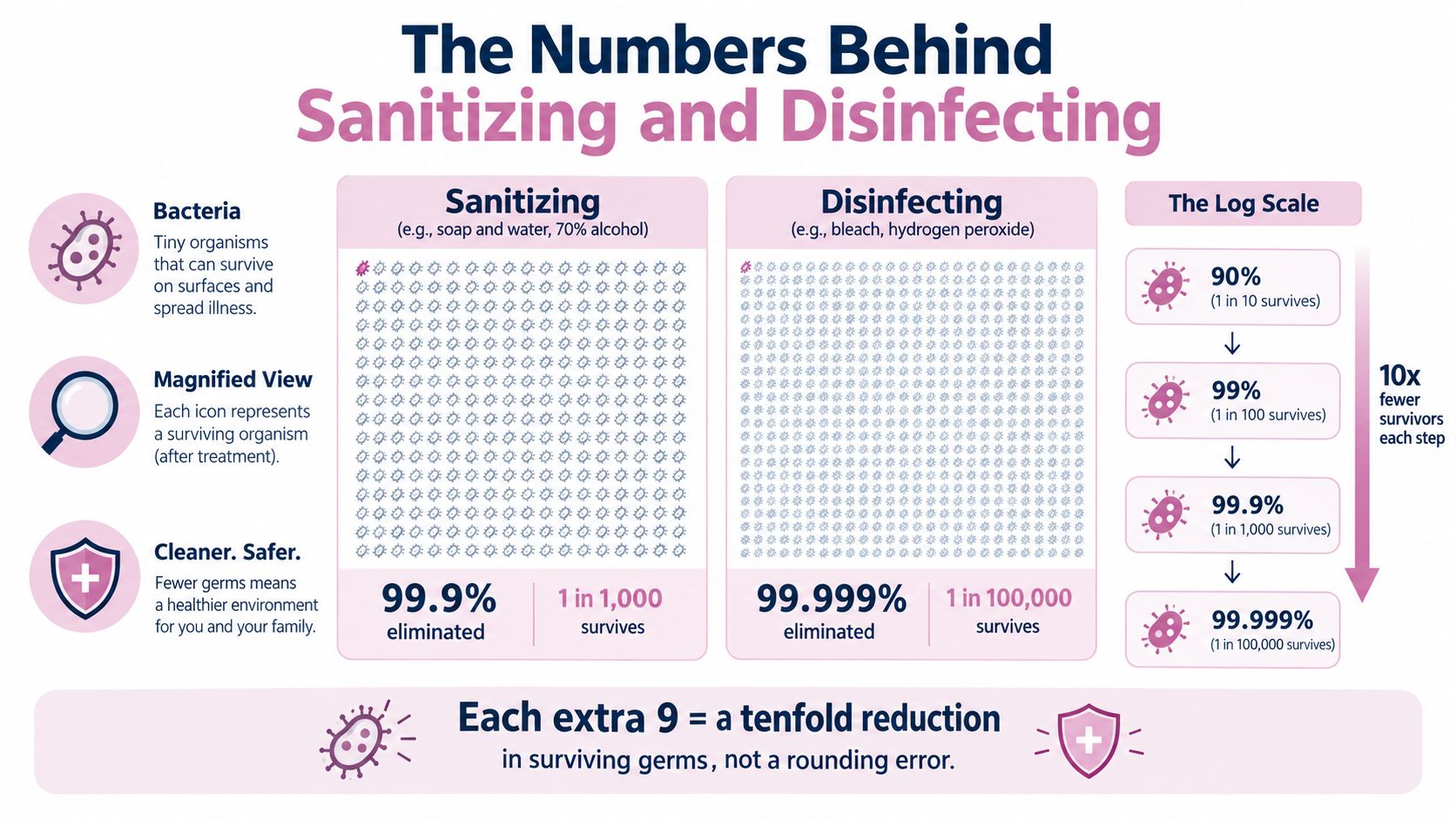
The extra nines matter most when the situation calls for a higher level of control, such as illness in the home or an occupant with a weakened immune system. For routine appearance cleaning, chasing the highest number can add chemical use without solving the actual problem.
Why Cleaning Always Comes First
A disinfectant can't work directly on germs that are hidden beneath food residue, grease, dust, body oils, or a sticky biofilm. The residue becomes a physical barrier between the active ingredient and the microorganisms on the surface. If you spray a dirty faucet, desk, or stovetop, much of the product contacts the soil first.
The CDC recommends cleaning surfaces before sanitizing or disinfecting because cleaning removes most germs, dirt, and impurities and allows the later treatment to reach what remains. The CDC's home cleaning and disinfection guidance explains this order in practical terms.
A reliable preparation sequence
Start by removing loose debris. Sweep crumbs into a bin, pick up hair, or use a dry microfiber cloth for dust when that won't spread the material. Then apply water with soap or detergent and scrub with a suitable cloth, sponge, or brush.
Rinse or wipe away the detergent and loosened soil, then dry the surface when the material allows. Only after that should you apply a sanitizer or disinfectant, and the product must be compatible with the surface.
- Remove loose material: Clear dust, crumbs, hair, and other dry debris.
- Wash the surface: Use detergent, water, and friction to lift grease and residue.
- Rinse and dry: Remove the dirty solution so it won't dilute the next product.
- Apply the selected antimicrobial product: Use the labeled amount and coverage.
- Maintain contact time: Keep the surface wet for the required period, then wipe or rinse if the label says to do so.
The chemical step can't compensate for a skipped physical step.
This principle also supports pest prevention. Food residue and organic buildup can attract unwanted pests, so routine removal has a broader household benefit. For more context on preventing pest infestations with sanitation, consider how cleaning practices fit alongside professional pest-control measures.
Room-by-Room Examples for Homes and Offices
The best method changes from room to room because the surface, soil, and people using it change. A kitchen counter that holds food doesn't present the same task as a bathroom flush lever or a shared office phone.
In the kitchen, begin with detergent cleaning on countertops, appliance handles, and tables. If raw meat spills onto a hard surface, clean the residue thoroughly and then use a product approved for that surface and situation. Cutting boards and sponges need particular attention because food residue and moisture can remain after a quick wipe. Pet bowls may be appropriate candidates for targeted sanitizing after washing, provided the product label permits that use and gives clear food-contact directions.
Bathrooms usually need frequent soil removal from sinks, toilets, floors, and shower surfaces. After cleaning, disinfect high-touch points such as faucet handles, flush levers, and shared holders when household illness or heavier shared use creates a reason for that added step.
For nurseries and play areas, soap and water are often enough for routine toy cleaning. Disinfection becomes more appropriate after a confirmed illness event or when the product label and care instructions support its use on the toy. Keep treated items away from children until the label's contact, drying, and rinsing requirements are complete.
| Room | Surface | Recommended Method | Typical Frequency |
|---|---|---|---|
| Kitchen | Countertops and tables | Detergent cleaning, followed by sanitizing or disinfecting when the situation calls for it | As soil and food preparation require |
| Kitchen | Cutting boards and sponges | Thorough cleaning, with a compatible targeted treatment | Frequently, based on food use and residue |
| Bathroom | Sink and toilet surfaces | Routine detergent cleaning | As regular soil appears |
| Bathroom | Handles and flush levers | Cleaning, with disinfection when illness or shared use raises the risk | Based on use, illness, and household needs |
| Play area | Hard toys | Soap-and-water cleaning | As handling and visible soil require |
| Office | Phones, keyboards, and shared desks | Surface-compatible cleaning, with targeted sanitizing or disinfection when appropriate | At routine turnover and after relevant exposure |
| Break room | Food-contact and touch surfaces | Cleaning, then a compatible food-contact sanitizer where required | According to use and product directions |
For a broader household routine, this entire-house cleaning checklist can help organize ordinary cleaning before you decide whether an antimicrobial step is necessary. In an office, keep electronics away from excess liquid and follow the manufacturer's care instructions before using wipes.
When More Disinfecting Is Not Better
A stronger chemical and more frequent application don't automatically create a safer home. The CDC notes that routine disinfection in a healthy household is usually not needed, while disinfection becomes especially relevant when someone is sick or a person in the home has a weakened immune system. Routine cleaning still matters in both situations because it removes the soil that can interfere with antimicrobial products.
Consumer habits don't always match that measured approach. An ACI 2025 survey found that 51% of Americans reported disinfecting frequently touched surfaces, a figure included in the CDC's cleaning and disinfection guidance. That behavior may reflect a desire for reassurance, but frequent disinfection can become a substitute for choosing the right method for the actual risk.
Match the response to the risk
Overuse can leave chemical residue, irritate skin or breathing passages, damage finishes, and create problems when people mix products or ignore ventilation. It can also produce false confidence. A homeowner may disinfect a doorknob repeatedly while overlooking soil on the floor, a dirty cloth spreading residue, or an unwashed food-contact surface.
A healthier decision process distinguishes between ordinary maintenance and a specific reason for escalation:
- Healthy household: Rely mainly on thorough routine cleaning, with sanitizing for appropriate food-contact or labeled uses.
- Illness in the home: Clean first, then disinfect relevant hard, high-touch surfaces according to the product label.
- Weakened immune system: Ask a healthcare professional about household precautions and use targeted disinfection where appropriate.
- Shared workplace or community area: Consider traffic, touch frequency, confirmed exposure, and surface compatibility instead of disinfecting everything by default.
The balanced rule is simple: clean everywhere, sanitize where the product and surface call for bacterial reduction, and disinfect when illness, exposure, or high risk justifies it. The disinfecting done right guide can help you focus on product choice, surface preparation, and label contact time rather than assuming more product always means more protection.
A Simple Decision Plan for Everyday Spaces
You can make the choice in almost any room by asking a short series of questions.
First, does the surface look dirty or feel greasy? If it does, clean it before deciding anything else. Dust, food, body fluids, and residue all require physical removal before a sanitizer or disinfectant can perform properly.
Next, ask who touches the item and what has happened there. A rarely handled shelf usually needs ordinary cleaning. A doorknob, light switch, faucet handle, shared phone, or office keyboard may deserve more attention, especially after illness or known exposure.
Then identify the surface. Sealed, hard, nonporous materials often accept labeled disinfectants, but screens, electronics, fabrics, unfinished wood, and porous materials may require gentler methods. Never assume that a product safe for a countertop is safe for a phone or upholstered chair.
Five questions to keep nearby
- Is there visible soil? Clean first, regardless of the final goal.
- What kind of residue is present? Dust calls for removal, while food or body-fluid contamination may justify a higher-level response after cleaning.
- Who uses the space? Children, pets, sick household members, immunocompromised occupants, coworkers, and visitors can change the decision.
- Does the surface need sanitizing or disinfecting? Choose the product whose label matches the organism, material, and intended use.
- Can you follow the label? Respect dilution, ventilation, contact time, drying, and rinsing directions.
Keep the summary in mind: cleaning removes, sanitizing reduces, and disinfecting targets a higher level of germ inactivation. The difference in the EPA benchmarks is meaningful, but only when the surface is pre-cleaned and the product is used exactly as labeled. For households with pets, this guide to natural cleaning products that are safe for pets can support product conversations, but remember that a natural ingredient isn't automatically a registered sanitizer or disinfectant.
Questions Homeowners Ask Most Often
How do I choose a disinfectant?
Look for an EPA-registered product whose label lists the pathogen, surface, application method, and contact time relevant to your situation. Don't rely only on the word “disinfectant” on the front of the bottle. Read whether the product requires pre-cleaning, rinsing, ventilation, or special handling around food, children, and pets.
Can vinegar or hydrogen peroxide replace a disinfectant?
A household ingredient may clean or have antimicrobial properties, but that doesn't automatically give it an EPA-registered disinfectant claim for a particular pathogen and surface. Don't mix vinegar, peroxide, bleach, ammonia, or other cleaners. Use one product at a time, follow its label, and ventilate the room as directed.
How often should high-touch surfaces be treated?
There isn't one universal schedule for every home or small office. Base the frequency on how often people touch the item, whether the surface becomes visibly soiled, and whether someone is sick or has a weakened immune system. Routine cleaning is the starting point, with targeted sanitizing or disinfection when the situation warrants it.
What about bleach and food-contact surfaces?
Bleach products require careful ventilation, correct dilution, and strict separation from other chemicals. Food-contact surfaces may require a product specifically labeled for that use, followed by rinsing if the label directs it. Keep children and pets away until the required contact and drying period is complete.
When should I call a professional?
Professional help makes sense after confirmed illness when the household needs assistance with a detailed reset, after water damage, or following renovation dust and construction residue. It can also help busy families, renters, offices, and property managers maintain a repeatable cleaning routine rather than rushing through high-touch and hard-to-reach areas.
Do I need to rotate products or choose paper towels?
Product rotation isn't a substitute for correct cleaning, and changing brands won't fix poor surface preparation or insufficient contact time. Microfiber cloths can be useful for controlled wiping and soil removal, while disposable towels may be practical when cross-contamination is a concern. Whichever tool you use, assign clean cloths to appropriate areas and avoid carrying bathroom residue into food-preparation spaces.
Natural cleaners can be useful for routine soil removal, but “natural” doesn't automatically mean “sanitizer.” Check the product's actual label claims and use the cleaning, sanitizing, or disinfecting method that matches the surface and risk.
We provide sHouse Cleaning & Maid Service in Kennesaw, GA, serving Acworth, Woodstock, Cartersville, West Cobb, Marietta, Dallas, Hiram, Powder Springs, and nearby communities with reliable, health-conscious cleaning for homes, offices, and community amenities. For recurring cleaning, deep cleaning, move-in or move-out service, post-construction cleanup, or targeted high-touch care, visit Maid in America to discuss the right service for your space.
Maid in America provides reliable, personalized cleaning with natural products for homes, offices, and communities across West Georgia. Licensed, bonded, and insured, we’re locally and privately owned.
Get in touch with us today!
info@maidinamericaga.com