Move Out Cleaning vs Deep Cleaning: Which to Book
Why do so many careful renters and home sellers book the heaviest scrub they can find, only to fail a final walk-through or lose part of their security deposit? Many treat move out cleaning vs deep cleaning as a simple contest over elbow grease, assuming whichever service sounds tougher will cover every base.
That assumption causes real headaches. Picking the wrong appointment rarely comes down to how hard the cleaner scrubs. It happens when you ignore the lease clause, the move-in inspection report, or the real estate listing standard that defines a passing finish. A spotless living room rug won't save a deposit if the landlord opens the kitchen pantry and finds crumbs along the shelf track.
There's a second gap that almost every standard comparison skips: indoor air quality and lingering chemical odor. Walking into a freshly scrubbed house in Kennesaw or Acworth shouldn't leave your eyes watering or bother a child, a pet, or a prospective buyer touring the rooms. Whether you're handing over keys in West Cobb or resetting a lived-in home before family arrives, matching the right scope to your exact situation saves money, time, and frustration.
Table of Contents
- Move-Out and Deep Cleaning Side by Side
- What Move-Out Cleaning Covers in an Empty Home
- What a Deep Clean Reaches in a Lived-In Home
- What Each Cleaning Costs and What Changes the Price
- Low-Odor Cleaning and What to Ask Before You Book
- Choosing the Service and Booking Your Clean
Move-Out and Deep Cleaning Side by Side
The short answer is straightforward. Move-out cleaning and deep cleaning differ primarily in why you book them and whether furniture is still in the rooms. A move-out clean prepares an empty or nearly empty property for handover against a lease, listing, or inspection checklist, while a deep clean resets a home people still live in by stripping away settled dust, grease, and neglected detail buildup.
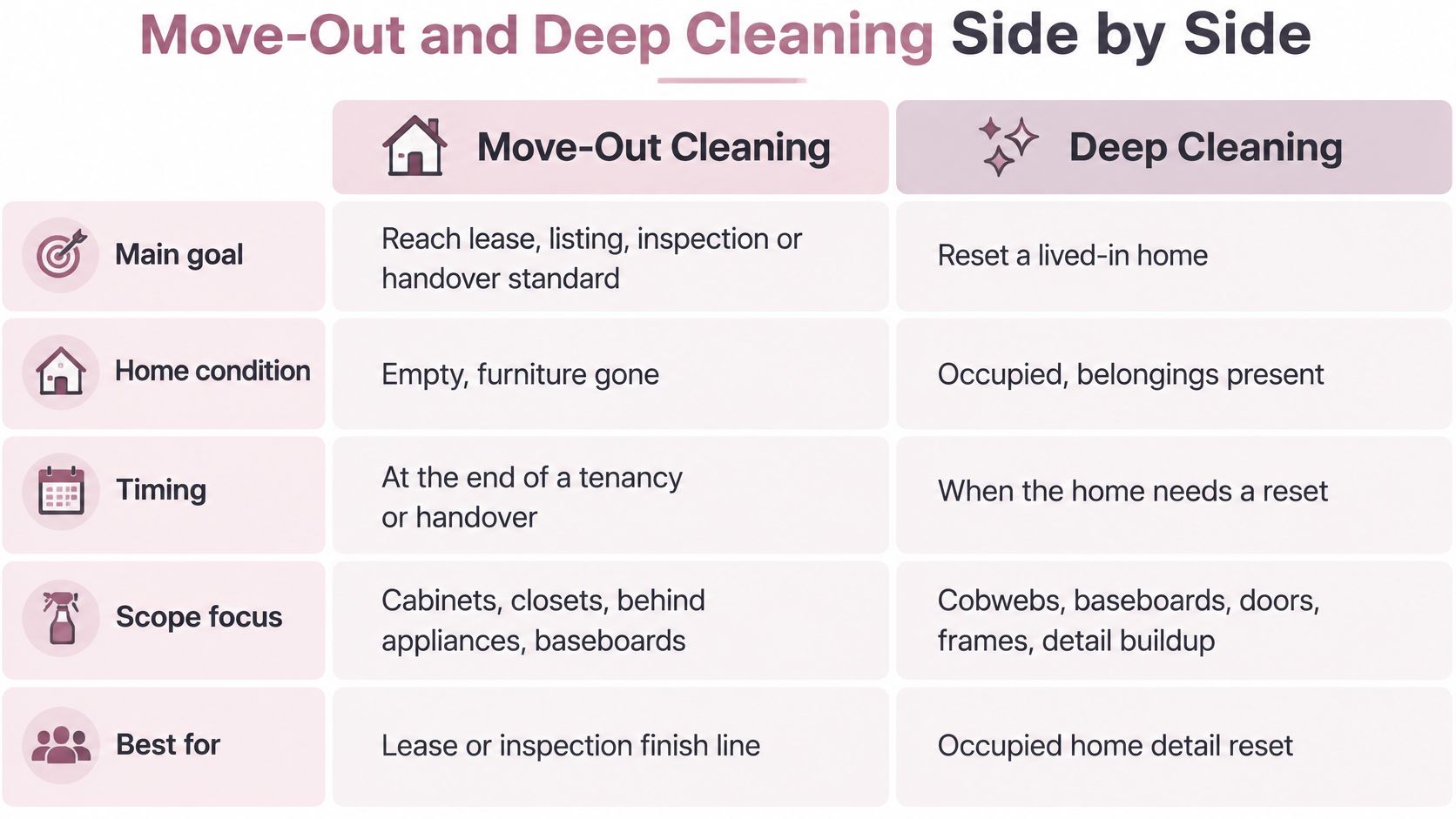
Many households across Kennesaw and Acworth need both services at different chapters of homeownership. Neither service sits strictly above the other; they solve different problems on different timelines.
| Factor | Move-Out Cleaning | Deep Cleaning |
|---|---|---|
| Main goal | Hand over an empty home that meets the lease or listing standard | Remove built-up dust, grime, and neglected detail from a home people still live in |
| Usual trigger | Lease end, sale, listing, or turnover | First visit, seasonal reset, special occasion, or overdue care |
| Timing | Booked around the move-out or closing date, with time before the walk-through | Booked any time the home needs a reset, often before recurring service starts |
| Home condition | Empty or mostly empty, furniture removed | Occupied, furniture in place |
| Detail areas | Inside cabinets, closets, floors, baseboards, and appliances when arranged in advance | High cobwebs, doors and frames, light switches, doorknobs, and high-touch surfaces |
| Success check | Matches the move-in checklist or handover inspection | Dust, grease, and buildup are gone from the places routine visits miss |
The trigger decides the service, not the amount of scrubbing.
Why Empty Access Changes the Whole Job
When a bedroom still holds a king-sized frame, two nightstands, and a dresser, even the most thorough cleaner works around those footprints. Once the movers carry everything out, every linear foot of baseboard, closet shelving, and flooring opens up. If your closing dates don't line up cleanly and boxes are crowding the garage or spare rooms, reviewing storage advice from Saxondale Self Storage helps you stage belongings off-site so cleaners aren't forced to work around stacked cartons.
Timing also separates the two bookings. You schedule a move-in or move-out clean tightly between the moving truck's departure and the landlord's walk-through or the photographer's arrival, leaving a buffer for inspection touch-ups. A Top-to-Bottom Deluxe deep clean, by contrast, works whenever daily life has left trim, bathroom tile, and kitchen edges looking tired, or right before starting a weekly, biweekly, every-three-weeks, or monthly Basic maintenance cleaning rhythm.
Knowing what happens inside an empty unit versus a furnished home makes the booking choice obvious, especially once you look at specific checklists, realistic budgets, low-odor product questions, and the exact paperwork to pull before scheduling.
What Move-Out Cleaning Covers in an Empty Home
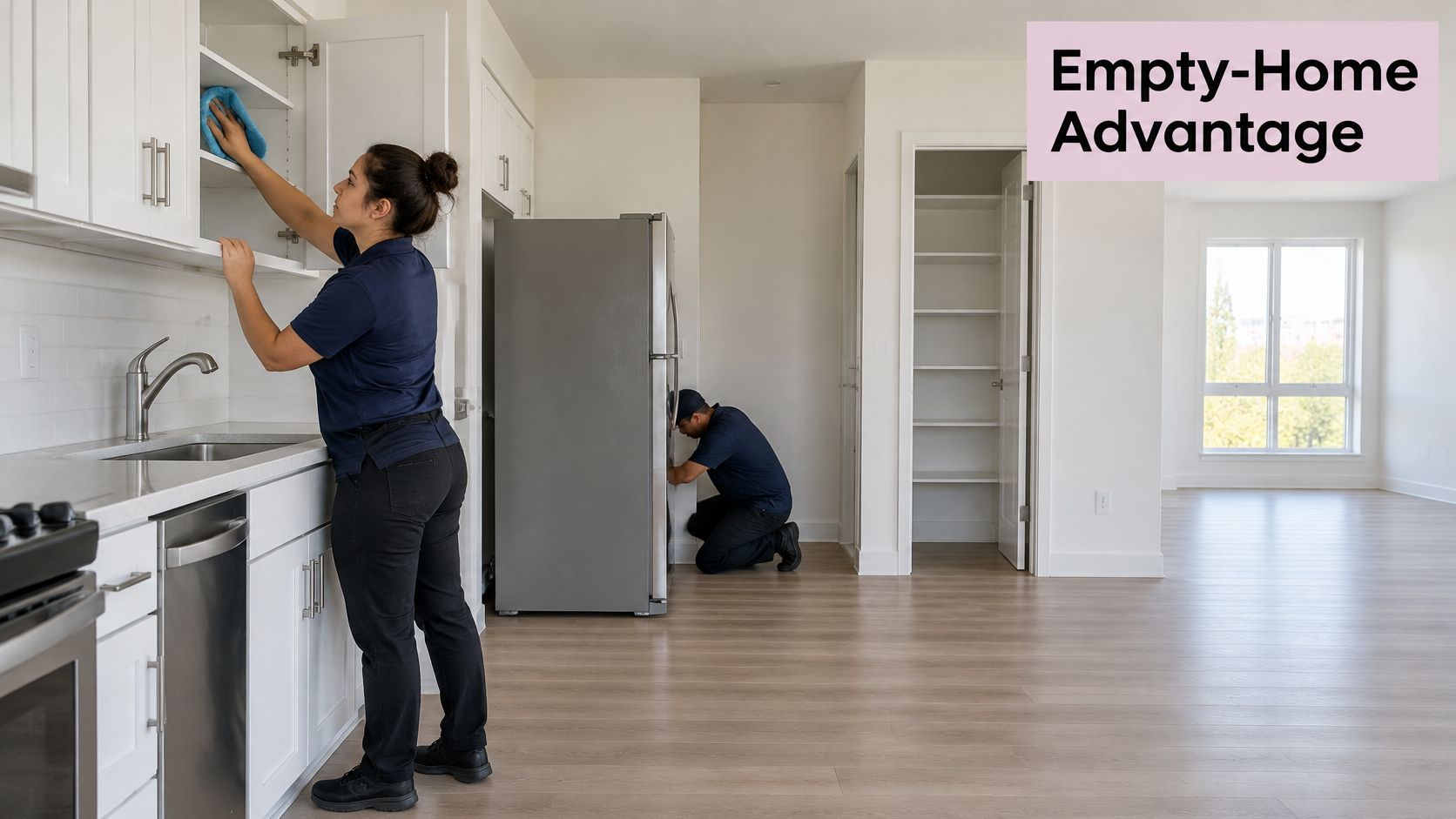
Once furniture, rugs, and wall art are gone, an empty property hides nothing. Daylight hits bare floors, scuffs stand out along trim, and every shelf inside the kitchen and closets becomes fair game during a walk-through. Move-In and Move-Out Cleaning serves as a final cleaning for move-in, move-out, listing, or turnover, designed around unobstructed access rather than working around daily clutter.
Landlords and property managers rarely fail a handover over a single speck on the foyer floor. They check the spots departing tenants forget. As the California Courts Self-Help Guide on security deposits illustrates, the typical legal benchmark isn't making a rental brand-new; it's returning the unit to the cleanliness level recorded at move-in, minus ordinary wear and tear, with any deductions itemized. Cleaning disagreements drive a massive share of deposit disputes: in a 2024 English landlord survey, 59% of landlords who withheld deposit money cited cleaning, and cleaning appeared in 54% of Tenancy Deposit Scheme dispute claims in 2024 to 2025.
Core Empty-Home Checklist Items
A handover clean targets both visible presentation and the enclosed spaces inspectors open first. Here is what a complete empty-home scope focuses on and why each piece matters:
- Kitchen and bathroom surfaces: Degreasing counters, backsplashes, sinks, tubs, showers, and fixtures eliminates the film that dulls surfaces under harsh inspection lighting.
- Inside cabinets, drawers, and closets: Our Move-In and Move-Out Cleaning includes inside cabinets, drawers, and closets when requested, because property managers routinely pull open utensil drawers and wipe top pantry shelves for crumbs or sticky spills.
- Appliance exteriors and interiors: Wipe-downs on refrigerator doors and range fronts handle fingerprints, while Move-In and Move-Out Cleaning includes appliance interiors and exteriors when arranged in advance so baked-on oven spills or crisper-drawer residue don't trigger a surprise fee.
- Baseboards, doors, and frames: Stripping away dust lines and handprints along trim restores crisp edges across empty rooms where furniture used to block the view.
- Full floor care: Sweeping, vacuuming corners, and mopping with flooring-appropriate solutions lifts tracked-in soil from every wall edge, closet corner, and hallway.
- Pre-arranged add-ons: Extra tasks such as cleaning inside the oven or refrigerator, detailed grout scrubbing, interior window and door glass, or leftover laundry and dishes change labor time and pricing, so we always discuss add-ons in advance.
If you're budgeting for a multi-room turnover or checking how optional extras affect a quote, taking a moment to compare move out cleaning prices gives helpful context before you finalize your task list.
A Room-by-Room Walk-Through Order
When you inspect an empty Acworth, Kennesaw, or Powder Springs home ahead of handover, follow a top-to-bottom, dirtiest-to-cleanest path so nothing gets overlooked. Start in the kitchen, opening every upper and lower cabinet, checking under the sink for leaks or rings, pulling out refrigerator bins, and looking inside the oven and microwave. A glossy stainless front won't pass an agent's check if the range hood filter drips grease or the freezer door seal holds food debris.
Move next to the bathrooms, inspecting shower glass for soap film, checking caulk lines and toilet bases, and wiping medicine cabinets. From there, walk the bedrooms, closets, and hallways, checking closet rods, shelf corners, window sills, and every stretch of exposed baseboard before looking closely at floor edges. Finish with a slow final review in bright daylight, comparing each room line by line against your move-in checklist. Taking timestamped photos of appliances, cabinets, bathrooms, floors, and any pre-existing wear before and after the clean gives both tenants and landlords clear proof of handover condition.
What a Deep Clean Reaches in a Lived-In Home
A lived-in home collects a completely different kind of dirt than a vacant one. Even families who wipe kitchen counters every night and run a vacuum every weekend still accumulate fine dust on ceiling fan blades, grease vapor on cabinet pulls, and mineral buildup around shower glass. Our Top-to-Bottom Deluxe Cleaning is built for exactly those first visits, seasonal resets, special occasions, and homes that need more than routine maintenance.
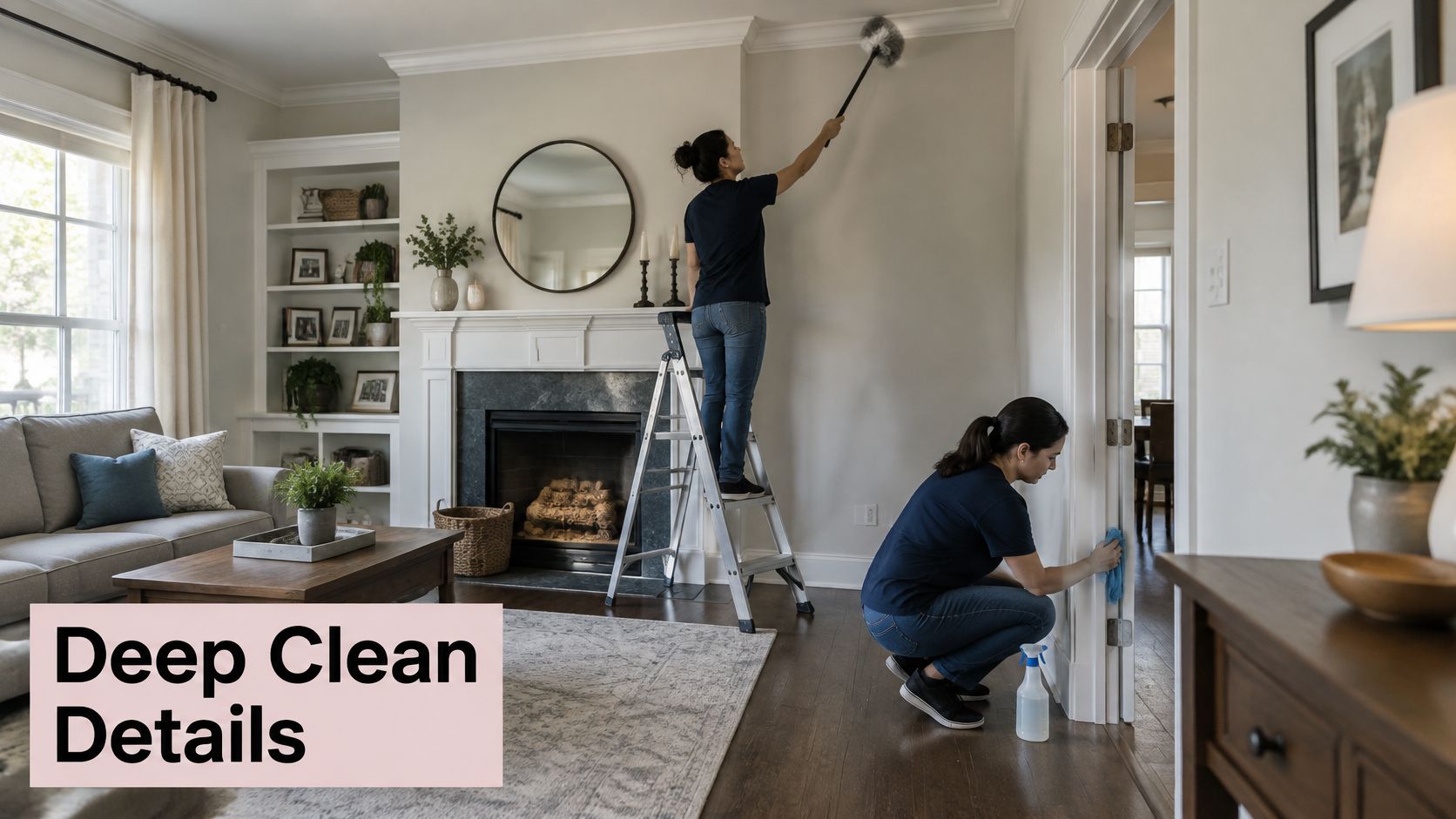
Standard whole-home cleaning covers high cobweb removal, dusting baseboards, dusting doors and frames, detailing light switches and doorknobs, and sanitizing high-touch surfaces. In living areas, that expands to dusting all accessible surfaces, wiping electronics such as TVs and remotes, and vacuuming carpets, rugs, and upholstery. Bathrooms receive detailed attention too, including scrubbing the tub and shower walls, cleaning shower doors and glass, sanitizing the toilet inside, outside, and at the base, and polishing mirrors streak-free. If you want to see how those tasks break down room by room in a smaller footprint, our apartment deep cleaning checklist lays out every detail area clearly.
Dust Control and Disinfection Limits
The case for periodic deep cleaning in an occupied home comes down to how indoor dust behaves. According to the U.S. Environmental Protection Agency guide on indoor particulate matter, household dust is settled particulate matter that everyday movement, including walking, vacuuming, and cleaning, can stir right back into the air. Inhaled particles can aggravate asthma and reduce lung function, which is why the EPA recommends decluttering, damp-dusting, and vacuuming to reduce asthma triggers, allergens, pests, and indoor pollutants. At the same time, the EPA cautions that ordinary household dust isn't automatically evidence of a hazardous condition, so we frame deep cleaning as creating a healthier home with fewer dust reservoirs rather than making medical promises.
Order of operations matters just as much as product choice. In our structured 12-step cleaning flow, we always remove dry soil first through high-to-low dusting and thorough vacuuming before any damp microfiber cloth touches a surface. Spraying moisture onto heavy dust turns it into a gray slurry that smears across trim and streaks glass. For households with sensitive lungs, stepping into another room while vacuuming happens keeps occupants away from temporarily resuspended fine particles.
Cleaning removes soil, dust, and grease; disinfection is a separate step that only works when surfaces stay visibly wet for the full contact time on the product label.
That distinction comes straight from CDC environmental cleaning guidance, which defines contact time as the undisturbed period a disinfectant must remain wet on a surface to kill germs and prioritizes high-touch zones like doorknobs, switches, handles, counters, faucets, toilets, keyboards, and phones. Spraying a counter and wiping it dry three seconds later cleans away visible mess, but it doesn't sterilize the room. Larger allergen-bearing particles also settle quickly back onto hard surfaces, meaning air purifiers alone never replace physical dusting and vacuuming.
Georgia Pollen, Red Clay, and Summer Humidity
Homes in Kennesaw, Acworth, Marietta, and Woodstock face three stubborn regional realities every year. Yellow Georgia spring pollen coats window sills, screen tracks, and entryway floors every April. Heavy afternoon rain tracks fine red clay onto foyer tile, grout lines, and living room rugs, where dry grit acts like sandpaper on hardwood finishes if it isn't lifted thoroughly.
Humid summers add a different boundary that every homeowner and property manager needs to understand. The EPA mold and moisture guide recommends keeping indoor relative humidity below 60 percent, ideally between 30 and 50 percent, because trapped moisture supports mold growth. Deep cleaning washes away soap residue, surface film, and dust, while a move-out clean prepares a vacant home after repairs finish. Neither service fixes a leaking pipe, an undersized dehumidifier, or condensation behind a shower wall. If you spot recurring dampness or active mold growth in a bathroom or basement, resolve the moisture source first, then schedule the clean.
What Each Cleaning Costs and What Changes the Price
A useful price comparison starts with the standard the home must meet: the lease checklist, inspection requirements, or listing preparation. Paying for a detailed clean that leaves out required cabinet interiors can still leave you with unfinished work at handover.
National benchmarks need context. DataIntelo's vacation rental cleaning services report covers the vacation-rental market, where cleaning between stays serves a different purpose from preparing a home for a new tenant. Those services should not be treated as interchangeable price guides.
For a broader apartment reference, Rapid Eye Inspections apartment turnover statistics puts average U.S. turnover expense at $3,872 per unit, with cleaning typically accounting for $150 to $400, or roughly 4% to 10%, in its 2026 compilation.
The comparison below separates that apartment benchmark from Maid in America starting prices. Starting prices are a budgeting reference; the actual quote depends on the property and requested work.
| Service | Cost Range | Context |
|---|---|---|
| Move-In / Move-Out Cleaning | $437 to $483 | One-time starting pricing for an empty or mostly empty home |
| Top-to-Bottom Deluxe Cleaning | $333 to $368 | One-time starting pricing for detailed top-to-bottom care |
| Basic Maintenance Cleaning | $228 to $252 | Starting pricing for one-time or recurring maintenance |
| Apartment turnover cleaning, make-ready budget | $150 to $400 | National benchmark from the turnover compilation above |
What Moves Your Quote and Timeline
Local estimates depend on home square footage, current condition, service type, cleaning frequency, and add-ons requested in advance. An empty home gives cleaners access to cabinets and closets, but that access also adds surfaces to clean. An occupied home may need more attention to accumulated kitchen grease or pet hair.
Compare the task lists before comparing totals.
At Maid in America, Move-In / Move-Out Cleaning prepares empty or mostly empty homes for move-in, move-out, listing, or turnover. Appliance interiors and exteriors are included when arranged in advance; inside cabinets, drawers, and closets are included when requested. Confirm those details against your lease or inspection checklist before accepting the estimate.
Top-to-Bottom Deluxe Cleaning suits first visits, seasonal resets, special occasions, and homes needing more than routine maintenance. Choosing it solely because its starting price is lower can leave a mismatch if your handover requires specific interior cleaning. Our breakdown of deep cleaning costs explains how property size and condition affect local pricing.
Mention fragrance sensitivities when discussing the scope, too. Maid in America uses natural, low-odor products, so a strong scent should not be your measure of value.
Cleaning Inside the Wider Turnover Budget
According to the National Apartment Association survey cited in Steadily's tenant retention analysis, 53.8% of property-management firms reported average turnover costs of $1,500 to $3,500, while 19.4% reported costs above $3,500, in 2025. That wider budget includes work beyond cleaning, such as painting, repairs, flooring, and vacancy.
Keep those jobs separate in your estimate. Cleaning does not replace repairs, and listing preparation needs a clear scope.
Duration depends on size, condition, selected service, and requested tasks. Ask for a realistic time window, schedule after repairs, and leave room before key handover for the cleaning professional's final review.
Low-Odor Cleaning and What to Ask Before You Book
Walk into a freshly turned-over rental and smell heavy pine, bleach, or artificial lemon. It's easy to assume the place must be spotless. That reflex is backwards. Strong fragrance can hide lingering grease, pet odor, or mildew instead of addressing the soil left on the surface.
Indoor-air chemistry gives good reason to question heavy scents. Purdue University researchers reported that fragrances from air fresheners, floor cleaners, disinfectants, and similar everyday products can react with indoor ozone and rapidly form nanoscale airborne particles, noting that the health effects of breathing those particles remain unresolved. The "natural equals completely harmless" shortcut does not hold up either. Both synthetic fragrances and botanical products can raise indoor-air concerns, so the useful question is not whether a scent smells pleasant. It is whether the product leaves a heavy residue or lingering vapor in the rooms where people will live.
The best handover clean isn't the one with the strongest smell. It's the one that removes visible soil and sticky residue while leaving the air calm and breathable.
Questions to Ask About Products and Ventilation
Whether you have kids crawling on newly mopped floors, dogs napping on rugs, or sensitive family members moving into a new home in Hiram or Acworth, vet any service's product habits before booking:
- Product disclosure: Ask which exact sprays, degreasers, and floor solutions will enter your home, rather than accepting vague "eco-friendly" labels.
- Fragrance-free and low-odor options: Confirm whether unscented or mild solutions are available, especially for nurseries, bedrooms, and pet zones.
- Ventilation and dwell time: Find out how cleaners ventilate bathrooms and kitchens while products sit on tile or fixtures, so vapors do not linger in closed rooms.
- Residue control: Ask how cleaning agents are handled after scrubbing, since film left on floors, fixtures, or touch points can feel tacky and attract fresh dirt.
- Separate deodorizing: Clarify whether odor treatment is a distinct step from soil removal, since masking smoke or pet smell with perfume fails the moment windows close.
At Maid in America, cleaners use natural, low-odor cleaning products chosen with household sensitivities in mind. The aim is to clean the surfaces that matter for a move-in, move-out, listing, or turnover without making the home smell as if a fragrance product was applied for its own sake. That matters because the finish line is usually set by a lease, inspection, or listing standard, not by how strong the cleaning scent is when the door opens.
No honest company can promise that any product is risk-free for every person. If you are comparing household sprays between visits, choosing a green cleaning spray explains what to look for on ingredient labels. Your final check is practical: surfaces look and feel clean, high-touch areas are not sticky, the air carries no heavy chemical cloud, and rooms have aired out comfortably before anyone unpacks.
Choosing the Service and Booking Your Clean
The right service is usually decided by the standard you have to meet, not by how much cleaning you can tolerate. Start with the reason the home must be clean. A lease, listing, inspection, appraisal, or handover sets a finish line that a general whole-home clean may not address. Pick Move-In or Move-Out Cleaning when the home is empty or mostly empty and the job is to prepare it for move-in, move-out, listing, or turnover. Pick Top-to-Bottom Deluxe Cleaning when people are still living there and the goal is to reset accumulated dust, soap film, and detail grime. Use targeted add-ons when an empty property still needs oven or refrigerator interiors, grout work, cabinet detailing, or extra trim washing before a walk-through.

Handover standards are not universal, so paperwork matters more than guesswork. Under HUD occupancy handbook guidance, a landlord conducts a move-out inspection after a tenant vacates, records observed damage, and compares the result with the move-in condition report to separate normal wear and tear from negligence or excessive damage, noting when required cleaning or repairs will be completed. HUD leaves specific cleaning criteria to individual property owners rather than enforcing one national checklist. That is why a deep clean can look impressive and still miss the exact item a landlord or manager expects to see finished.
Matching Real Situations to the Right Package
Consider a renter in Kennesaw moving out of a townhome with a security deposit on the line. Once movers clear the rooms, a scoped move-out clean that matches the lease's cabinet, baseboard, and oven requirements protects the refund far better than an occupied-home deep clean. A landlord or property manager in Marietta turning over a single-family rental needs empty-home turnover cleaning coordinated right after painters and carpet cleaners finish, keeping vacancy days short.
Real estate agents preparing a vacant listing in Woodstock or Cartersville rely on spotless kitchens, crisp trim, and streak-free mirrors so listing photos look their best. Pairing a vacant handover clean with smart staging steps helps you sell your home faster for top dollar. Homeowners leaving a house they have owned for years often pair professional organizers and movers ahead of time, then schedule move-out cleaning with oven and refrigerator interior add-ons for a gracious closing handover. A family moving into a newly purchased home in Acworth wants an empty-house move-in clean before unpacking dishes into cabinets. A busy commuter family staying put or retirees hosting holiday guests need a Top-to-Bottom Deluxe deep clean, optionally followed by recurring Basic maintenance weekly, biweekly, every three weeks, or monthly.
What to Gather Before You Schedule
Spending a few minutes pulling these items together before calling gives you a better quote and fewer handover surprises:
- Your move-in condition report or inventory: Shows the baseline cleanliness your landlord or HOA property manager will compare against.
- The lease cleaning clause or listing checklist: Identifies required items such as interior windows, blinds, or garage sweep-outs.
- Your hard deadline: Note the day movers finish, the walk-through date, or the property photographer's appointment so your clean fits between them.
- Written add-on priorities: List oven interiors, refrigerator interiors, cabinets, closets, grout, or interior glass upfront so labor time is scheduled properly.
- Before-and-after photos: Take clear pictures of empty rooms, inside appliances, and existing scuffs to document handover condition.
At Maid in America, the Move-In and Move-Out Cleaning service can be customized for homeowners, renters, real estate professionals, and property managers across West Georgia. The company is locally owned, licensed, bonded, and insured, holds a 4.9-star average across 400+ public reviews, and assigns one dedicated cleaner whenever possible for continuity. Add-ons are discussed in advance, and cleaning time depends on the size and condition of the home, the service selected, and the requested tasks. A cleaning professional reviews completed work before leaving the home.
Whether you are handing back keys on a tight move-out deadline or resetting a lived-in home with natural, low-odor care, match the service to the standard in front of you. Request a personalized estimate, confirm the checklist in writing, and book the clean around the date the property must be ready.



Maid in America provides reliable, personalized cleaning with natural products for homes, offices, and communities across West Georgia. Licensed, bonded, and insured, we’re locally and privately owned.
Get in touch with us today!
info@maidinamericaga.com