Care of Granite Countertops: Daily Cleaning and Sealing

You've cleared the dinner plates, but the granite still looks cloudy around the stove. There's a coffee ring near the sink, and the cleaner under the cabinet promises to work on almost everything. Before you spray it across the counter, check what your particular stone needs. Good care of granite countertops starts with a gentle routine, not a stronger product or another coat of sealer.
Table of Contents
- Why Granite Care Depends on the Slab
- Your Daily Granite Cleaning Routine
- Cleaners and Sanitizers to Use and Avoid
- How to Test Whether Your Granite Needs Sealing
- What Resealing Costs and How Often to Do It
- Decide Whether to Reseal or Book Professional Care
Why Granite Care Depends on the Slab
Typical granite water absorption is approximately 0.05% to 0.40% by weight, according to the Natural Stone Institute's guidance on stone misconceptions. Many slabs absorb very little water, while more porous varieties take up liquids more readily. That difference helps explain why neighboring countertops can respond differently to the same spill.
Granite is low-maintenance, not maintenance-free. Its mineral composition, surface finish, and the products already applied to it affect how you should clean it. A shiny surface doesn't prove that the stone resists absorption, and a matte finish doesn't automatically mean it needs sealing.
Make Decisions About Your Own Counter
The useful questions are straightforward:
- Daily cleaning: Can warm water remove the soil, or does the greasy area need a little mild detergent?
- Product compatibility: Does the cleaner suit both the stone and its existing treatment?
- Sealer condition: Does a controlled water test show absorption, rather than another anniversary on the calendar?
In Kennesaw, Acworth, and Marietta, spring pollen and tracked-in red clay add practical reasons to remove loose debris before wiping. Dust transferred from bags and other items can leave grit on a kitchen island. You don't need an aggressive scrub to deal with that everyday mess.
Identify the Finish Before Treating It
Look at your countertop in good light. Note whether it's polished, honed, or leathered, and photograph any pits, dull areas, or patches that darken when damp. Those observations help a fabricator distinguish ordinary texture from a care problem.
If you're comparing materials during a renovation, Excellent Home Improvement's overview of granite countertop options for NYC kitchens offers selection context. For an installed Georgia countertop, though, its appearance or trade name is only a starting point. Your actual slab's behavior should guide treatment.
Your Daily Granite Cleaning Routine
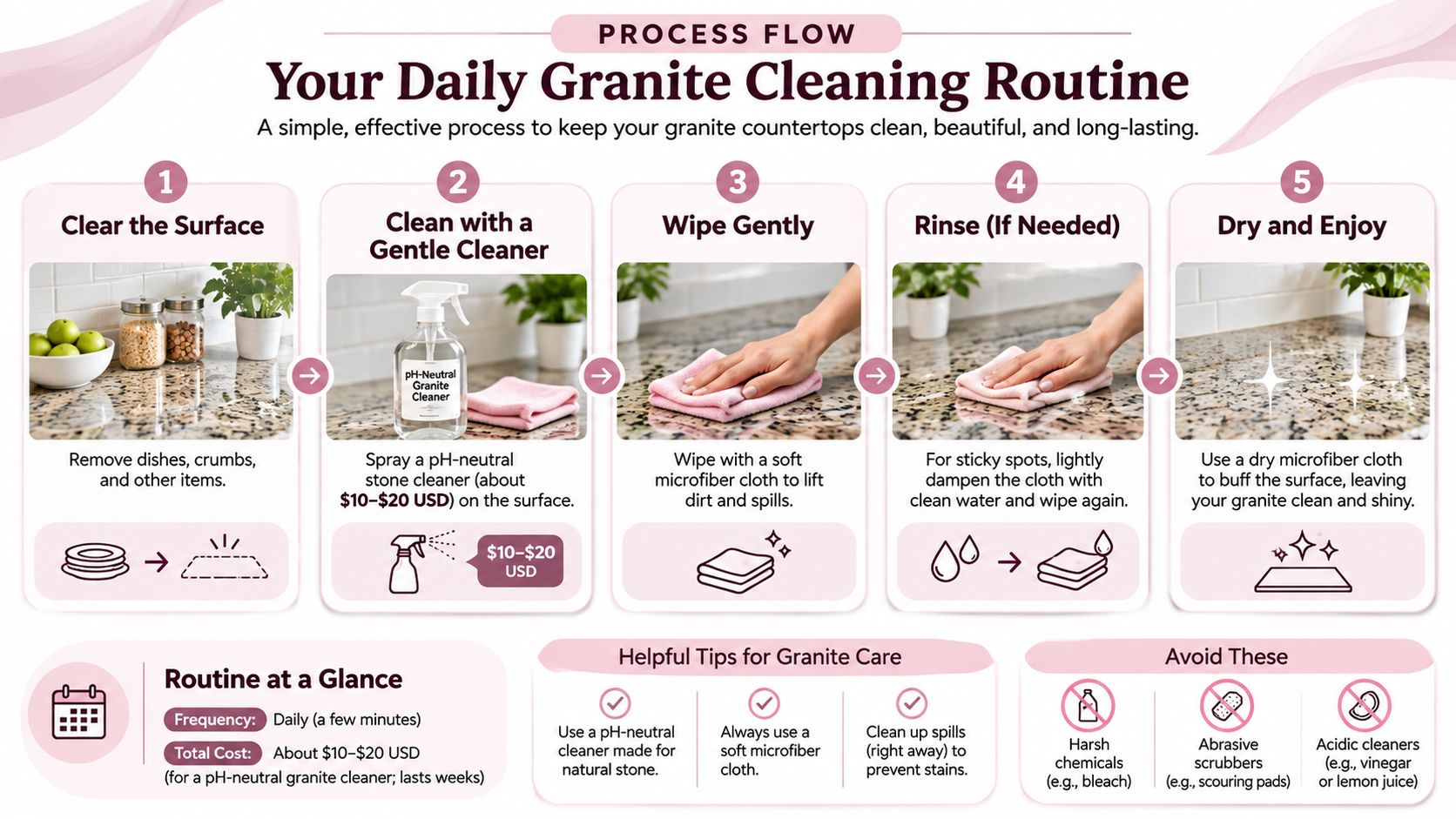
Keep a clean microfiber cloth, a separate drying cloth, and mild dish detergent within reach. The best routine removes loose particles, lifts residue, and leaves no cleaner behind.
Slabwise's granite-cleaner guide recommends a neutral-to-mildly alkaline cleaner, approximately pH 7–10, and a small amount of detergent for greasy soil. That range is a screening tool, not permission to use any product with a suitable pH. Check stone compatibility too.
Wipe in This Order
Lift crumbs before adding water. Use a dry microfiber cloth to gather crumbs and loose debris without grinding them against the finish. Shake the cloth out away from the counter.
Dampen a clean cloth with warm water. For greasy film, add one drop of mild dish detergent, following the Slabwise guidance cited above, rather than pouring soap directly onto the stone.
Wipe with a nonabrasive cloth or soft sponge. Work from the backsplash toward the front edge so you're not pulling debris back across an already-clean area. Refold the cloth when its working face gets dirty.
Rinse with a fresh, damp cloth. This removes detergent instead of redistributing it, which matters when yesterday's soap film is making the counter look cloudy.
Dry completely with a soft cloth. Pay attention around the faucet, behind countertop appliances, and beneath items you moved. Don't return a wet bottle to a freshly dried surface.
Blot spills promptly rather than wiping them outward. Coffee, wine, citrus, and tomato products deserve quick attention; after blotting, clean and dry the affected area.
Check Marks Without Scrubbing Harder
During your weekly kitchen reset, inspect the dry counter under bright light. A persistent dark patch deserves investigation, not an automatic dose of sealer. Let the area dry fully before testing its absorption.
Practical rule: If gentle cleaning leaves a mark, change the diagnosis before changing the scrubbing pressure.
For a suspected set-in stain, ask your fabricator or stone supplier about a stone-specific poultice, and test the recommended treatment in an inconspicuous spot. Abrasive scrubbing won't draw absorbed material out of the stone.
Renters combining this routine with a larger cleanup can use our apartment deep-cleaning checklist to organize the surrounding tasks. Keep the granite's care requirements separate from those of nearby appliances and flooring.
Cleaners and Sanitizers to Use and Avoid
Granite cleaners: what to use and what to avoid
| Product | Verdict | Why it matters |
|---|---|---|
| Mild dish detergent in warm water | Use | Gentle and close to neutral; rinse well to avoid film |
| Stone soap or pH-neutral granite cleaner | Use | Made for stone and designed to be compatible with sealers; confirm label suitability |
| Vinegar, lemon or citrus cleaners for routine cleaning | Avoid | Acids can dull susceptible finishes and attack some sealers |
| Ammonia or bleach-based cleaners | Avoid | Harsh chemicals can degrade sealers and dull the finish |
| Abrasive powders, scouring pads or steel wool | Avoid | Micro-scratches trap dirt and dull polished stone |
| Product labeled natural or multi-surface, ingredients unclear | Test first | Natural labeling does not guarantee stone safety |
The most useful everyday cleaner is one you can identify clearly and rinse away easily. A concentrated product that leaves a slippery coating isn't an improvement over a small amount of mild soap. More fragrance also doesn't mean a cleaner has removed more soil.
Natural Ingredients Still Need a Compatibility Check
Vinegar and lemon surprise homeowners because they're common ingredients in homemade cleaning mixtures. They may suit another household task, but that doesn't make them a good daily choice for unidentified granite. Some stones contain acid-sensitive minerals, and the treatment on top of the stone may react differently from the stone itself.
The same caution applies to a bottle labeled natural or multi-surface. Read the intended surfaces, exclusions, and application instructions. If you can't establish compatibility, don't experiment across the entire island.
Our guide to green cleaning spray provides broader product-selection context, but granite still needs its own check. A health-conscious approach means choosing a suitable product and using it correctly, not assuming every plant-derived ingredient is gentle on every finish.
Why the Vinegar Sanitation Finding Isn't a Household Recipe
The Natural Stone Institute's sanitation bulletin reports that a diluted 10% vinegar solution produced strong bacterial reduction on tested granite, second only to stainless steel and 160 times better than the next closest tested material. Those results describe the tested surfaces and conditions, not every granite countertop.
The bulletin also warns that some granite species contain acid-sensitive mineral groups and that acids can attack or discolor certain sealers and impregnators. A favorable sanitation result doesn't erase that material-compatibility problem. Repeated exposure may cause trouble even when a quick application leaves no obvious mark.
A cleaner can remove visible food residue without providing a validated disinfecting treatment.
Cleaning and disinfecting are different jobs. Cleaning removes soil; a disinfectant must be used under its labeled conditions, including the required wet contact time. Spraying and immediately wiping a disinfectant dry may not meet those directions.
Where disinfecting is needed, first remove food residue. Then use a product whose label explicitly supports the stone, sealer, intended purpose, and food-contact setting. Follow any required rinse instructions, and don't shorten the contact time to protect an incompatible finish. Choose a compatible product instead.
Ask Before Applying
Before choosing a sanitizer or disinfectant, establish:
- Stone identity: Is it confirmed granite, and are there special mineral or finish considerations?
- Sealer identity: What treatment is present, and what chemicals does its manufacturer permit?
- Food-contact directions: Does the label address countertop use and any required rinsing?
- Granite compatibility: Does the manufacturer explicitly permit the surface and specify dwell time?
At Maid in America, discuss natural stone, hardwood, stainless steel, specialty finishes, and other delicate surfaces with our office before service. We record special-care instructions in advance so surface care isn't left to guesswork.
How to Test Whether Your Granite Needs Sealing
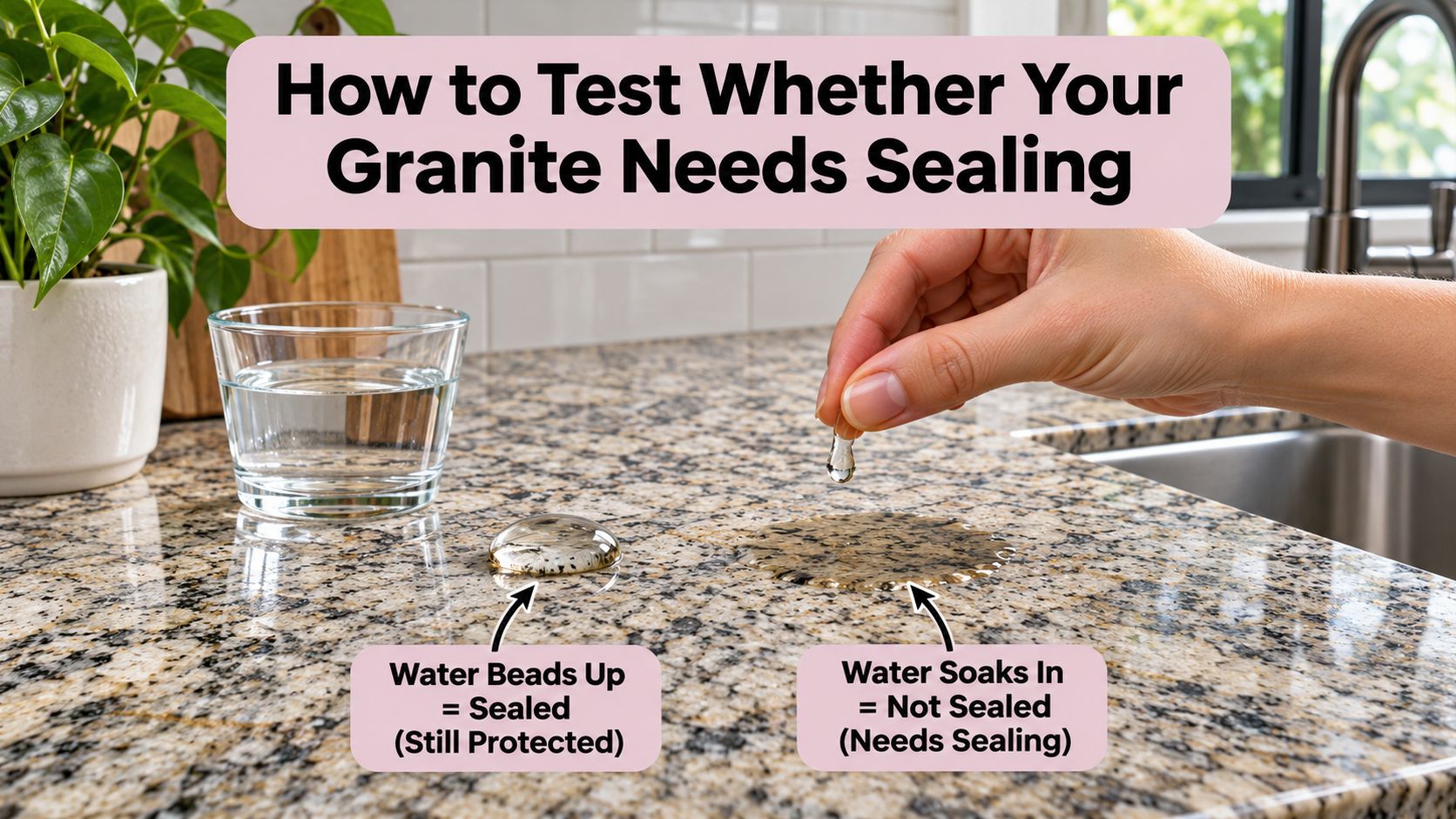
Use a localized water test before buying sealer. It's a practical screening method, not a laboratory measurement or proof that the entire installation has equal protection.
Run a Controlled Test
- Clean and dry a high-use section. Choose a preparation area or a spot near the sink, but stay away from seams and edges. Starting with damp stone makes the result harder to interpret.
- Place several drops or a small puddle of water on the surface. Keep the test localized so you can compare it with the surrounding dry stone.
- Observe for 10–15 minutes, as recommended in Stonify's natural-stone sealing guidance. Look for darkening beneath the water, not just a change in the droplet's shape.
- If the water remains beaded and the stone doesn't darken, protection is likely adequate. Record the location and result so a later check has a useful comparison.
- If water absorbs or the stone darkens within minutes, let it dry fully. Confirm a compatible penetrating sealer with the fabricator or stone supplier before treating it.
Appearance alone won't settle the question. A named-stone overview, such as Varun Marbles on Titanium Black granite, can help you discuss a selection with a supplier, but it can't establish how your installed slab responds to water.
Apply Only What the Stone Needs
Work in small sections with the compatible penetrating sealer. Maintain the manufacturer's dwell time, remove excess before it dries, and buff away remaining residue. Follow the product's cure and food-contact instructions before returning the counter to use.
Avoid these common mistakes:
- Sealing damp or dirty stone: Prepare the surface fully before application.
- Leaving excess on the face: Unabsorbed product can leave haze rather than added protection.
- Using the wrong coating: Don't substitute a topical coating where a penetrating treatment is intended.
- Expecting waterproofing: An impregnating product slows liquid entry; it doesn't make granite stain-proof.
Edges, seams, and oil exposure can behave differently from the tested patch. If results differ around the counter, document each location and have a stone professional assess the installation rather than repeatedly treating the same visible area.
What Resealing Costs and How Often to Do It
Budget for the work your counter needs, not the most expensive bottle. The figures below are published planning ranges, not Maid in America prices or local sealing quotes.
Granite sealing options and typical costs
| Option | Typical cost | Notes |
|---|---|---|
| DIY sealing, kitchen | $15–$40 | Takes 30–60 minutes, according to HomeMaintList's 2026 guide |
| Professional sealing, 50 sq ft kitchen | About $50–$150 | About $1–$3 per sq ft, according to Slabwise's 2026 cost guide |
| Consumer-grade sealer | $25–$55 per quart | Check label coverage against your square footage |
| Premium sealer | $80–$120 per quart | Higher cost per quart |
The consumer-grade and premium quart prices are the respective ranges reported in South Florida Kitchen and Bath's 2026 sealer guide. A bottle's purchase price and a project's material cost aren't necessarily the same: coverage, leftover product, and the amount the stone accepts affect the comparison.
Treat Intervals as Planning Guidance
Granite Depot of Savannah's 2026 guidance places most granite countertops at approximately every 1–3 years, depending on porosity, sealer type, and use. That's a planning range, not a requirement to apply product when a reminder appears.
Porous, heavily used areas may need attention sooner than dense, lightly used stone. The water test should override a routine resealing calendar.
Budget check: If the stone passes the test, skip the extra product and keep the money.
Before purchasing, compare the label's coverage with the area you intend to treat. For professional work, clarify whether the estimate includes edges, sink cutouts, and backsplash surfaces, along with any cleaning or residue removal. If several areas fail the test, a professional assessment can help you avoid paying for the wrong treatment.
Decide Whether to Reseal or Book Professional Care
A passing water test is the cheapest outcome: keep the daily routine, blot spills quickly, and leave the sealer on the shelf. Because porosity and finish vary slab to slab, let the test and the symptom decide. If several test spots darken or water soaks into the work zones, pause before coating the whole counter. Widespread sealing can waste product on dense areas while missing the finish problem that caused the symptom.
For busy households in Kennesaw, Acworth, Marietta, and Cartersville, the workable habit is clearing the counter before cooking and drying it after cleanup. During humid Georgia summers, do not park a damp sponge against the stone. During holiday hosting, keep a clean blotting cloth near the prep area.
Match Help to the Actual Problem
A cloudy film usually points to residue removal and better rinsing. Persistent darkening, rough patches, etching, or scratches point to a stone specialist. Maintenance cleaning removes soil; restoration addresses the finish and absorption behavior. Booking the right service prevents paying for treatment the slab does not need.
If a renovation is already planned, Jennifer Gilmer Kitchen & Bath's guide to choosing between quartz and granite can frame maintenance questions before you replace a counter that still has useful life.
Plan Personalized Care
Maid in America is locally and privately owned, based in Kennesaw, and licensed, bonded, and insured. Whenever possible, recurring service assigns one experienced cleaner for continuity, and special-care instructions are recorded before the visit. Tell the office about product preferences, pets, access instructions, and delicate surfaces such as natural stone.
Our cleaning services support homes, offices, and community spaces across Acworth, Kennesaw, Woodstock, Marietta, Dallas, Hiram, Powder Springs, Cartersville, and nearby communities in Cobb, Paulding, and Bartow counties. If you have a concern about your cleaning, call 770-427-4448 so the office can review the details with you.
Maid in America offers standard and deep cleaning with natural, low-odor products, helping keep kitchen counters clean while respecting special-care requirements. Visit Maid in America to request an estimate online, or call 770-427-4448 and describe your granite finish, trouble spots, and household priorities.




Maid in America provides reliable, personalized cleaning with natural products for homes, offices, and communities across West Georgia. Licensed, bonded, and insured, we’re locally and privately owned.
Get in touch with us today!
info@maidinamericaga.com