Green Cleaning Spray: What's Inside and How to Use It
Switching to a plant-based cleaner isn't enough to make your cleaning routine healthier. That familiar advice leaves out what matters most: what's in the bottle, what surface you're cleaning, and how you use it. A citrus scent can come from plants and still add unwanted compounds to indoor air.
For homeowners, renters, and businesses in Kennesaw, Acworth, Marietta, and Woodstock, the useful question isn't whether a bottle looks green. It's whether the formula removes the dirt you have without unnecessary fragrance, surface damage, or unsupported germ-killing claims.
Table of Contents
- What Green Cleaning Sprays Contain
- What Natural and Fragrance-Free Really Mean
- Benefits and Limits for Indoor Air
- Who Needs Extra Care and When to Disinfect
- How to Use a Green Spray Safely, Step by Step
- Hand the Job to a Professional or Request a Free Estimate
What Green Cleaning Sprays Contain
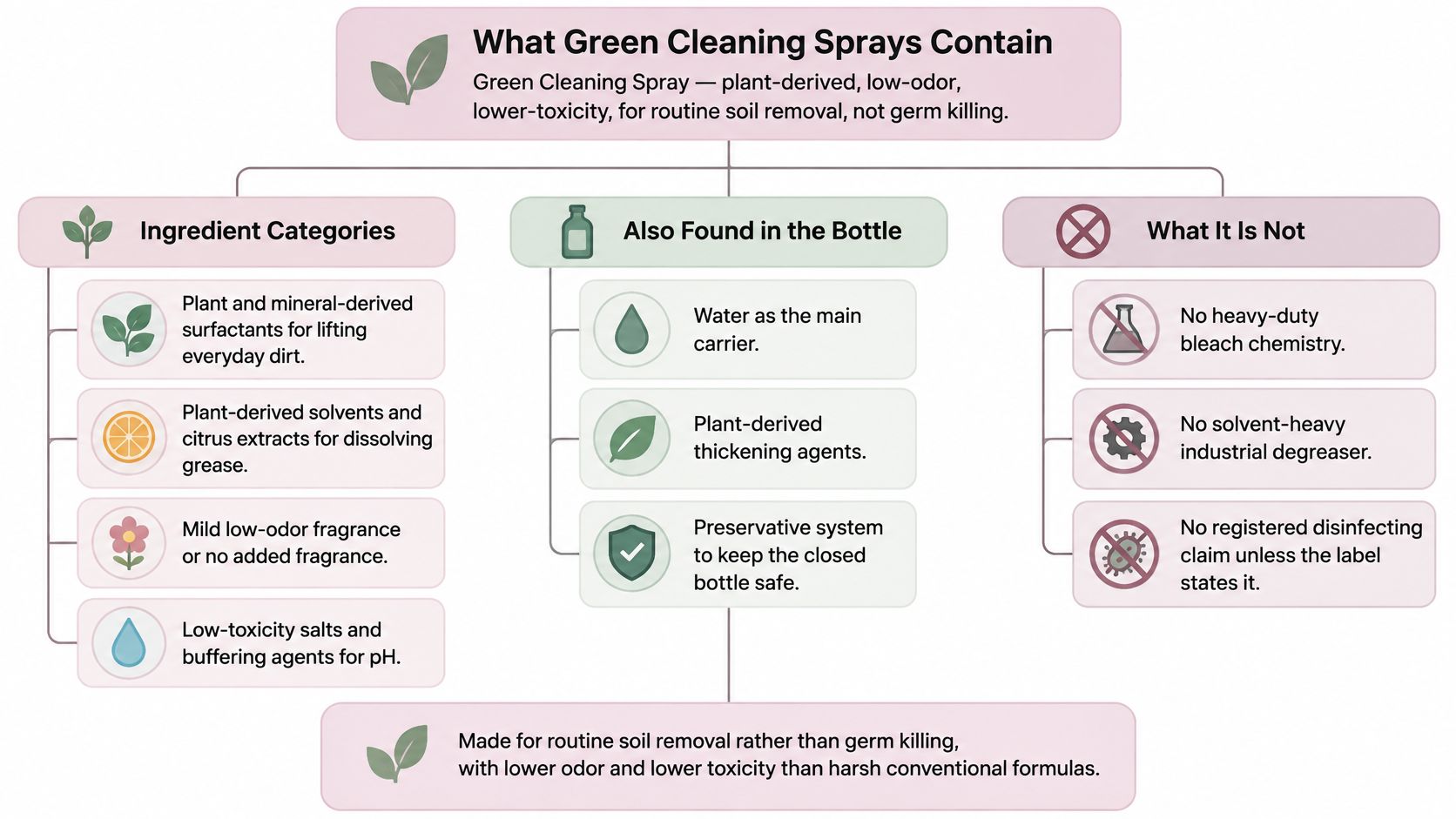
A green cleaning spray is typically a ready-to-use spray marketed as plant-derived, low-odor, or lower-toxicity, intended for routine soil removal rather than germ killing. Without a recognized certification, green is a marketing description, not evidence that every ingredient meets a defined standard.
Water usually carries the cleaning ingredients. Surfactants loosen oily dirt, solvents help dissolve grease, and buffering agents adjust the formula's acidity or alkalinity. Thickeners and preservatives may also help the product stay usable in its bottle.
Common green spray ingredients and what they do
| Ingredient | Typical Role | What to Know |
|---|---|---|
| Plant-derived surfactants (coco glucoside, decyl glucoside) | Lift oils, grease and grime | Biodegradable is not the same as low emission |
| Citric acid | Cuts mineral deposits and soap film | Can etch natural stone and grout |
| Vinegar (acetic acid) | Cuts soap scum and hard-water film | Not a disinfectant; avoid on natural stone |
| Baking soda | Mild abrasive for sinks and tubs | Can dull glossy or delicate finishes |
| Hydrogen peroxide | Lifts stains and oxidizes soil | Some sprays use it; check the label for any disinfecting claim |
| Plant essential oils | Provide scent | Fragrance is a major source of indoor VOCs |
| Enzymes | Break down organic soil such as food and pet residue | Work best with the label's dwell time |
Match the Ingredient to the Mess
Coco glucoside and decyl glucoside help release grease so your cloth can pick it up. Their plant origin doesn't tell you how much fragrance the finished spray releases.
Citric acid and vinegar target mineral buildup, but that same chemistry can damage acid-sensitive surfaces. Don't use them on marble or other natural stone, and check compatibility before treating grout.
Baking soda belongs to the abrasive category, even though it's a familiar pantry ingredient. Scrubbing with it can leave a glossy or delicate finish looking dull.
Hydrogen peroxide works through oxidation, while enzymes target organic residues such as food. Neither ingredient's presence establishes a finished product's disinfecting performance; for additional context about botanical claims, consult VirusFAQ.com on botanical disinfectant safety.
Essential oils add scent, not a universal safety benefit. Purdue's indoor-air guidance explains why scented botanical products can contribute to indoor pollutant formation.
At Maid in America, we use natural cleaning solutions and avoid chlorine bleach, ammonia, abrasives, phosphates, and phthalates. Before buying your own spray, scan for added fragrance and strong acids, then match the formula to your surface.
What Natural and Fragrance-Free Really Mean
Green label terms and what they do not prove
| Term | What It Usually Means | What It Does Not Prove |
|---|---|---|
| Natural | Ingredients derived from plants or minerals | Low emissions, safety or disinfection |
| Biodegradable | Breaks down in the environment after disposal | Anything about indoor air quality |
| Low-odor | Little scent is noticeable | Low VOC emissions; smell is not a safety test |
| Fragrance-free | No added fragrance | Zero VOCs; lower emissions in testing, not zero |
| Safer Choice (EPA) | Every ingredient reviewed and VOC content restricted | Performance on every surface; check the product details |
| Disinfecting | Registered to kill specific germs when used as labeled | Germ-killing on any surface or at any dwell time |
These terms answer different questions. Natural describes ingredient origin, while biodegradable concerns what happens after disposal. Neither tells you whether a spray suits your sealed wood table or a small bathroom without a window.
Low-odor describes what your nose notices. Fragrance-free is a more useful formulation detail because it addresses added scent, but other ingredients can still release volatile organic compounds, or VOCs.
What Certification Adds
Under EPA's Safer Choice standard, the agency reviews every chemical ingredient regardless of how small its percentage is, restricts VOC content, and evaluates ingredient disclosure, performance, and packaging. That's a more specific basis for comparison than leaves on a label.
Certification still doesn't replace surface instructions. A certified bathroom cleaner may be unsuitable for a particular stone countertop, and a certified cleaner doesn't automatically qualify as a disinfectant.
For a rental in Dallas or an HOA clubhouse in Powder Springs, keep the product's purpose separate from its environmental credentials. One label can describe responsible ingredient selection without promising pathogen control.
Label-reading rule: Judge a bottle by the claims you can verify, not by its color, scent, or plant imagery.
A Practical Label Check
A chamber study indexed by EPA's Health and Environmental Research Online database found conventional products generally produced higher VOC concentrations and emissions than green products, particularly fragrance-free formulations. That supports choosing fragrance-free when possible, not assuming it means emission-free.
Use this shopping check:
- Find ingredient disclosure. Look beyond a front-label list of featured botanicals to the fuller ingredient information.
- Check added scent. Prefer fragrance-free or very-low-fragrance formulas, especially when someone in the space dislikes scented products.
- Match the claim to the job. For greasy fingerprints, look for cleaning directions. For disinfection, look for registration, supported germ claims, approved surfaces, and application instructions.
If you can explain what the spray contains, where it belongs, and what it promises, you're making a more informed choice than packaging alone allows.
Benefits and Limits for Indoor Air
A green spray can offer a gentler, lower-odor clean, but it doesn't guarantee negligible air emissions. The benefits depend on the finished formula, not the category name.
Potential advantages include:
- Fewer harsh ingredients. A thoughtfully selected formula can avoid chemicals you don't need for everyday soil.
- Alternatives to bleach and ammonia. Many routine cleaners work without either ingredient.
- Less noticeable scent. Fragrance-minimized options can make cleaning more comfortable for households that dislike lingering perfume.
Why Botanical Scent Still Matters
A peer-reviewed 2024 study found average monoterpene concentrations of 25.0 mg/L in green products versus 8.6 mg/L in conventional products, with modeled ozone reactions increasing formaldehyde by up to 7% and peroxyacetyl nitrate compounds by up to 6%. Those findings describe the tested products and modeled reactions, not every green spray or every home.
Monoterpenes include aromatic compounds associated with citrus and pine fragrances. Once released, they can react with indoor ozone, so replacing synthetic perfume with botanical scent doesn't necessarily remove the indoor-air concern.
The American Lung Association reports that indoor VOC concentrations can reach up to 10 times outdoor levels and recommends label reading and increased ventilation. A pleasant smell isn't a reliable way to judge exposure.
Air Out the Room Thoughtfully
During humid summers in Kennesaw and Acworth, it's tempting to keep everything shut while the air conditioning runs. During Georgia spring pollen season, opening every window may create another cleanup problem.
Use a bathroom exhaust fan that vents outdoors, or an outdoor-venting kitchen hood where appropriate. When pollen is a concern, choose a brief window-opening opportunity when outdoor conditions are suitable rather than leaving windows open throughout cleaning; a recirculating fan alone doesn't remove pollutants.
Choose the lowest-fragrance option, use only the amount needed, and ventilate during each cleaning session. Don't add scent afterward to make the room seem cleaner.
Who Needs Extra Care and When to Disinfect
Removing soil and disinfecting are different jobs. A green spray can help lift grime, but pathogen control requires a product registered for the intended use and applied according to its label.
Approach by household or setting
| Situation | Main Concern | Suggested Approach |
|---|---|---|
| Asthma or migraine triggers | Fragrance and VOC load | Choose fragrance-free, ventilate, and use the smallest amount that works |
| Infants and toddlers | Hand and mouth contact with surfaces | Rinse food-contact and play surfaces as directed; store products out of reach |
| Homes with pets | Sensitive noses and paws | Keep pets out until surfaces are dry; never mix products |
| Kitchens used for food prep | Food-contact surfaces | Rinse food-contact surfaces after cleaning as the label directs |
| Confirmed illness or contamination | Pathogen control | Use an EPA-registered disinfectant with the full label contact time |
| Offices and HOA amenities | Shared use by many people | Routine low-odor cleaning; disinfect high-touch surfaces only where the label permits |
A 2024 respiratory-health review summarized by BBC Future found green products appeared less harmful than conventional products, while emphasizing that more evidence is needed. That isn't a medical assurance for an individual household or proof that a particular spray won't cause discomfort.
For someone with asthma or migraine triggers, focus on the specific fragrance and VOC load rather than trusting natural wording. Discuss known sensitivities before cleaning begins, and follow personal medical advice rather than treating a product label as health guidance.
Choose the Approach Before You Spray
For routine dust, fingerprints, or a food spill, use a compatible low-odor cleaner and microfiber cloth. If a household member has a contagious illness, select an appropriate EPA-registered disinfectant for affected surfaces instead of wiping longer with an ordinary cleaner.
EPA's disinfectant guidance explains that contact time means the surface must remain visibly wet for the stated interval; if it dries early, reapplication may be necessary. Clean visible soil first when directed, and don't wipe away disinfectant before its required wet time ends.
More scrubbing with a cleaner doesn't turn it into a registered disinfectant.
Family homes and rentals in Kennesaw and Acworth need routines suited to their occupants. Offices in Marietta and Woodstock, along with HOA clubhouses, also need clear responsibilities for shared surfaces.
For pet-specific considerations, use our guide to natural cleaning products and pet safety. For a higher-risk setting, Castus's discussion of infection prevention for healthcare facilities offers context about why formal protocols matter, without making a household routine equivalent to healthcare cleaning.
The product label, not botanical packaging, determines the supported claim.
How to Use a Green Spray Safely, Step by Step
Good cleaning depends on controlled application and complete soil pickup. If the bottle uses unfamiliar terminology, our explanation of the difference between cleaning, sanitizing, and disinfecting can help you choose the right task before starting.
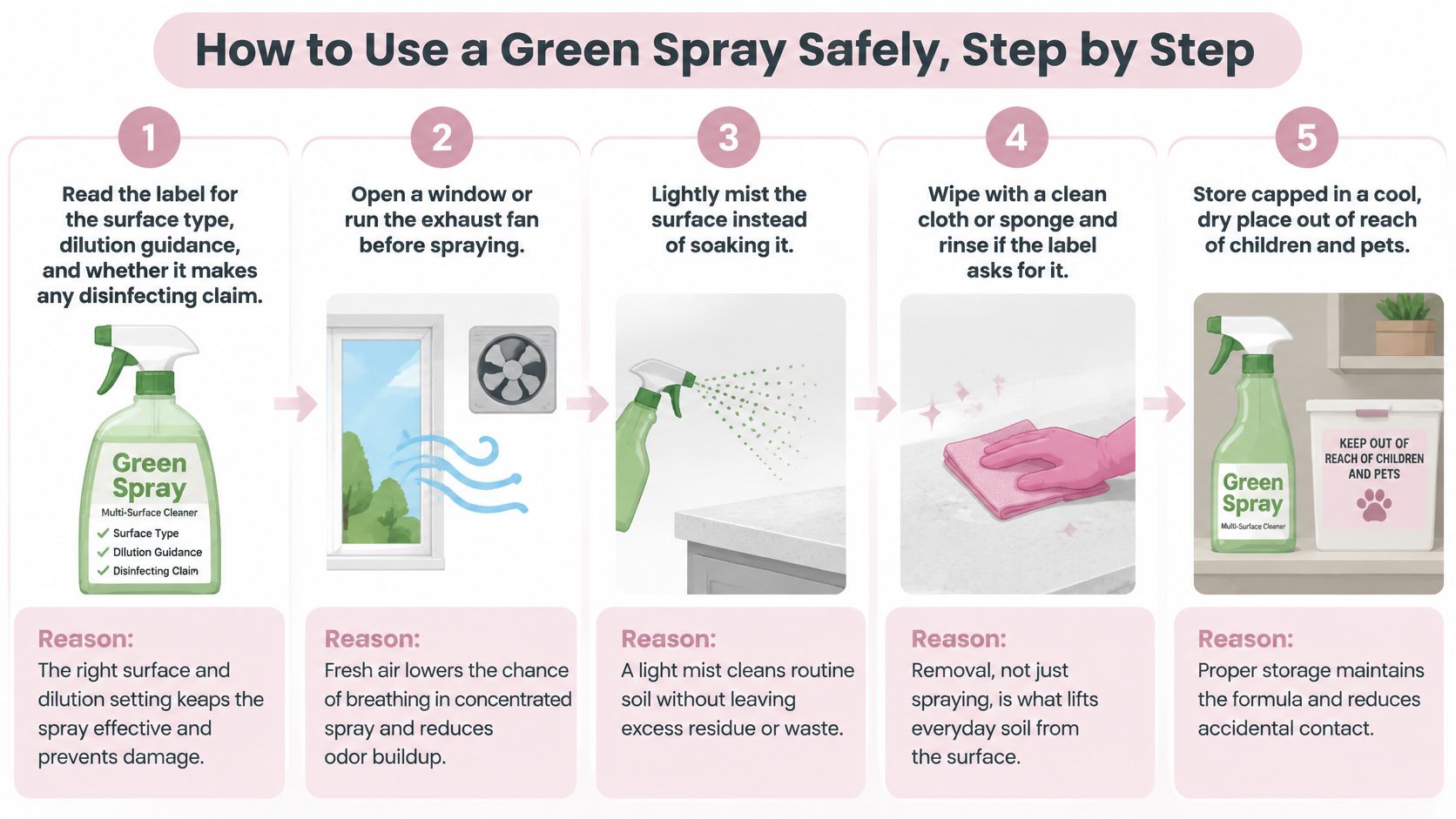
Read the whole label. Identify approved surfaces, dilution instructions, rinsing requirements, and any disinfecting claim before opening the nozzle. A common mistake is diluting a ready-to-use spray or assuming all-purpose means suitable for every finish.
Start ventilation before application. Open a suitable window or run an exhaust fan so you aren't working in concentrated mist. Don't wait until a room smells strong to begin moving air.
Check compatibility, then spot-test. On sealed wood or painted trim, test an inconspicuous area and let it dry before checking for dullness or color change. Don't test a known incompatible acid on natural stone, or treat a successful spot test as permission to ignore the surface manufacturer's instructions.
Apply lightly and keep others away from mist. For routine cleaning, use a controlled spray rather than soaking the surface, and keep children and pets clear during application and drying. Over-spraying laminate edges is a common mistake because liquid can collect at seams.
Use the solution suited to the surface. A compatible light spray may suit sealed counters, while floors need their flooring-appropriate solution and moisture level. Don't carry the countertop bottle around the house and use it on every floor finish for convenience.
Agitate, collect soil, and finish properly. Work with a clean microfiber cloth, changing to a clean face as it loads with dirt, then rinse if directed and dry as appropriate. For disinfectants, complete the required wet contact time before any permitted finishing wipe; otherwise, premature wiping defeats the application.
Keep products separate. The American Lung Association's household-cleaner guidance warns that mixing bathroom products can generate toxic gases and that VOCs can persist for hours, days, or longer depending on product use and ventilation. Never combine your spray with bleach, ammonia, or another cleaner; when switching products, follow removal directions and use a rinsed surface and clean cloth.
Close and store the bottle. Keep it in its original labeled container, secured out of reach of children and pets, under the storage conditions specified. Decanting into a drink bottle or leaving an unlabeled mixture beneath the sink creates avoidable confusion.
Check the Finish, Not Just the Scent
Our Clean phase includes high and low dusting, hand dusting and wiping, washing and scrubbing, dry shining and polishing, vacuuming, and mopping with the solution suited to the flooring. Removing loose Georgia red clay before wet cleaning helps avoid spreading gritty mud across a floor.
Final check: The surface looks clean, smells faint or not at all, and feels dry, without sticky residue.
That check assesses your finish, not disinfectant efficacy. Only the correct product and completed label procedure support a disinfecting claim.
Hand the Job to a Professional or Request a Free Estimate
Professional help makes sense when the challenge isn't choosing a bottle but carrying out the whole routine consistently. Consider handing over the work when:
- Someone is fragrance-sensitive. You need known preferences and special-care instructions recorded before cleaning.
- A surface needs label-standard disinfection. You need the task identified clearly, with product compatibility and wet contact time accounted for.
- Time is tight. Commuting, caregiving, moving, or holiday hosting leaves little room for careful ventilation, wiping, and finishing.
Maid in America is a locally and privately owned house cleaning and maid service owned by Vicky Bates. We're licensed, bonded, and insured, and our cleaning professionals are carefully selected and trained. One dedicated cleaner is usually sent to each home rather than a large team, supporting consistent, personalized service; clients often get to know their cleaner by name.
Plan Around Your Home's Needs
We provide the cleaning supplies needed for the scheduled service and record special-care instructions in advance. Tell us about fragrance preferences, delicate finishes, pets, and priority areas so those details are part of the agreed plan.
Homeowners, renters, and businesses can review our cleaning services and discuss their space rather than choosing by product buzzwords. Maid in America holds a 4.9-star Google rating and was voted Best Home Cleaning Service by Around Acworth Magazine.
Ventilation problems may also need a separate building solution. Trickle Vent Installation Costa Blanca's information about affordable condensation vent installation rates illustrates a distinct ventilation service in Spain, not a Georgia installation recommendation or local pricing guide.
We serve Kennesaw, Acworth, Woodstock, Cartersville, West Cobb, Marietta, Dallas, Hiram, and Powder Springs, plus nearby communities in Cobb, Cherokee, Paulding, Douglas, and Bartow counties. Our approach reflects a straightforward commitment: Add sparkle and shine with your health in mind.
Maid in America offers Basic maintenance cleaning, Top-to-Bottom Deluxe/deep cleaning, and recurring care with natural, low-odor products and attention to your home's special-care needs. To arrange a cleaner home without choosing products by packaging alone, request a free estimate online from Maid in America or call 770-427-4448.




Maid in America provides reliable, personalized cleaning with natural products for homes, offices, and communities across West Georgia. Licensed, bonded, and insured, we’re locally and privately owned.
Get in touch with us today!
info@maidinamericaga.com