How to Clean a Shower Curtain: Fabric and Plastic Care
Saturday morning in Kennesaw, and the bathroom still smells faintly of last night's showers. You reach in to pull the curtain closed and your hand slides across a slick pink-gray film along the bottom third. The hem is cold and wet even though nobody has bathed since 9 p.m.
That pattern shows up in most homes here from May through September. A curtain left bunched against the wall holds water in its folds, and a humid Georgia bathroom gives that water nowhere to go. It doesn't mean anyone is a poor housekeeper.
Here's the useful part: cleaning a shower curtain well takes one afternoon of figuring out the material, then about 20 minutes a month after that. Most curtains come clean with warm water, mild detergent and patience. Very few need bleach.
Table of Contents
- Why Shower Curtains Get Grimy So Fast
- Pick the Right Method for Your Curtain Type
- How to Machine Wash a Fabric Shower Curtain
- How to Clean Plastic and Vinyl Curtains by Hand
- When Mildew Keeps Coming Back
- A Care Routine That Prevents Mildew
- When to Replace It and When to Call a Pro
Why Shower Curtains Get Grimy So Fast
Three things coat a shower curtain, and only one of them is dirt in the usual sense.
- Soap scum and body oils bond to plastic or fabric in a thin, tacky layer that catches everything floating past it.
- Hard-water minerals leave chalky spots wherever droplets sit and evaporate, most visibly along the bottom third.
- Mildew colonizes wherever the material stays wet longest: the hem, the folds, the pockets around the rings.
That last one explains why a curtain can look acceptable and still smell. In 2025, Healthline reported that testing of three shower curtains found up to 60 times more microbial life on them than on toilet seats.
The mechanism behind that is moisture, not soap. A Phoenix homeowners' bathroom mold guide from Restore Heroes walks through how warmth, humidity and residue keep a surface wet long enough for growth to establish. Picture your curtain as a large, thin, hanging wick. A bunched curtain dries about as well as a folded towel.
Cleaning a shower curtain properly is two skills: choosing a method your material can survive, and drying it fast enough that nothing grows back. Our guide to cleaning porcelain tubs covers the tub side of the same moisture problem. Next, match your curtain to a method, wash it without wrecking the coating, and set a routine that holds up through a Georgia summer.
Pick the Right Method for Your Curtain Type
Before you touch a sponge, find the sewn-in care label, usually tucked into a side seam or the bottom hem. That label outranks every general rule in this article. IKEA's shower curtain care guide sets out the logic: wash fabric curtains according to their care labels, clean PEVA and EVA plastic curtains gently by hand because machine washing can damage them, and clean PVC curtains with mild detergent and lukewarm water rather than high heat, which can deform or damage the plastic. For machine-washable fabric curtains a gentle cycle is typically appropriate, but the sewn-in label remains the controlling instruction.
Pull the hooks or rings off before anything else. They scratch the curtain in the drum, and metal rings rust.
| Curtain material | Best cleaning method | Water temperature | Machine dryer safe? | Key caution |
|---|---|---|---|---|
| Polyester fabric | Machine wash, gentle cycle | Warm, per care label | No, hang to dry | Wash separately or with towels to avoid dye transfer |
| Cotton or linen fabric | Machine wash per care label | Warm, per care label | Only if the label allows low heat | Pre-treat mildew spots; skip chlorine bleach |
| Vinyl (PVC) | Hand wash with mild detergent | Lukewarm | No, air dry only | High heat warps or melts the plastic |
| PEVA or EVA liner | Hand wash gently | Lukewarm | No, air dry only | Machine agitation can damage the material |
| Hookless or weighted curtain | Hand wash unless the label says otherwise | Lukewarm | No | Protect magnets, weighted hems and fasteners |
Three rules sit above every row of that chart.
- Test a hidden corner first. When the color looks unstable or the fabric has a coating or print, a dab of your solution on an inside hem tells you more than any label does.
- "Natural" is not a safety rating. Vinegar, baking soda and castile soap are mild, but vinegar dulls some finishes, and no cleaner should sit on a printed or coated surface for long.
- Keep hardware out of the drum. Magnets, weights and metal grommets get hand-cleaned, not tumbled.
When the label is missing or unreadable: hand wash in lukewarm water and air dry. That combination is safe for nearly every curtain sold today, and it costs you 15 minutes instead of a replacement.
How to Machine Wash a Fabric Shower Curtain
Fabric curtains are the ones you can machine wash, which is exactly why people ruin them. The failure is almost never the washing itself. It's the temperature, the detergent dose, or the dryer.
Here's the sequence that keeps the fabric intact.
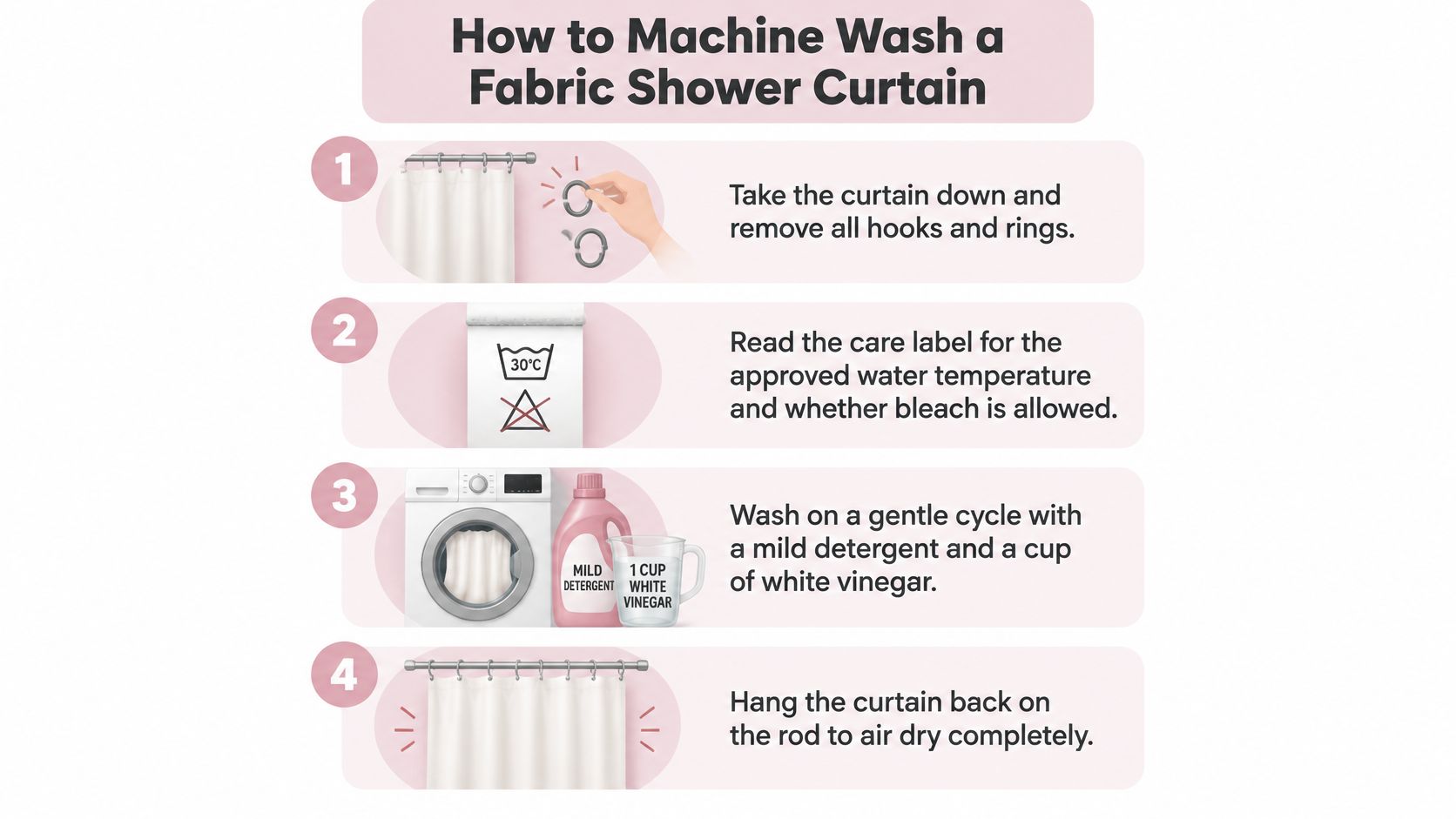
- Take the curtain down and remove every hook and ring. Lay it flat and check for split seams or loose hems while you can still see them.
- Read the care label for the approved water temperature and whether any machine drying is allowed. If it says cold, use cold.
- Pre-treat visible soap scum and mildew spots. A paste of baking soda and water, or a dab of liquid detergent, left to sit for 10 to 15 minutes, beats any additive you pour into the drum.
- Load the curtain alone or with two or three towels. The towels give the fabric something to rub against and keep it from balling into a corner.
- Add standard detergent and run the warmest cycle the label allows. Skip chlorine bleach unless the manufacturer explicitly permits it, because bleach weakens fibers and strips color.
- Use a gentle cycle, and add an extra rinse if your machine offers one. Detergent left in the weave attracts the next layer of grime.
- Pull it out immediately, reshape the seams and hem, and hang it open to air dry. A curtain left sitting damp in the drum picks up permanent creases and a musty smell before it's even back on the rod.
Heat and chemistry matter more than scrubbing pressure. A controlled textile-laundering study in the National Library of Medicine's PMC archive found that washing at 60 °C with detergent produced reductions greater than 5 log10 CFU/carrier across tested polyester, cotton and cotton/linen fabrics, while 40 °C with detergent fell below 4 log10 and did not effectively inactivate the tested organisms. That is not a shower-curtain success rate, and your care label still decides the setting. It does explain why a lukewarm wash sometimes leaves a curtain smelling faintly of the shower.
Three failures are the most common, and all three are easy to avoid.
- Overdosing detergent. Extra suds rinse out poorly, and the residue becomes a sticky base for soap scum.
- Leaving the curtain bunched while wet. Every fold that dries slowly becomes a mildew line.
- Machine-drying fabric the label says to hang. Heat sets creases and can shrink a hem out of square.
How to Clean Plastic and Vinyl Curtains by Hand
Plastic runs on different rules, and the first one is temperature. Vinyl, PVC, PEVA and EVA all soften and warp in water hot enough for a comfortable bath, so everything below is lukewarm at most. It also means the machine is out, however tempting the convenience.
- Detach the liner and lay it flat. The tub floor works, or a towel on the bathroom floor if the liner is short.
- Mix lukewarm water with a few drops of dish detergent in a spray bottle. A few drops is the whole recipe; more detergent just means more residue to rinse off.
- Spray both sides and wipe with a soft sponge or microfiber cloth. Work the bottom third hardest, where soap scum and body oils concentrate.
- For stubborn film, apply a baking-soda paste and work it in slow circles with your fingers or a soft cloth, then rinse.
- For mineral spots, spray white vinegar and give it a few minutes. The acid dissolves the calcium deposits. Scrubbing at them only scratches the plastic.
- Never mix vinegar with bleach or any other cleaner. That combination releases toxic gas, and a small bathroom with the door closed is the worst place to discover it.
- Rinse thoroughly with lukewarm water, hang the curtain fully extended, and towel-dry the hem. The hem dries last and spots first.
A few cautions belong right next to those steps. No hot water, no clothes dryer, and no abrasive scrub pads, since a scratched surface gives mildew thousands of tiny anchor points. Skip chlorine bleach on colored or PEVA curtains, particularly in a bathroom with weak airflow, where fumes linger and plastic yellows.
Time-saver: the same spray-and-wipe works as a monthly touch-up with the curtain still hanging. Spray the bottom third, wipe, and let it air dry.
Hand washing a standard liner takes about 15 minutes of actual work. Most of that is the bottom third, and most of the rest is rinsing.
When Mildew Keeps Coming Back
If spots return within a few weeks of a wash, the curtain usually isn't dirty. It's wet. Cleaning harder doesn't fix a drying problem, and reaching for a stronger chemical just adds fumes to a small room.
The U.S. Environmental Protection Agency's guide to mold, moisture and your home advises keeping indoor relative humidity below 60%, with an ideal range of 30% to 50%, and drying damp or wet materials within 24 to 48 hours to help prevent mold growth. For bathrooms, the agency recommends running an exhaust fan or opening a window, cleaning more frequently when mold repeatedly returns, scrubbing mold from hard surfaces with detergent and water, and drying cleaned surfaces completely. Notice what's absent: no universal washing interval, because your drying conditions, visible buildup, odor and household sensitivity set the frequency.
| Symptom | Likely cause | Fix |
|---|---|---|
| Mildew returns within weeks | Curtain stays bunched and wet | Spread it fully after every shower and run the fan during and after bathing |
| Spots cluster at the hem | Water pools in the folds and hem | Shake out the pleats, keep the hem off the tub floor, dry within 24 to 48 hours |
| Pink or orange film | Soap scum and residue buildup | Pre-treat with detergent or a baking-soda paste before washing, then rinse well |
| Musty smell survives washing | The liner never dries completely | Improve airflow, wash more often, replace a liner that stays damp |
| Curtain still damp the next morning | Weak ventilation or humidity above 60 percent | Check the exhaust fan, open a window, allow more drying time |
Established mold on a curtain calls for gloves and eye protection, and never a bleach cocktail mixed with acids, ammonia or another cleaner. Rinse away residue after treatment rather than leaving product to sit. The surrounding surfaces feed the same problem, and AMPM Restoration Services' guide to mold in a shower covers the caulk lines and corners where a wet hem rests. Our own walkthrough on removing mold and mildew from a shower handles tile, grout and glass.
The next-day test: a clean curtain hangs with air gaps and no pooled water at the hem. If it's still damp the next morning, the setup is the problem, not the soap.
A Care Routine That Prevents Mildew
Frequency is the question everyone asks, and a calendar alone won't answer it. In 2025, TimesLIVE reported that shower curtains should be washed monthly and plastic or vinyl curtains replaced every 6 to 12 months. Treat the monthly wash as a starting point and pull it forward when the bathroom runs humid, the fan is weak, or several people shower back to back.
| Task | How often | Why it matters |
|---|---|---|
| Spread the curtain fully after showering | Every shower | Lets the material dry instead of trapping moisture in the folds |
| Run the exhaust fan or open a window | During and after every shower, until the room is dry | Moves humid air out so the curtain isn't drying inside a cloud |
| Inspect hems, folds and rings | Weekly | Catches soap film and early spots before they spread |
| Machine wash a fabric curtain | About monthly, or when soiled | Removes soap scum, body oils and microbial buildup |
| Wipe down a plastic or vinyl liner | About monthly | Cleans without the heat damage a machine can cause |
| Apply a mildew-prevention treatment | Every 28 days | Slows regrowth on soft surfaces |
| Replace a plastic or vinyl liner | Every 6 to 12 months | Worn liners hold stains, odors and moisture |
In 2024, Good Housekeeping recommended applying a mildew-prevention treatment to soft surfaces such as shower curtains every 28 days. That interval fits the humid stretch from May to September well, and it's easy to fold into a weekly wipe-down.
Small habits carry most of the load in North Georgia homes. Leave the bathroom door open after showers so air moves through. Keep the liner inside the tub and the outer curtain outside it, so each surface can dry instead of pressing wet against the other. Soak the rings and hooks in warm soapy water now and then, because they collect the same film the curtain does. Through humid summers and pollen season in Acworth, Woodstock and the surrounding communities, look at the bottom third of the curtain once a week rather than once a month.
For sensitive households: a weak fan, a windowless bathroom or a family member bothered by strong smells all point the same way. Lean on ventilation and gentle, frequent washing rather than stronger products.
If your grout and caulk stay damp, the room stays humid no matter how often you wash the curtain. Fixing grout and controlling moisture from Western Bathroom Renovations explains how failing grout lines feed a bathroom's humidity. Bath mats hold the same dampness, and cleaning bathroom rugs regularly keeps the floor from adding to the load.
When to Replace It and When to Call a Pro
A liner has reached the end of its useful life if it stays mold-stained or smelly after washing, has cracked plastic, or cannot dry between showers. The EPA's overview of mold explains the importance of controlling moisture, but those replacement signs are practical guidance, not EPA rules. Torn grommets, a stiff hem, or clouding that blocks light can also make a curtain less useful.
Replacing a worn liner is usually simpler than tackling buildup elsewhere in the bathroom. Maid in America's Basics service includes a top-to-bottom tub and shower detail and a toilet cleaned and disinfected inside and out. The company uses natural cleaning solutions and avoids chlorine bleach, ammonia, abrasives, phosphates, and phthalates.
For grime on grout or glass, or for a seasonal bathroom reset, Maid in America offers cleaning services in Kennesaw, Acworth, Woodstock, Marietta, and nearby communities. Request an estimate based on your space and priorities at Maid in America.





Maid in America provides reliable, personalized cleaning with natural products for homes, offices, and communities across West Georgia. Licensed, bonded, and insured, we’re locally and privately owned.
Get in touch with us today!
info@maidinamericaga.com