How to Clean Construction Dust Safely After Renovation
The contractors have packed up, your new kitchen looks beautiful, and then you run a hand across the counter. There's a pale film again. In a Kennesaw or Acworth renovation, that residue can reach cabinet interiors, window tracks, and rooms that weren't part of the project.
Knowing how to clean construction dust starts with identifying what the contractor disturbed, not choosing a stronger cleaner. Some residue is ordinary fine debris. Dust from masonry or old paint can require specialized assessment before anyone starts wiping.
Table of Contents
- Dust Sources That Need Silica-Safe Cleanup
- Older Homes and Suspected Lead Dust
- Protecting Your Household During Cleanup
- How to Clean Construction Dust in the Right Order
- How to Clean Each Surface Without Re-Dusting It
- Recheck the Room and Book the Final Clean
Dust Sources That Need Silica-Safe Cleanup
If concrete, mortar, brick, stone, tile, grout, or drywall compound was cut, ground, or sanded, treat the residue as possibly containing respirable crystalline silica. The material and the work performed matter more than the color of the dust. A white film isn't automatically harmless drywall residue.
OSHA's construction silica guidance identifies an action level of 25 micrograms per cubic meter of air and a permissible exposure limit of 50 micrograms per cubic meter, both calculated as 8-hour time-weighted averages. These are workplace exposure limits, not residential clearance standards, but they show why small airborne amounts deserve controlled handling.
Dust sources, main concern and cleanup method
| Dust source | Main concern | Cleanup method |
|---|---|---|
| Concrete, mortar, brick or stone cut or ground | Respirable crystalline silica likely | Stop dusty work first, dampen compatible surfaces, HEPA vacuum, wet wipe; obtain assessment if dust is heavy |
| Grout and tile cutting | Silica possible | Dampen compatible surfaces, HEPA vacuum with nozzle close to surface, wet wipe and mop |
| Drywall compound and sanding dust | Fine particles, may contain silica | Wet wipe compatible surfaces and HEPA vacuum; no dry sweeping or dusting |
| Wood sanding and general debris | Fine particulate, lower silica risk | HEPA vacuum, damp wipe, mop with clean rinse water |
| Old paint chips or flaking paint dust | Lead hazard in older homes | Use only a HEPA-filtered vacuum for vacuuming, never dry sweep; call a specialist before cleanup |
| Unknown source | Hazard cannot be ruled out | Confirm materials with the contractor; treat as hazardous until confirmed |
Wood sanding and general debris generally carry lower silica concern than masonry cutting, but they still call for fine-particle capture. A broom may remove the visible pile while leaving the smallest particles available to circulate.
Resolve the material question before booking
For a Cartersville bathroom remodel or Woodstock tile installation, ask the contractor what materials were cut and how the dust was contained. Confirm that high-dust work has ended and that appropriate controls were used before anyone disturbs unknown residue.
Natural, low-odor products don't neutralize silica. At Maid in America, we record special-care instructions before cleaning, so material concerns and sensitive finishes should be disclosed when arranging the appointment.
Stop-work rule: If masonry or old paint was disturbed and the source or extent of contamination is unclear, stop and obtain an industrial-hygiene assessment before cleanup.
That rule applies equally to Kennesaw and Acworth homeowners. A cosmetic cleaning appointment isn't a substitute for determining whether a hazardous material needs specialized handling.
Older Homes and Suspected Lead Dust
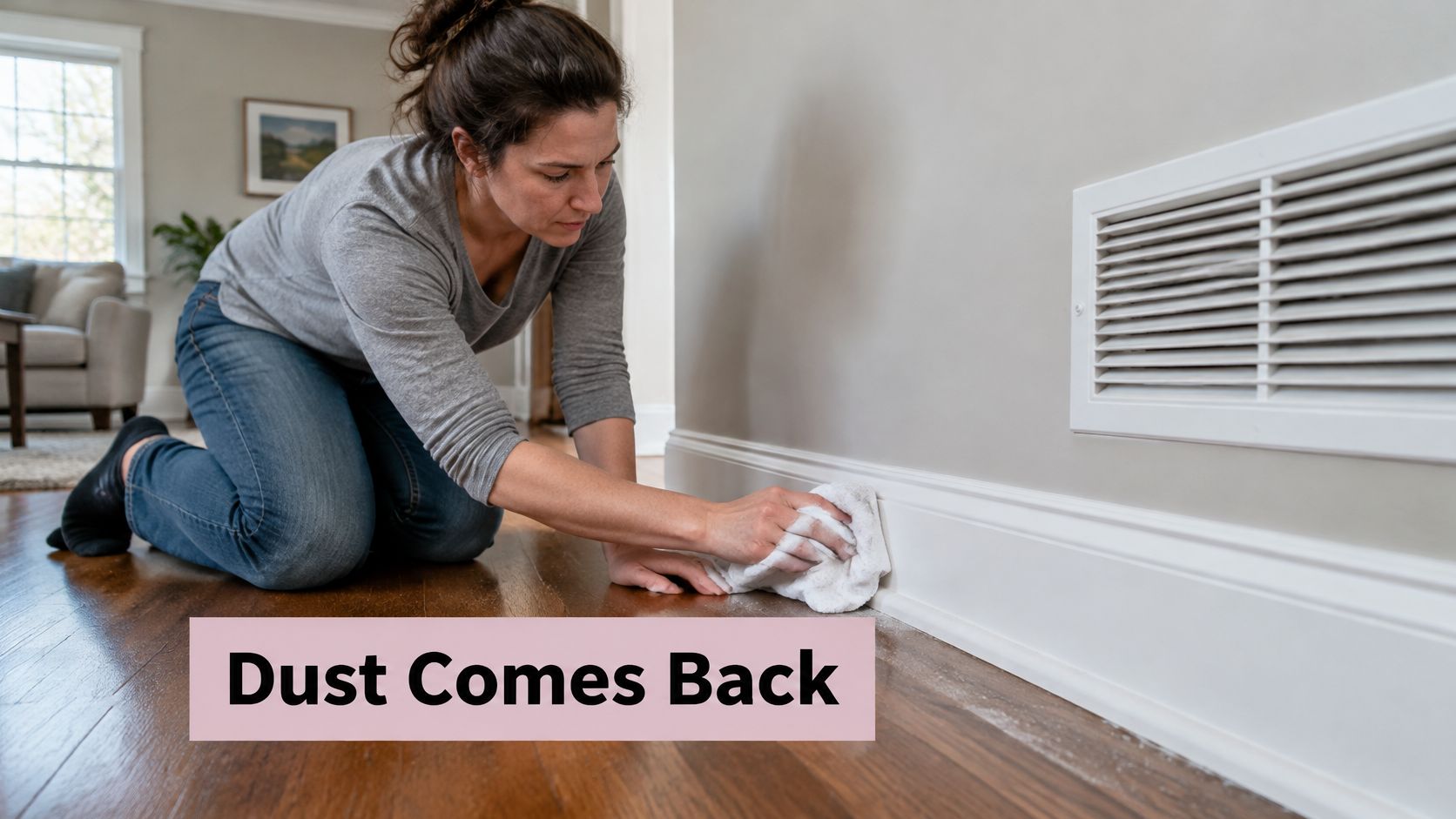
Older paint layers change the job. Renovation can release chips and fine dust from lead-based paint, mixing them with plaster, wood, or drywall residue. You can't reliably sort that mixture by appearance.
EPA's home lead-exposure guidance recommends HEPA vacuuming and wet wiping dusty surfaces, followed by wet mopping floors with plenty of rinse water before removing protective plastic. Keeping plastic over doors, windows, and vents during cleanup helps contain settled particles rather than carrying them into adjacent rooms.
Keep suspected paint dust separate from routine housekeeping
When visible chips or dust from chipping or flaking lead-based paint are present, only a HEPA-filtered vacuum should be used for vacuuming, and dry sweeping should never be performed. That doesn't mean a homeowner should begin removing suspected lead dust with rented equipment. The hazard needs assessment first.
For an older house in Marietta or Acworth:
- Isolate the work zone. Keep renovation residue out of occupied rooms.
- Keep children and pets away. Don't let them cross the containment area.
- Disclose the paint concern. Tell the cleaning provider before the appointment, not after work begins.
- Get qualified help. Ask a certified lead professional to assess uncertain paint or dust conditions.
If your next question is whether the remaining painted surface can be covered, Hayes Painting and Decorating's explanation of lead-safe encapsulant vs ordinary paint provides useful context. Encapsulation decisions are separate from collecting contamination already released during renovation.
Ordinary cleaning shouldn't start until the paint question is answered. A clean-looking baseboard isn't proof that a suspected lead problem has been resolved.
Protecting Your Household During Cleanup
Keep children, pets, and anyone sensitive to dust outside the work zone during heavy removal and until the final mop is dry. Plan an actual separation, not just a request to stay on the other side of the room. In a busy household, that may mean closing off the renovated space while everyone uses another entrance.
For confirmed routine residue, wear disposable gloves and eye protection, and follow the equipment and cleaning-product instructions. If silica or lead may be present, stop and call a qualified professional. Respirator selection and containment depend on the hazard and the work, and a casual face covering doesn't resolve that decision.
Set up before opening the dust bags
- Control air movement. Keep HVAC equipment off during cleanup and leave ceiling fans off.
- Keep waste contained. Seal captured dust in suitable bags before moving it through occupied areas, and follow applicable disposal requirements.
- Empty equipment outside occupied space. Never empty a HEPA vacuum indoors; follow its dust-removal procedure without shaking out the contents.
- Share the material history. Tell cleaners what was cut, ground, sanded, or removed before they begin.
Low odor is a comfort choice. Dust containment and capture are the controls that matter during removal.
Natural products can reduce harsh smells, but they don't replace a suitable vacuum, careful handling, or hazard assessment. Trained cleaners also need advance notice about unfinished wood, fresh coatings, and other surfaces that shouldn't receive moisture. Keeping those instructions with the cleaning plan helps protect both the people in the space and the new finishes.
How to Clean Construction Dust in the Right Order
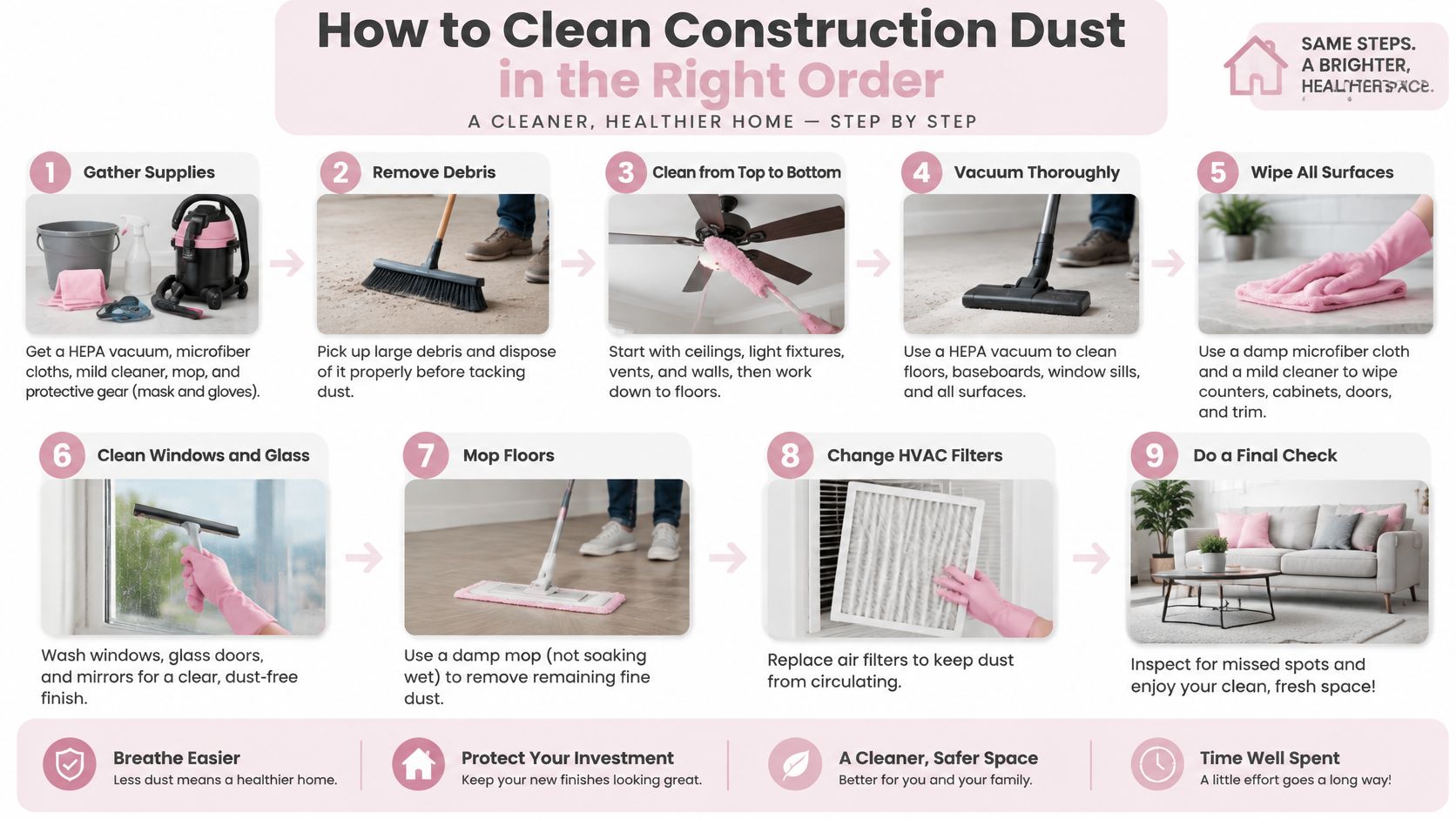
After a renovation in a Kennesaw home or Acworth office, fine residue can still coat surfaces even when the contractor has removed the debris. Treat it as a possible silica or lead hazard first. Only proceed with ordinary cleanup once the dust has been identified as suitable for it. Dry dusting and sweeping can send settled particles back into the air, so control the area and capture dust before wiping or mopping.
EPA's renovation work-practice guidance calls for HEPA vacuuming followed by wet wiping and wet mopping. It specifies a vacuum with final-stage HEPA filtration that captures 99.97% of particles at 0.3 microns without leakage around the filter. A HEPA label alone does not ensure that air cannot bypass the filter.
Follow a controlled cleaning sequence
Isolate the work area. With the HVAC system off, close doors and cover supply and return registers with suitable plastic and tape. Leave the system off until cleanup is complete. An uncovered return can draw dust into the system, even when supply vents are sealed.
Pick up larger debris without sweeping. Use suitable gloves to collect loose pieces by hand, or lift small fragments with a damp cloth. Contractors should have removed construction waste before final cleaning. Avoid dragging scraps across new floors or using a broom to chase fine powder.
HEPA-vacuum from high to low. Use overlapping passes on accessible ceilings, walls, ledges, trim, cabinet tops, fixtures, and floors. Check that the filter is seated and the collection system is sealed before starting. A poorly fitted filter can allow a household vacuum to release fine residue back into the room.
Wet-wipe compatible hard surfaces. Start high and work downward with clean microfiber cloths. Fold each cloth to expose a clean side, and change it when it becomes soiled. Otherwise, it can spread residue rather than remove it.
Wet-mop the floor in sections. Use a solution and moisture level suited to the flooring, and change rinse water frequently. Keep water away from vulnerable seams and avoid flooding wood or laminate. Refresh cloudy water instead of carrying it into the next section.
Keep containment in place through the final cleaning pass. Remove plastic carefully, folding the dusty side inward. Taking barriers down too early can drop captured residue onto surfaces that have already been cleaned.
Inspect with bright, low-angle light. Shine a flashlight across counters, trim, and floors to reveal remaining film or grit. Repeat the suitable capture and wiping steps where residue remains. Don't polish over powder that is merely hard to see under overhead lighting.
Finish the room, not just the obvious surfaces
Maid in America's post-construction cleaning takes place after contractors have completed the work and removed construction debris. It focuses on fine dust from accessible surfaces, trim, sills, fixtures, and cabinet exteriors, along with kitchen and bathroom details, mirrors, glass, doors, frames, reachable windows, floors, and finishing wipe-downs. Cleaning methods still need to suit the surface and the residue.
The entire-house cleaning checklist can help track rooms and touchpoints, including adjoining spaces. Before leaving, the cleaning professional reviews the completed work. Check for visible film and grit underfoot, and make sure rinse water stays clean during the finishing pass. These are practical housekeeping checks, not hazardous-material clearance.
How to Clean Each Surface Without Re-Dusting It
Dry sweeping, dry brushing, and compressed air can undo a cleanup by lifting settled particles into the air. Use the controlled order already established, but adjust the tool and moisture level to each material. The goal isn't to make every surface wet; it's to collect residue without damaging the finish.
EPA's remediation cleaning guide describes damp wiping and HEPA vacuuming as cleanup methods, with material compatibility determining how moisture is used. Construction cleanup needs that same restraint, especially around gypsum, unfinished wood, and electrical components.
Surface cleanup methods and what to avoid
| Surface | Method | Avoid |
|---|---|---|
| High ceilings and walls | HEPA vacuum with overlapping passes, then damp wipe compatible finishes from high to low | Dusting with a dry cloth or feather duster |
| Ceiling fans and light fixtures | Turn power off at breaker, let fixtures cool, HEPA vacuum, then damp wipe suitable exterior surfaces; let dry | Spraying liquid directly onto the fixture |
| Cabinet interiors and exteriors | HEPA vacuum inside, use damp microfiber on compatible faces and tops | Blowing out drawers with compressed air |
| Window tracks and sills | HEPA vacuum the track, damp wipe sill and frame | Dry brushing the track |
| Blinds | HEPA vacuum slats gently, damp microfiber wipe compatible closed slats individually | Shaking blinds in the room |
| Hard floors | HEPA vacuum, then wet mop in sections with clean rinse water | Dry sweeping or using a broom |
| Carpet and upholstery | HEPA vacuum slowly, making overlapping passes in different directions | Dry brushing or beating rugs without containment |
| Outlets and switches | Cut power, wipe exterior plates with a barely damp cloth, let dry before use | Spraying liquid near outlets or switch plates |
Use less moisture where the material needs it
A damp cloth should collect dust without leaving drips. Over-wetting gypsum can damage the surface, while unfinished wood can absorb moisture. Don't assume a wet vacuum makes a moisture-sensitive material suitable for wet cleaning.
For fans and fixtures, cut power at the breaker before wiping, and never reach into electrical components. If you can't safely access a high surface, leave it for someone with suitable access equipment instead of stretching from furniture.
Window tracks and cabinet corners reward a close-fitting vacuum attachment. Keep the nozzle close to the residue rather than hovering above it, then use a fresh cloth for the final wipe.
A clean cloth should remove the film, not turn it into grey streaks.
If the vacuum smells dusty after a pass, stop and inspect the bag, filter seating, seals, and maintenance requirements. Don't keep running it and hope the smell clears. Our explanation of what deep cleaning includes helps distinguish detailed housekeeping from the specialized hazard work that ordinary cleaning doesn't replace.
Recheck the Room and Book the Final Clean
A renovated kitchen can look finished one day and show a pale film on the windowsill the next. Before cleaning again, check likely dust traps: fan blades, textured surfaces, cabinet interiors, window tracks, fabric furnishings, and HVAC returns.
OSHA's construction silica guidance includes housekeeping and restricted access in construction exposure-control planning. For homeowners, the practical takeaway is to wait until dusty work has stopped and the contractor has controlled the spread. Cleaning while cutting or sanding continues nearby can quickly undo the work.

Check before restoring normal air movement
Keep the HVAC off until the initial inspection is complete and protected registers can be uncovered without dispersing residue. If dust may have entered the system, arrange an HVAC assessment before restarting it. Clean room surfaces alone cannot confirm that internal equipment is clean.
- Test a fan blade. Turn off power, then wipe an accessible blade with a clean, lightly damp cloth.
- Open a cabinet. Check an interior shelf and upper corners as well as the door.
- Light the window tracks. A flashlight can reveal powder tucked beside the frame.
- Inspect the filter. Check that it is clean and seated correctly, and maintain or replace it according to the manufacturer's instructions.
- Revisit the room after airflow resumes. Look for fresh dust before returning belongings.
Handle suspected system contamination before normal HVAC operation. Then complete detailed surface cleaning and check for settling after airflow resumes.
Give the cleaner the details that change the job
Schedule the final clean after dusty work has ended, contractors have removed construction debris, containment has been addressed, and HVAC concerns have been checked. Share which materials were cut or ground, whether old paint may be present, and when the work finished. These details help clarify the work needed.
Maid in America offers post-construction cleaning after contractors finish and remove debris. The service addresses fine dust on accessible surfaces, trim, sills, fixtures, and cabinet exteriors, along with floors, kitchens, bathrooms, mirrors, glass, doors, frames, reachable windows, and finishing details. Floor care includes vacuuming, sweeping, and mopping. Sweeping is not appropriate for suspected silica or lead residue. See what to expect when choosing a post-construction cleaning company for preparation details.
We're a locally and privately owned company that is licensed, bonded, and insured. Maid in America uses natural, low-odor cleaning solutions.
The service is available in Acworth, Kennesaw, Woodstock, Marietta, Dallas, Hiram, Powder Springs, Cartersville, and nearby communities in Cobb, Paulding, and Bartow counties.
For a free estimate, call 770-427-4448 or complete the Contact Us form on Maid in America. Describe the renovation and any material concerns so the cleaning can be planned around the work left behind.




Maid in America provides reliable, personalized cleaning with natural products for homes, offices, and communities across West Georgia. Licensed, bonded, and insured, we’re locally and privately owned.
Get in touch with us today!
info@maidinamericaga.com