Green Cleaning Products: What the Labels Really Mean
The most repeated advice about green cleaning products is to swap anything harsh for a bottle that says natural. I'd push back on that. A plant-derived fragrance can bother a sensitive person's airways as much as a synthetic one, and a plain unscented bottle with no eco claim anywhere on it can be the lower-emission choice. What counts is what's in the formula, how much of it evaporates into your rooms, and what happens after it goes down the drain.
Table of Contents
- What Green Cleaning Products Actually Mean
- What Each Cleaning Label Claim Actually Proves
- Why Low Odor Does Not Prove Low Emissions
- Choosing and Using Low-Odor Cleaners for Kids, Pets and Sensitive Households
- Concentrates, Packaging and the Rest of the Footprint
- Green Cleaning in Offices and HOA Amenities
- Request a Free Estimate for a Low-Odor Clean
What Green Cleaning Products Actually Mean
A bottle labeled natural can still leave a fragrance-sensitive person with a headache, and a bottle with no green claim at all can still be low in emissions. Those two facts break most shopping advice on this subject. Green cleaning products, properly understood, are cleaners whose ingredients, emissions, packaging and disposal were chosen to reduce harm to people and to waterways. That's a formulation decision, not a color scheme on the label.
Three ideas get blended together on store shelves, and they measure completely different things:
- Natural describes where an ingredient came from. Citrus oil is natural. It's also a solvent that evaporates into the air you breathe.
- Green is a broad marketing word with no single test behind it. A brand can print it because the bottle is recyclable, because one surfactant is plant-derived, or because the label looks better in sage.
- Independently verified safer means an outside program checked every ingredient against published criteria and keeps checking. That's a different kind of claim entirely.
A label is a reference letter, not a background check. One is written by the applicant. The other is done by someone with no stake in the answer.
The two risks people confuse are indoor air and water. According to the EPA's guidance on identifying greener cleaning products, VOCs in cleaning products can affect indoor air quality and contribute to outdoor smog, while phosphorus and nitrogen can contribute to nutrient pollution in waterways. A product can be gentle on one front and poor on the other. Each risk depends on the ingredient, the dose and the route of exposure.
That matters here in a specific way. During spring pollen season, Kennesaw and Acworth households keep windows shut and run the air conditioning, so whatever evaporates indoors stays indoors. Red clay tracked in from the yard means more mopping, which means more product going down the drain. Humid Marietta summers slow drying and keep fumes hanging in closed bathrooms.
Reading a label well comes down to ingredient disclosure, a named certification, an honest look at emissions, and whether the cleaner removes soil on the first pass.
What Each Cleaning Label Claim Actually Proves
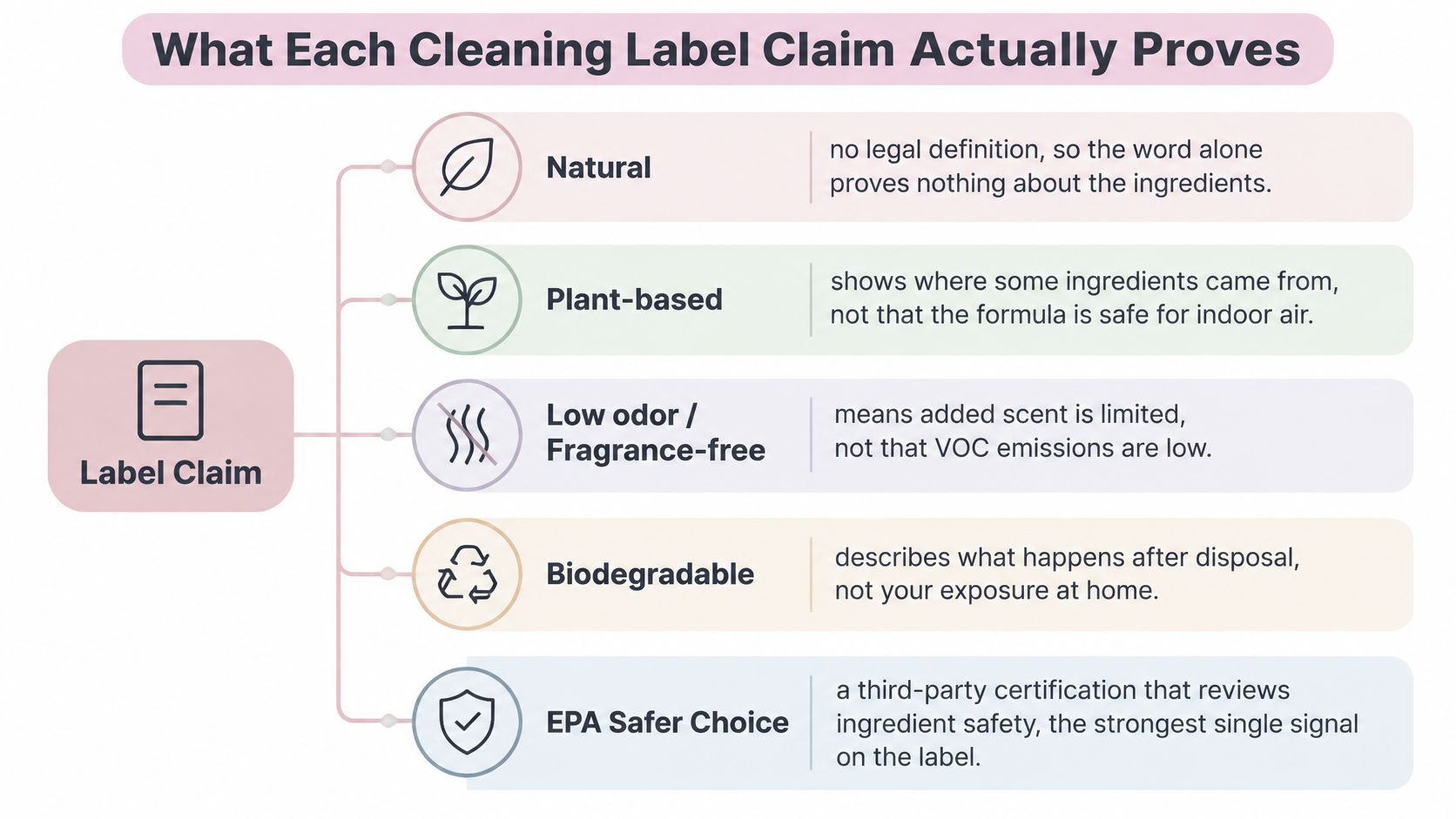
Here's the shelf test in one table, walking from the weakest claim to the strongest.
| Label claim | What it tells you | Where to verify |
|---|---|---|
| Natural | Describes ingredient origin; no single standard for cleaning products | Full ingredient list |
| Plant-based | Describes the source of ingredients, not their hazard or emissions | Ingredient list and hazard screening |
| Low odor or fragrance-free | Fewer or no added scent chemicals; does not confirm low VOC content | Ingredient list and VOC statement |
| Biodegradable | Describes how a substance breaks down in the environment, not indoor safety | Degradation criteria on the product data |
| EPA Safer Choice label | Every ingredient evaluated, VOC content restricted, certified products audited each year | Certified product listing |
| Green Seal GS-37 | Linked to lower life-cycle impact than typical alternatives in a comparative study of industrial and institutional cleaners | Certifier listing |
Origin claims and scent claims
Natural and plant-based tell you about sourcing. Neither word carries a hazard assessment, and natural has no single definition for cleaning products, so two brands can use it to mean opposite things. If the front of the bottle says plant-based and the back says "fragrance" with no further detail, you've learned nothing about what you'll be breathing.
Fragrance-free is more useful, but narrower than people assume. It means no added scent chemicals. It doesn't confirm low VOC content, because solvents that evaporate at room temperature aren't necessarily there for smell. Read the ingredient list for alcohols and glycol ethers, and look for a separate VOC statement.
Biodegradable describes the end of the product's life, not the middle of it. A surfactant can break down readily in a treatment plant and still be irritating in your kitchen while you're using it. Ask for the degradation data, not the adjective.
The certifications that carry weight
The EPA Safer Choice label is the strongest single signal on a shelf. Its predecessor, Design for the Environment, began in the early 1990s, and the EPA's Safer Choice performance measures record that the DfE product label was replaced by the Safer Choice label in February 2015. Certified products must meet the Safer Choice Standard, and EPA conducts annual audits to verify continuing compliance. The same report counts 1,656 Safer Choice-certified products in fiscal year 2025, so this isn't a boutique program you'll struggle to shop from.
Performance is part of that certification, not an afterthought. Under the Safer Choice surfactant criteria, qualifying products must also meet category-specific efficacy tests, including removal of at least 80% of relevant particulate or greasy soil under specified test methods or an accepted equivalent. A safer formula that can't clean doesn't get a pass.
Green Seal GS-37 is the standard I'd point a facility manager toward, because it's tied to documented life-cycle comparisons for institutional cleaners rather than to packaging aesthetics.
Three checks, in order:
- Read the full ingredient list, not the front panel.
- Look for a named third-party certification you can look up in a certifier's listing.
- Confirm the product matches the task, since a bathroom cleaner and a floor cleaner aren't interchangeable. If you're unsure whether you need cleaning, sanitizing or disinfecting in the first place, our guide to the difference between cleaning, sanitizing and disinfecting sorts that out before you buy anything.
A certified product still needs correct dilution and ventilation to behave the way it was tested.
Why Low Odor Does Not Prove Low Emissions
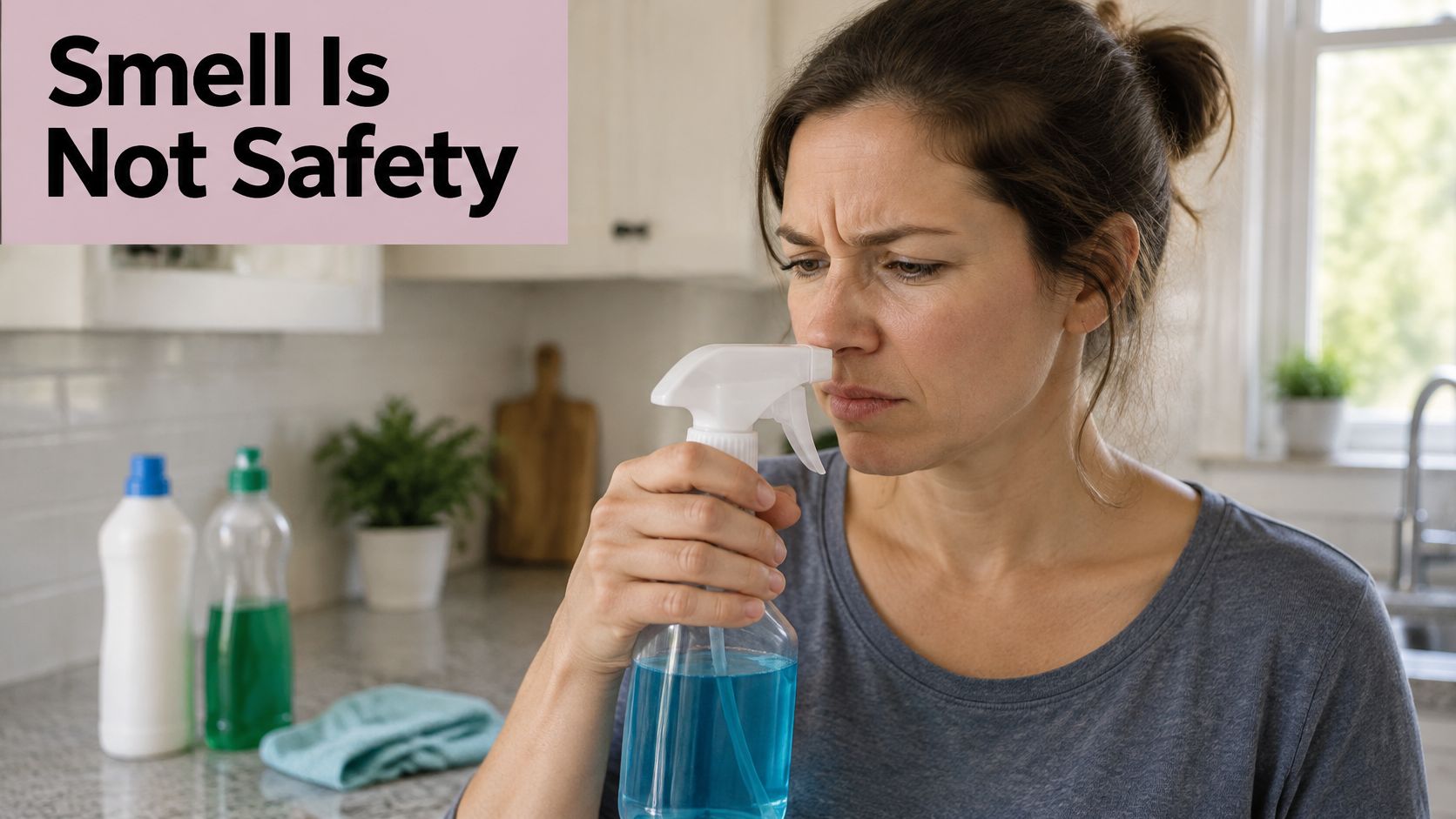
Most buyers assume that if a cleaner smells mild, it must be putting less into the air. Scent is a signal of fragrance and solvent chemicals, not a measurement of safety, and the two can move in opposite directions.
VOCs are chemicals that evaporate at room temperature. They leave the surface and enter the room, and in a closed bathroom during a humid Georgia summer they linger long after the wiping is done. A laboratory and real-world assessment of cleaning products indexed by EPA found that conventional products generally produced higher total VOC concentrations, emission factors and numbers of VOCs than green products, especially fragrance-free ones, but some green all-purpose cleaners still increased indoor concentrations of fragrance chemicals of concern.
| Product type | Total VOC levels | Fragrance chemicals | What to remember |
|---|---|---|---|
| Conventional cleaners | Generally higher total VOC concentrations and emission factors | Present, not separately quantified in the assessment | Highest overall VOC levels in the comparison |
| Green fragrance-free cleaners | Generally lowest among the products assessed | None added | Lowest measured levels, and still ventilate during and after use |
| Green scented all-purpose cleaners | Lower than conventional, not zero | Some raised indoor fragrance chemicals of concern | A pleasant scent doesn't confirm low emissions |
| Green cleaners in the chamber study (13 products) | Monoterpenes commonly emitted | Monoterpenes react with indoor ozone | Secondary pollutants, including formaldehyde up to 7% higher and peroxyacyl nitrates up to 6% higher |
The chemistry trap in a pleasant pine scent
That last row is the part most shoppers never hear. A separate chamber study examining 10 conventional and 13 green cleaners reported that green products commonly emitted more monoterpenes, the citrus and pine smelling compounds that make a natural cleaner feel authentic. Indoors, those compounds react with oxidants such as ozone and generate secondary pollutants, including formaldehyde increases of up to 7% and peroxyacyl nitrates of up to 6%. The product was greener by ingredient origin and busier by indoor chemistry.
Scent is a design choice. Treat it as a neutral detail about the product, not as evidence that the room is clean or the air is safe.
What actually lowers exposure
The rules that hold up are unglamorous. Choose low-odor or fragrance-free formulas. Mix only to the labeled dilution, because a stronger batch doesn't clean twice as well but does leave twice the residue. Ventilate during application and afterward, not just while you're spraying. Apply to the cloth rather than misting the air, which puts the product on the surface instead of in your breathing zone.
Clients notice the difference in a modest, practical way. As Sara put it, "The cleaning products used were all low odor." That's the right size of claim. Nobody's home becomes a laboratory, and a mild-smelling clean doesn't promise anything about anyone's health. It just means fewer unnecessary chemicals in the air your family is breathing while the floors dry.
Choosing and Using Low-Odor Cleaners for Kids, Pets and Sensitive Households
Three groups take the biggest share of whatever a cleaner leaves behind. Young children spend hours on floors and put hands and toys in their mouths, right where residue settles. Pets groom their paws and sleep low to the ground, so floor residue reaches them directly. Household members with asthma or fragrance sensitivity react to scented formulas and fumes that other people never notice. The aim is a healthier home with fewer harsh chemicals, not a promise about any condition.
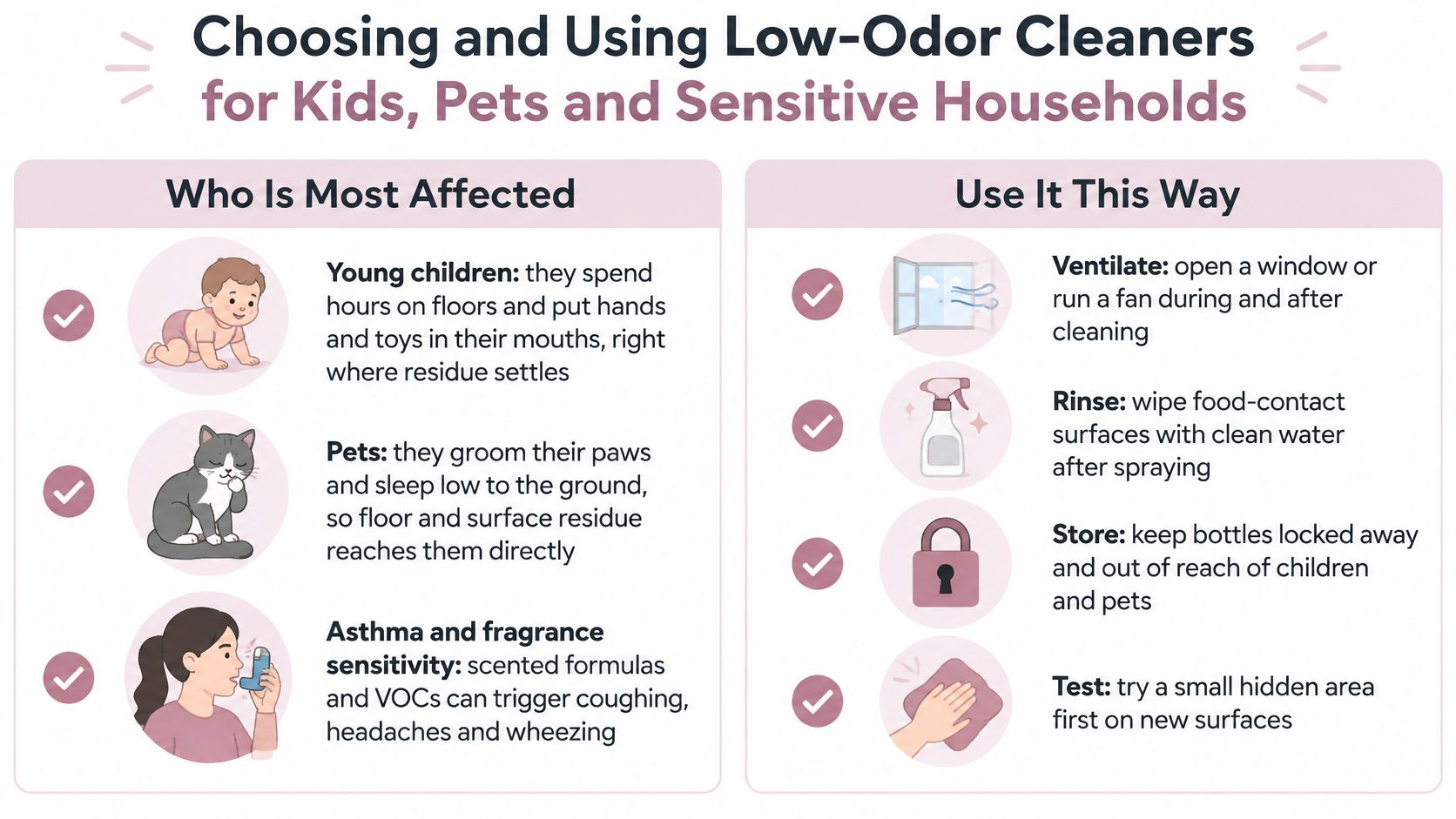
The American Lung Association's guidance on cleaning supplies and household chemicals explains that indoor VOC concentrations can reach up to 10 times outdoor levels, and that short-term exposure may cause eye, nose and throat irritation, headaches, nausea, dizziness or breathing difficulty. Longer-term exposure to some VOCs has been associated with damage to the liver, kidneys and central nervous system, as well as cancer. Fumes can stay in the air after the cleaning is finished, which is why the routine below matters as much as the product you pick.
The routine, step by step
- Match the product to the surface and the task. A bathroom cleaner built for soap scum is acidic and wrong for a sealed hardwood floor. Use the floor cleaner on the floor.
- Measure the labeled dilution. Extra concentrate leaves a sticky film that grabs dirt, so you end up cleaning again sooner. A measuring cup beats a glug.
- Start the airflow before you start cleaning. Open a window or run the bathroom exhaust fan first, and keep it running after you finish until surfaces are dry and the air has turned over.
- Apply to the cloth or directly to the surface. Spraying into the air creates a mist you inhale and wastes product on the surrounding floor.
- Work top to bottom. Dust ceiling fans and shelves before counters, counters before floors, so you're not re-soiling what you already cleaned. Rinse or dry wherever the label calls for it, especially food-contact surfaces.
- Store bottles closed, cool and out of reach. Under-sink cabinets need a child latch if a toddler or a determined dog lives there. Never mix two cleaners, and don't top off a partly used bottle with a different product.
- Dispose of leftovers and wash water as the label and local guidance direct. Don't pour concentrate down a storm drain, and don't dump mop water into the yard where it heads straight for the street.
On new or delicate surfaces, test a hidden spot first: the back of a cabinet door, the corner of a tile behind the toilet. For a deeper look at what's safe around animals, our notes on natural cleaning products that are safe for pets cover the ingredients worth avoiding.
Humidity, notes and the sign it worked
Georgia humidity slows drying, and a damp surface keeps releasing whatever is on it. Dry-buff glass and stainless, run the ceiling fan, and don't close a freshly cleaned bathroom door right away.
Keep one short product list on the inside of the cabinet door: what you use, the dilution, where it's stored, and anything a family member with asthma should stay away from. We record special-care instructions in advance of the cleaning, so a cleaner arriving at your home already knows about the cat's water bowl, the baby's floor time and the bedroom that needs to stay unscented.
The success sign is quiet. By the time you finish a room, it smells mild or neutral, and nobody has a headache or irritated eyes.
Concentrates, Packaging and the Rest of the Footprint
Ingredient labels cover part of the story. A peer-reviewed life-cycle assessment of four green cleaning products, including an all-purpose cleaner, a hand wash and dish soaps, used cradle-to-grave methods and found ingredient composition among the greatest contributors to overall environmental impact, while also flagging data-quality limitations. A product can look favorable in one category and still carry impacts from ingredient manufacturing, packaging, transportation or disposal.
EPA's framework already thinks this way. The Safer Choice and Design for the Environment standard weighs whole-product characteristics such as possible ingredient synergies, pH, energy efficiency and water savings, not just whether an ingredient came from a plant.
So a concentrate in refillable packaging isn't automatically greener than a ready-to-use spray. It depends on how accurately you dilute it and whether it cleans well enough to finish the job once. The buying moves that reliably help:
- Buy the concentrate and dilute it exactly as labeled. You stop shipping water across the country and cut packaging per clean.
- Refill the sprayer you already own. A trigger bottle that lasts years beats a new one every month.
- Match strength to the soil. Under-diluting wastes product; over-diluting means a second pass, more water and more time.
- Buy the size that matches your cleaning frequency. A gallon of a product you use twice a year is a disposal problem waiting to happen.
- Handle leftovers and wash water properly. The disposal route is part of the footprint, not an afterthought.
First-pass performance is the quiet variable. Red clay tracked in from a Kennesaw yard and humid Acworth summers mean floors get cleaned more often here than in a dry climate. A concentrate that lifts that clay in one pass does more for the total footprint than a boutique bottle that takes three tries and a second bucket of rinse water.
Green Cleaning in Offices and HOA Amenities
Shared spaces raise the stakes because you can't ask everyone what they're sensitive to. The same restroom, break room or clubhouse gets used by employees, residents, guests and vendors, some of whom will notice a scented floor cleaner immediately and some of whom won't say a word.
A documented procurement standard solves the guessing. A comparative life-cycle assessment of industrial and institutional cleaners found that conventional ready-to-use products had the highest environmental impact across all product types examined, while products complying with the Green Seal GS-37 standard had lower impacts in most categories. That gives a purchasing decision something to stand on besides a supplier's brochure.
Demand for this is already mainstream in facilities. In a September 2024 U.S. survey, CloroxPro's 2024 Clean Index report found that two-thirds of cleaning professionals reported their facility used eco-conscious cleaning solutions, and 60% said their facility had set a goal to use more such products.
What a manager should put in writing
For offices in West Cobb, Marietta and Powder Springs, and for HOA boards and property managers handling clubhouses and pool areas in Woodstock, Cartersville and Acworth, the practical answer is a one-page product list:
- Product and certification for each task, so a substitute purchase doesn't undo the standard.
- Dilution instructions in ounces per gallon, posted where the mixing happens.
- Surface compatibility, especially for stone counters, luxury vinyl plank and stainless elevator panels.
- Ventilation timing around busy periods, so restroom and locker room cleaning happens before an event rather than during it.
Boards juggling a renovation alongside routine upkeep will find the construction advice from Access Management Group useful for sequencing the messy work before the final clean. Share the product list with both the cleaning team and the building manager, and keep it updated when a product changes. Our office cleaning service works from an agreed plan like this. No cleaner eliminates every odor or risk in a shared building, but a written standard removes most of the surprises.
Request a Free Estimate for a Low-Odor Clean
Maid in America is a locally owned house cleaning and maid service based in Kennesaw, serving West Georgia. We use natural cleaning solutions and leave out chlorine bleach, ammonia, abrasives, phosphates and phthalates, and we bring the supplies needed for the scheduled service, so nothing gets swapped mid-visit for whatever is on sale.
Special-care instructions are recorded in advance of the cleaning. Tell us about the pet who bolts when the vacuum starts, the toddler who naps at two, or the family member with asthma, and that note travels with the appointment. Our cleaning professionals are selected and trained, and we usually assign one cleaner to each home whenever possible rather than rotating a large team through, so clients often get to know their cleaner by name.
The service menu covers standard maintenance cleaning, deep cleaning, move-in and move-out cleaning, post-construction cleaning, recurring maid service on a weekly, biweekly, every-three-week or monthly schedule, office cleaning, and community amenity cleaning for clubhouses and shared spaces. Gift cards for cleaning packages are also available.
We're licensed, bonded and insured, and carry a 4.9-star average across 400+ public reviews. Service coverage runs through specific ZIP codes across Cobb, Paulding and Bartow counties, including Kennesaw, Acworth, Woodstock, Marietta, Cartersville, Dallas, Hiram and Powder Springs. Request a free estimate online or call 770-427-4448.
If you'd rather not decode another ingredient list, let us bring the low-odor products and the routine that goes with them. Visit Maid in America to request a free estimate for a recurring or one-time clean, or call 770-427-4448 and tell us who's in the house, including the pets and anyone sensitive to fragrance, so we can plan the visit around them.



Maid in America provides reliable, personalized cleaning with natural products for homes, offices, and communities across West Georgia. Licensed, bonded, and insured, we’re locally and privately owned.
Get in touch with us today!
info@maidinamericaga.com