Recurring House Cleaning Services: A Stress-Free Solution


Saturday morning arrives, and the kitchen is already telling on the week. There are fingerprints on the refrigerator, crumbs under the table, a bathroom that needs more than a quick wipe, and a floor competing with the backyard for your attention. You can spend the morning scrubbing, or you can use those limited hours for errands, children's sports, yardwork, and the people waiting for you.
That's the core reason homeowners consider recurring house cleaning services. The question isn't just whether a cleaner can make the house look better. It's whether the service cadence, visit scope, products, and price fit the way your household lives. Choose the wrong schedule and you'll either pay for more service than you need or keep fighting the same mess between visits.
Table of Contents
The Weekend Cleaning Dilemma Most Homeowners Know Too Well
By midmorning, the decision usually feels less like a luxury purchase and more like a scheduling problem. You've got a sink full of dishes, a shower that needs attention, and dust collecting on the surfaces nobody touched during the workweek. The cleaning can wait for now, but it won't disappear. If you handle it yourself, the cost is your Saturday. If you hire help, the cost is money you could use elsewhere.
Many homeowners underestimate how little time they spend cleaning. Independent survey coverage reported that most Americans spend only four to six hours cleaning their homes each month, according to Cleaning & Maintenance Management's survey coverage. That doesn't mean the home stays consistently maintained. It often means cleaning happens in uneven bursts, usually when the mess has become impossible to ignore.
The problem is consistency
One rushed bathroom scrub before guests arrive won't maintain the rest of the house. A quick vacuum won't deal with kitchen film, dust on reachable surfaces, or the residue that builds up in high-use rooms. Recurring service works because it brings the home back to a manageable baseline before every room reaches emergency-cleaning status.
That matters especially for households with packed schedules. The market has moved well beyond occasional convenience. One estimate places the global house cleaning services market at USD 16.27 billion in 2025, with a projection of USD 35.84 billion by 2033, representing a projected 9.17% CAGR, as reported by Market Reports World. The same source reports that about 25 million households in high-income regions subscribed to recurring cleaning plans in 2024, representing roughly USD 45 billion in annual services.
Practical rule: If cleaning repeatedly takes over the weekend, treat the schedule as a household-management decision, not an indulgence.
Once you stop debating whether to outsource, the useful questions become practical. How often should the crew come? What does a recurring visit really include? Which tasks require a separate deep clean? And what products will be sprayed into the rooms where your family eats, sleeps, and plays?
What Recurring House Cleaning Services Actually Mean
Recurring house cleaning services are fixed-schedule appointments arranged for ongoing maintenance rather than a single reset. The provider reserves a repeating slot, assigns a crew or lead cleaner when possible, and follows a defined checklist each visit.
The four common cadences serve different households. Weekly service suits homes with children, shedding pets, heavy traffic, or residents who want the house ready for company most of the time. Biweekly service is the practical middle ground for many households. It controls visible buildup without putting a cleaning appointment on the calendar every week.
Choose the interval that matches the mess
A three-week rotation works for lighter-traffic homes that still want professional consistency. Monthly service fits households that can handle tidying and spot-cleaning between visits, but still want an outside reset on a predictable schedule.
| Cadence | Best Fit Household | Key Trade-Off |
|---|---|---|
| Weekly | Large families, pet-heavy homes, allergy-sensitive households, frequent hosting | Highest visit frequency, but less buildup between appointments |
| Biweekly | Mid-sized homes with ordinary traffic and regular self-tidying | Strong balance between maintenance and cost |
| Every three weeks | Lighter-traffic households that want continuity | More dust and bathroom film can appear before the next visit |
| Monthly | Homes that stay fairly orderly between appointments | Lower appointment frequency, but more self-cleaning and occasional add-ons |
The crew's priorities also change between recurring and restorative work. A standard maintenance visit usually concentrates on kitchen wipe-downs, bathroom cleaning, dusting accessible surfaces, vacuuming, and floor care. It isn't designed to remove every layer of accumulated residue from neglected baseboards, cabinet interiors, walls, blinds, or appliance interiors.
That distinction matters because soil and dust have time to accumulate between visits. A technical summary examining office-cleaning behavior looked at accessible horizontal surfaces and floors cleaned once or twice weekly, along with the effect of cleaning on weekly dust buildup and airborne dust concentrations, as documented in this technical cleaning study summary. The practical lesson carries into homes. Cadence affects how much material the crew must remove each time.
A recurring plan should also provide predictable communication, a consistent scope, and a clear process for skips or rescheduling. Without those basics, you haven't bought a maintenance system. You've booked the same type of one-off clean repeatedly.
Matching Cleaning Frequency to Your Household Reality
If your home looks clean on Monday and worn out by Friday, the right schedule is a budget decision as much as a cleaning decision. Traffic, occupants, pets, square footage, bathrooms, and your tolerance for visible buildup determine how much work accumulates between visits. Pick a cadence your household can support, not one that sounds ideal.
Consumer adoption also reflects lifestyle. A summary reporting Grand View Research figures says 41% of households use recurring cleaning services, while 58% of dual-income households regularly outsource cleaning, as described in Grand View Research's cleaning services market report. The same summary reports that 49% of urban consumers hire a cleaner monthly compared with 22% of rural consumers, a pattern associated with density, commuting, and working-household schedules.
Compare the lived experience, not just the invoice
Weekly service keeps the home closest to presentation-ready condition. Pet hair, crumbs, bathroom film, and tracked-in soil have less time to spread. Families with young children or indoor allergy concerns often get more from weekly visits because the crew spends less time recovering the baseline and more time maintaining it.
Biweekly service is the sensible starting point for many households. It gives the crew enough regularity to maintain kitchens, bathrooms, floors, and common areas without requiring a weekly appointment. If the home looks worn out before the second visit, the interval is too long.
A three-week plan fits a quieter home where residents remove shoes, control clutter, and handle small spills and bathroom touch-ups. Monthly service costs less across the calendar, but it demands more work from the household. You will need to tidy between visits, and a longer gap can leave the next appointment focused on recovery rather than upkeep.
The cheaper schedule is not always the cheaper decision. Monthly visits may reduce appointment frequency, while biweekly service can preserve a cleaner baseline and reduce the need for extra reset work. Ask what the crew can realistically accomplish at each cadence, then compare the total effort and cost.
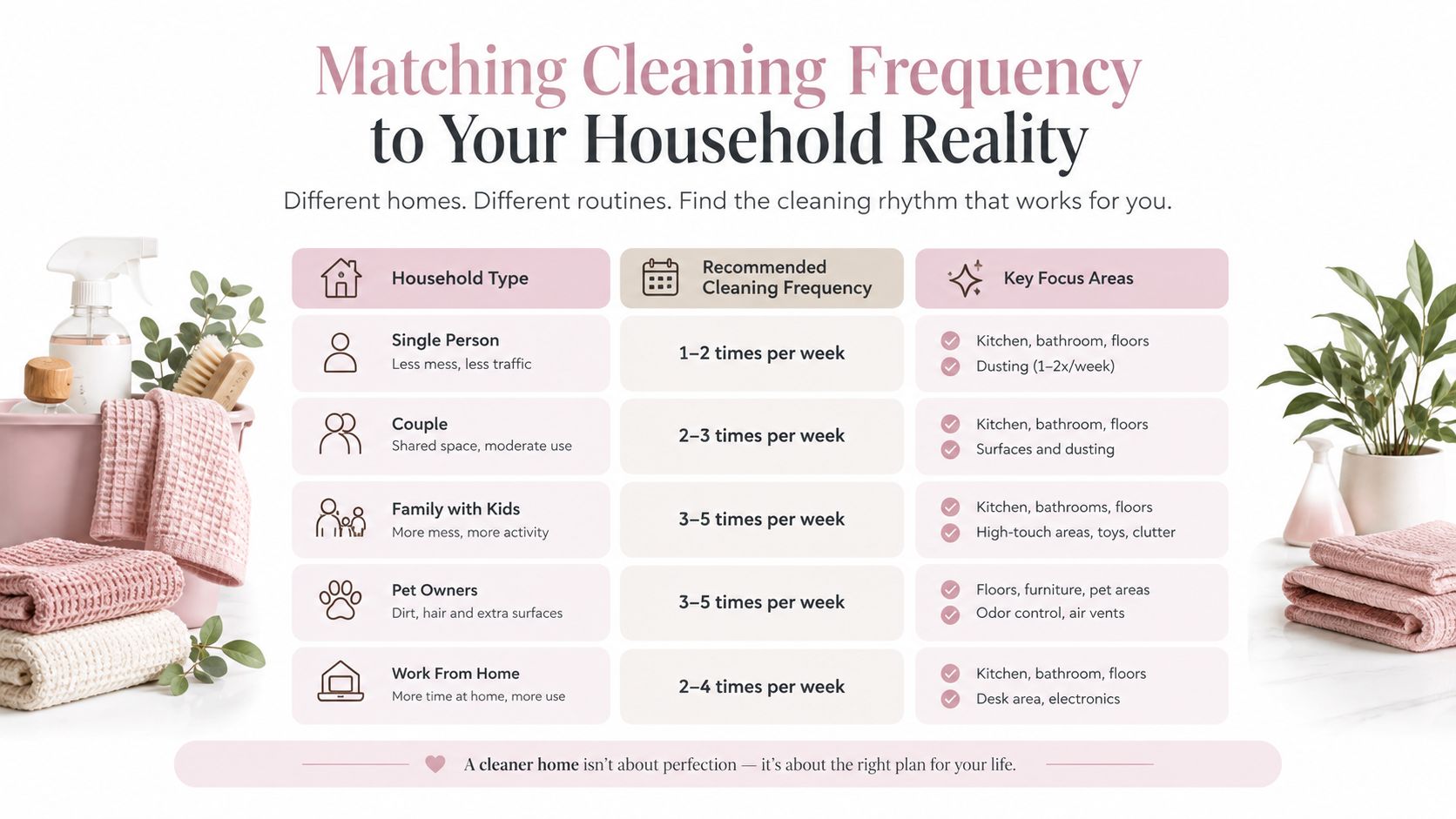
Start with biweekly service when you are unsure, then judge the home after several visits. Move to weekly after a new baby arrives, pets join the household, or visible dust returns too quickly. Choose every three weeks or monthly when the home stays orderly and occupants consistently manage light maintenance.
For households considering weekly upkeep, compare recurring weekly cleaning with the home's actual condition, not an idealized version of it. Ask how the schedule affects dust, product use, and the work left between visits.
What a Recurring Visit Typically Covers
A recurring visit is a maintenance pass through the rooms that work hardest. The crew should leave the home cleaner, calmer, and easier to maintain, but standard service isn't a blank check for every task on your wish list.
The regular room-by-room work
In the kitchen, expect counters wiped, stovetops cleaned, appliance exteriors addressed, and the sink polished. Crews usually remove accessible crumbs and surface soil, but interior appliance cleaning often belongs on an add-on list.
Bathrooms typically receive the most detailed routine attention. That includes toilets, tubs, showers, mirrors, fixtures, and accessible surfaces. Floors receive appropriate vacuuming or mopping, depending on the material and the provider's process.
Living areas usually include dusting reachable surfaces, vacuuming rugs and upholstery edges where accessible, mopping hard floors, and removing trash. Bedrooms commonly receive made beds, surface wipe-downs, floor care, and wastebasket emptying.
A recurring crew protects the baseline. It doesn't replace every periodic reset your home will ever need.
What usually falls outside the rotation
Interior windows, inside the refrigerator, inside the oven, walls, baseboards, blinds, and laundry are commonly excluded from a basic recurring checklist. Some providers offer them as add-ons, while others schedule them as part of a deep-cleaning appointment.
Deep cleaning belongs at the beginning of service when a home needs substantial restoration, during seasonal resets, or before a special occasion. Move-in and move-out cleaning is a separate service because empty homes expose cabinets, closets, baseboards, appliance interiors, and other areas that routine maintenance doesn't prioritize.
Post-construction cleaning has its own demands. Fine dust and job residue can settle on fixtures, floors, cabinet exteriors, mirrors, windows, and surfaces, so it requires a different scope and often different equipment. Review the provider's basic cleaning service before booking so you know whether the published checklist matches your expectations.
The most common disappointment comes from confusing “clean every visit” with “clean every possible item every visit.” Ask for the checklist, identify priority rooms, and schedule periodic add-ons for the areas maintenance crews can't reasonably reach during every appointment.
The Economics Behind Recurring Service Pricing
Recurring service usually costs less per visit because a provider can plan labor instead of rebuilding the schedule each time. A fixed appointment slot reduces gaps, improves route density, cuts the effort needed to fill every opening, and gives the crew a better chance of keeping a familiar account.
That discount reflects shared efficiency. You commit to a repeating schedule, and the provider returns part of the savings through a lower per-visit rate. Labor remains a major provider expense, and pressure from labor and fuel costs can push prices higher, as detailed in cleaning industry pricing coverage.
What changes the price
Square footage matters, but it does not set the price alone. Bathrooms, occupants, flooring, pet hair, clutter, and the home's condition affect the time required. A large, orderly home may take less work than a smaller house with several pets and heavy buildup.
Your cadence changes the trade-off. Monthly service may mean fewer invoices, but the home needs more upkeep between visits and may require periodic add-ons. Biweekly service costs more across the schedule, while each appointment can stay focused on predictable maintenance. Weekly visits make sense when pets, children, allergies, or a busy household quickly undo the baseline.
The right question is not just, “What is the cheapest visit?” Ask which schedule keeps the home manageable without paying for service your household does not need.
| Service Type | Avg. Per Visit (USD) | Typical Visit Length | Key Cost Drivers |
|---|---|---|---|
| One-time cleaning | Provider-specific | Provider-specific | Initial condition, requested scope, home size, bathrooms, pets |
| Recurring cleaning | Usually 10 to 20% below one-time pricing | Provider-specific | Fixed cadence, maintenance scope, route planning, home size, labor |
The table avoids invented market averages. A provider should price the actual home and requested work, not copy a generic online figure. Confirm whether the quote includes a first-time deep clean, recurring maintenance, supplies, travel, and add-ons. Those details can change the first invoice substantially.
For a broader example of how service businesses price labor and scope, review this discussion of office cleaning fees. Residential pricing follows the same basic principle. Predictable work is easier to schedule fairly, assign consistently, and price transparently. Ask for the recurring rate, cancellation terms, and add-on pricing before you commit.
Why Product Choice Matters More Than the Word Natural
“Natural” is not a safety standard. A bottle can show leaves, lemons, or essential oils and still contain ingredients that bother people, pets, or sensitive airways. Ask what the cleaner uses, how it's diluted, where it's applied, and whether the product leaves fragrance or residue behind.
Indoor air is part of the cleaning result. A peer-reviewed review found that cleaning products and disinfectants can increase occupant exposure to harmful chemical air contaminants and particulate matter, as summarized in the PubMed review. The same verified material notes that a 2026 ACS report found scented cleaning products can rapidly form airborne nanoparticles that may travel deep into the lungs, with low-fragrance or fragrance-free products and ventilation identified as practical exposure controls.
Ask better product questions
A responsible provider should answer these questions directly:
- What products do you bring? Ask for product names or labels rather than accepting “green” as an answer.
- Do you add fragrance or essential oils? Strong scent isn't proof of cleanliness, and essential oils aren't automatically appropriate for every household.
- Does a recognized standard apply? The EPA's Safer Choice program is an official federal framework for products made with safer ingredients, and its directory includes attributes such as fragrance free, as shown in the EPA Safer Choice product directory.
- How do you ventilate? Ask whether windows, fans, or other ventilation practices are appropriate for the products used.
- What happens around pets and children? Confirm drying expectations and whether residents should remain out of treated areas until surfaces are dry.
Pet owners should be especially specific. Veterinary and consumer-safety guidance identifies concerns involving quaternary ammonium compounds, chlorine bleach, pine-oil cleaners, and certain essential oils, with exposure risk highest during and immediately after application, according to pet-friendly cleaning safety guidance.
Consistent lower-odor routines usually make more sense than occasional harsh cleaning sessions. Product choice should serve the household's air, surfaces, children, pets, and sensitivities, not merely the marketing label on the provider's website.
Setting Expectations Before Your First Recurring Visit
A trustworthy provider should make the first appointment easy to verify. Before anyone enters your home, request evidence of state or local business licensing, general liability insurance, and workers' compensation coverage. Ask for the certificate of insurance and the relevant coverage limits rather than relying on a badge or verbal assurance.
You should also know who will clean the home. Background-checked crew members, consistent assignment of the same cleaner or lead whenever possible, and a clear process for handling keys, alarm codes, pets, and parking all reduce avoidable problems.
Put the scope in writing
The first visit often takes longer because the crew is learning the home, its surfaces, access points, priorities, and trouble spots. Don't treat that appointment as a normal maintenance visit unless the provider explicitly says it is.
Review and approve a published checklist before recurring work begins. It should identify rooms included, standard tasks, exclusions, add-ons, product preferences, and what happens when clutter prevents access to a surface.
Bring these questions to the booking conversation:
- Documentation: Can the provider send a certificate of insurance, W-9, or business registration?
- Crew continuity: Will the same cleaner or lead return whenever scheduling allows?
- Supplies: Will the company bring clearly labeled commercial-grade products, or will it use homeowner supplies?
- Access: Who receives the alarm code, key, garage instructions, and parking information?
- Pets: Should animals be secured, and what products are acceptable around them?
- Communication: What channel handles skips, reschedules, arrival updates, and feedback?
- Quality review: How can you report a missed item after the visit?
The provider should arrive prepared with supplies unless you've agreed otherwise. Maid in America, for example, provides cleaning supplies for appointments and describes its recurring residential work as weekly, biweekly, every-three-weeks, or monthly service. Verify the actual scope and product preferences during your estimate instead of assuming every company's checklist is identical.
Putting It All Together and Choosing Your Next Step
The decision is straightforward once you separate the three issues people usually mix together.
First, match cadence to the household. Start with biweekly service if you're unsure. Move to weekly when children, pets, allergies, entertaining, or heavy traffic make buildup return quickly. Choose every three weeks or monthly when the home stays mostly clear and someone reliably handles light cleaning between visits.
Second, separate maintenance from restoration. Recurring service should cover the routine kitchens, bathrooms, floors, reachable surfaces, bedrooms, and trash work you need repeated. Deep cleaning, move-in or move-out preparation, and post-renovation dust removal belong in separately defined appointments or add-ons.
Third, document products and people. Ask for the checklist, product information, insurance documentation, access process, and communication expectations before the first recurring visit. The CDC says sanitizing or disinfecting is usually unnecessary unless someone in the home is sick, while high-touch areas such as light switches, doorknobs, and countertops should be cleaned regularly and after visitors, according to the CDC's home cleaning guidance. For surfaces touched by multiple people, the CDC's guidance recommends cleaning and disinfecting at least daily, with frequency adjusted for use, as described in its cleaning and disinfection guidance.
A provider that handles recurring residential work may also support move-in and move-out cleans, post-construction resets, small-office accounts, or community amenities. That lets you keep one vetted service relationship for different cleaning needs instead of starting the screening process from scratch each time.
If you're ready to stop giving up weekends to catch up, visit Maid in America to discuss a recurring weekly, biweekly, every-three-weeks, or monthly cleaning schedule using natural, low-odor products. Share your home's size, occupants, pets, priorities, and preferred cadence so the team can build a practical maintenance plan for your West Georgia home.



Maid in America provides reliable, personalized cleaning with natural products for homes, offices, and communities across West Georgia. Licensed, bonded, and insured, we’re locally and privately owned.
Get in touch with us today!
info@maidinamericaga.com