Office Cleaning Fees in Kenessaw, GA Explained: A Practical 2026 Guide

Most modern office cleaning fees fall between $0.07 and $0.20 per square foot per visit, with typical monthly totals ranging from about $100 for a small weekly-serviced office to several thousand dollars for a large multi-day contract. The number on your quote is less mysterious once you separate square footage, visit frequency, restroom workload, finish expectations, and the labor required to deliver them.
You may be looking at three bids for the same office and wondering why one is far lower than the others. That difference usually isn't caused by a contractor randomly choosing a number. It comes from what the crew is expected to clean, how often they return, how long the work takes, and whether the proposal includes the details your building needs.
Table of Contents
What Office Cleaning Fees Actually Include
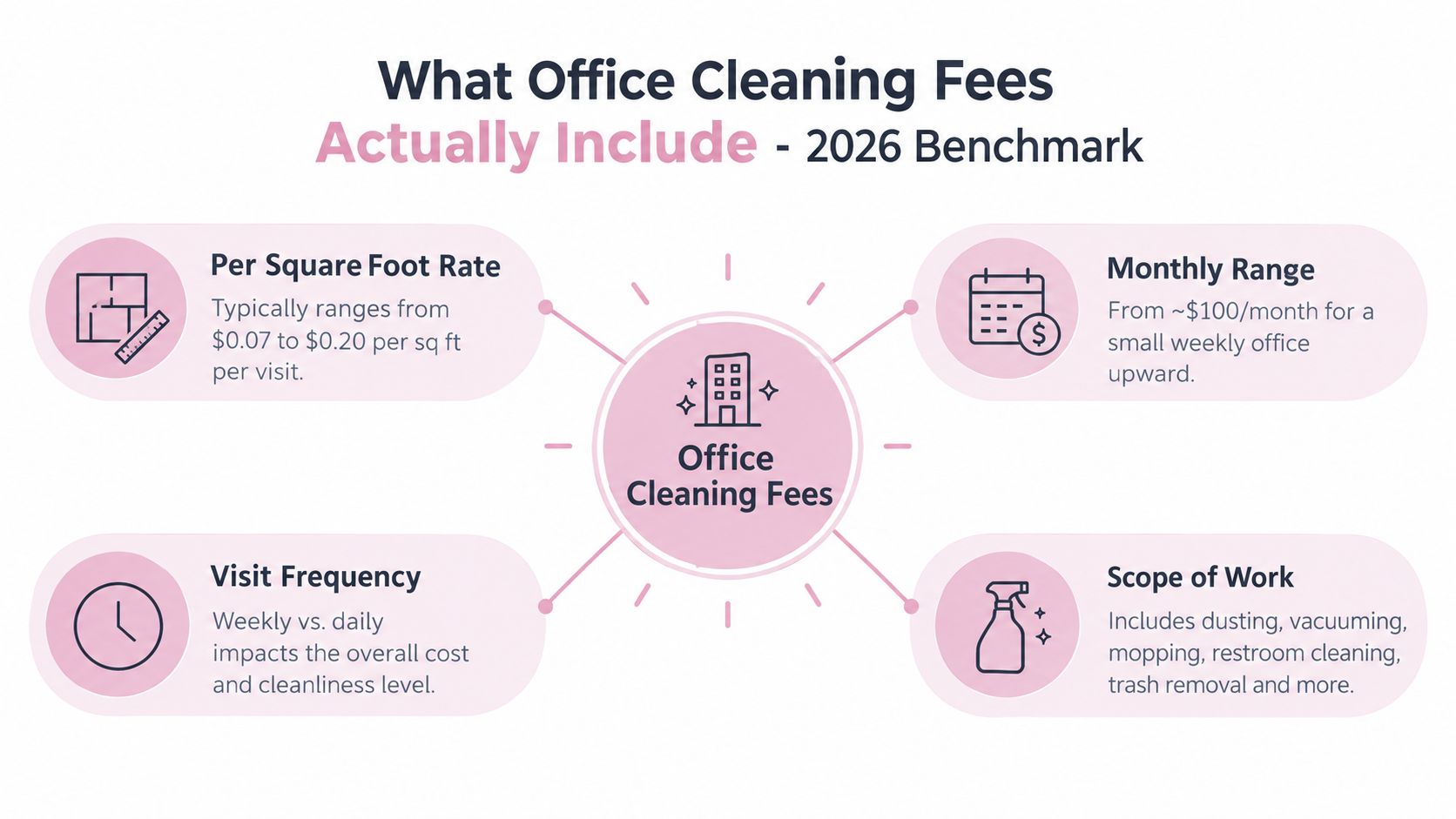
The most useful 2026 benchmark is $0.07 to $0.20 per square foot per visit, based on current commercial cleaning pricing guidance from Thumbtack's commercial cleaning cost guide. Monthly totals can start around $100 for a small office serviced weekly and reach several thousand dollars for a large contract with cleaning on multiple nights each week.
A quoted fee pays for more than someone passing a vacuum through the workspace. It covers labor, travel and mobilization, equipment, cleaning products, supervision, insurance, administrative overhead, and the specific tasks listed in the scope. If the scope is vague, the price may look attractive because important work has been left undefined.
The four inputs behind the number
Start with square footage. More space generally means more vacuuming, mopping, dusting, waste removal, and travel time inside the building. Size matters, but it doesn't tell the whole story.
Next, identify service frequency. A weekly visit, a three-night schedule, and nightly service create different monthly fees even when the building never changes. Frequency also affects how much soil and waste accumulates between visits.
Then count the restrooms. Restrooms require fixtures, partitions, floors, dispensers, mirrors, and replenishment work. Two offices with equal floor area can have very different restroom labor.
Finally, define the finish level. Basic maintenance might cover floors, trash, restrooms, and accessible surfaces. A higher-finish office may require detailed dusting, interior glass, touchpoint work, careful floor care, and presentation standards associated with Class A space.
Consider a 2,500-square-foot professional suite cleaned three nights per week. A provider will assess the suite's size, count its restrooms, review the floor and glass, and determine whether the requested finish is routine maintenance or detail-oriented presentation cleaning. The monthly figure then reflects three recurring visits each week, not just the area on the floor plan.
Practical rule: If a quote only shows square footage and a monthly total, ask what labor and tasks sit underneath it before comparing the price.
For a clearer view of what a recurring program can include, review the office cleaning services offered by Maid in America. The important question isn't whether the number looks low. It's whether the written scope matches the way your staff and visitors use the building.
How the Per-Square-Foot Pricing Model Works
Most recurring janitorial quotes begin with a simple equation:
Square footage × price per square foot = price per visit.
A practical example is a 5,000-square-foot office billed at $0.15 per square foot, which produces $750 per visit. Those figures come from the worked pricing model in the brief, while current market references place general office cleaning in a broader range of $0.08 to $0.18 per square foot per visit in 2025 and 2026 guidance, as outlined by Xiri's commercial cleaning pricing reference.
The schedule changes the monthly result. At three visits per week, the example produces $9,750 over a 52-week year when calculated as visit price multiplied by the annual schedule. Dividing that annual amount across a 13-period cleaning cycle produces approximately $2,250 per month. The arithmetic looks inconsistent until you identify the billing convention. A provider may price by actual visits, average the annual service across monthly payments, or use a defined recurring billing period. Ask which method appears in the contract.
What the rate is paying for
The per-square-foot rate normally contains three concealed components:
- Direct labor wage, the cleaner's paid time spent performing the work.
- Labor burden, which can include payroll taxes, insurance, supervision, training, travel time, and management.
- Consumables and overhead, including chemicals, liners, equipment, maintenance, scheduling, administration, and business operating costs.
Labor is the dominant cost driver in commercial cleaning. Current pricing references place janitorial labor around 50% to 65% of revenue, which is why a change in staffing time can move a quote more than a small adjustment to chemical or supply costs, according to CleanQuote's 2026 office cleaning cost analysis.
Price per sq ftWeekly service3x per week5x per week$0.07$350 per visit$1,050 per week$1,750 per week$0.15$750 per visit$2,250 per week$3,750 per week$0.20$1,000 per visit$3,000 per week$5,000 per week
These table figures show visit-frequency multiplication for a 5,000-square-foot office. They aren't monthly totals, because the number of calendar weeks and the vendor's billing method still need to be applied.
Larger facilities often receive a lower per-square-foot rate because the fixed cost of sending a crew, equipment, and supplies gets distributed across more space. That discount has limits. Restroom count, floor finish care, long travel paths, and high-detail areas can erase the efficiency gained from scale.
Don't spend your negotiation energy arguing over the rate alone. The meaningful savings usually come from changing frequency, scope, access conditions, or finish expectations while keeping the written service standard intact.
Hourly Rates Versus Flat Quotes
Hourly billing and flat-fee pricing solve different problems. Hourly work gives you flexibility when the scope is uncertain. A flat recurring quote gives you budget predictability when the building and tasks stay consistent.
Current commercial cleaning guidance commonly places hourly rates between $30 and $75 per cleaner hour, while some office-cleaning comparisons use a narrower $25 to $50 range for a cleaner's time. Nilfisk's commercial cleaning rate guidance explains why labor time, scope control, and route efficiency matter when a provider builds either model.
When hourly billing fits
Hourly pricing makes sense for:
- Small offices, where the routine is short and the scope may change from visit to visit.
- Post-construction cleanups, where dust, residue, and access conditions aren't predictable.
- One-time deep cleans, when the buyer needs extra detail but doesn't yet know the exact labor requirement.
- Correction work, when a building needs a defined block of additional labor.
The buyer's trap is the meter. An hourly customer may request every possible task, then watch the crew spend time on low-priority details while essential areas compete for the same labor budget. A written task list and a maximum authorized labor time prevent that problem.
When a flat quote fits
A flat per-square-foot quote works better for predictable recurring service. You know what the monthly budget should be, and the provider accepts the efficiency risk. If the crew becomes faster without reducing quality, the buyer doesn't pay for every saved minute.
The trap runs in the opposite direction. A vendor can staff the job too tightly, then technically complete a narrow scope while leaving the building below the standard the buyer expected. The protection is a detailed scope that identifies rooms, tasks, frequencies, exclusions, and quality checks.
Use hourly pricing for variable, project-based work. Use flat per-square-foot pricing for stable ongoing contracts, but only when the service schedule and scope are written clearly enough to audit.
What Makes One Office Quote Higher Than Another
Square footage is the starting point, not the final explanation. Two offices with the same area can produce materially different bids when one has more restrooms, more glass, harder floor-care requirements, or access restrictions.
A baseline 5,000-square-foot office at $0.13 per square foot produces a lower starting calculation than the same office priced at $0.18 per square foot after added complexity. The example below uses the specified facility features to show how a quote can move. It isn't a universal market rate, and each added item must be confirmed during a walkthrough.
Restrooms and presentation standards
Restrooms are labor-heavy rooms. The crew cleans fixtures, partitions, floors, mirrors, dispensers, and touchpoints, then may restock agreed consumables. Four restrooms create a different route and inspection burden than a suite with one compact restroom.
Finish level matters just as much. A basic office may need dependable vacuuming, mopping, waste removal, and restroom cleaning. A high-finish environment can require careful dusting, polished surfaces, interior glass, detailed edges, and floor work that leaves the space presentation-ready.
Surfaces, floors, and access
Interior glass and partitions add handwork that square footage doesn't capture. In the example, 1,200 square feet of interior glass adds surface area and detail time even though it doesn't change the office's floor plan.
Floor type also changes the labor model. Carpet tile, LVT, VCT, and polished concrete don't receive identical care. VCT may require stripping and finish work, while polished concrete demands a different maintenance method. Freight elevators, security clearances, loading restrictions, and after-hours access can add unproductive time before the crew reaches the first task.
FeatureBaselineWith featureAdded monthly costRestroomsBasic restroom count documentedFour restroomsQuote increases after added fixture and floor labor is measuredInterior glassRoutine surfaces only1,200 square feet of interior glassQuote increases for additional hand-cleaning timeFloor careRoutine floor maintenanceVCT stripping includedQuote increases for periodic specialty labor and equipmentFinish levelStandard office maintenanceHigher-detail presentation standardQuote increases when inspection and touchpoint expectations expand
The specified before-and-after example moves from $0.13 per square foot to roughly $0.18 per square foot once the four restrooms, interior glass, and VCT stripping are added. The lesson is practical: point to each complexity item on your own bid and ask whether it is included, excluded, or priced as an occasional service.
A low quote may not be wrong. It may leave one of those items under-scoped.
Why the Cheapest Quote Can Cost More Over Time
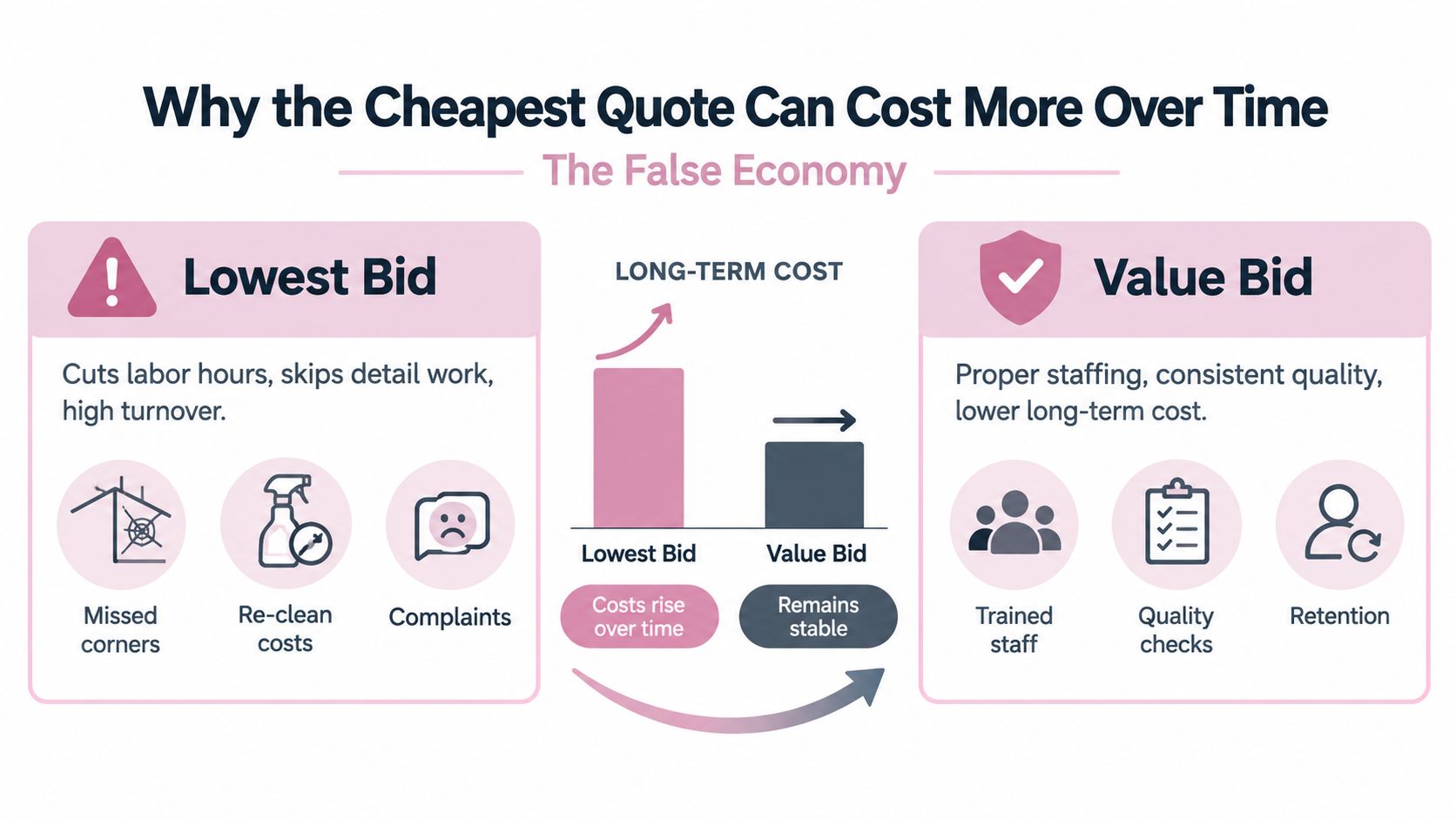
Choosing the lowest number from three bids feels responsible, but price alone doesn't tell you how much labor the provider has budgeted. Commercial cleaning labor commonly accounts for 50% to 65% of revenue, according to Stealth Agents' janitorial staffing cost research. A provider that prices far below the market has limited places to recover the difference.
Where the shortcut appears
The first failure is often reduced frequency. The proposal starts with a promised schedule, then the provider sends fewer visits once the initial period ends. Dirt and waste accumulate, and the buyer pays for supplemental work or spends management time chasing missed service.
The second is omitted detail work. If the scope doesn't name restrooms, touchpoints, interior glass, or specific floor tasks, the crew can skip them while still claiming it completed the contract. Vague language protects the bidder, not the buyer.
The third is thin staffing and turnover. A crew with too little time rushes through the route. New cleaners repeat the learning curve, results vary, and the office manager becomes the quality-control system.
The false economy calculation
The low bid may create costs that don't appear on the invoice:
- Complaint handling: Managers spend time documenting missed work and arranging corrections.
- Re-cleaning: Staff or a supplemental crew handles areas the original visit didn't finish.
- Presentation loss: Restrooms, kitchens, and entryways affect how employees and visitors judge the workplace.
- Contract disruption: The buyer rebids sooner because the original scope never matched operational needs.
Don't compare a cheap total to a higher total until you compare the labor assumptions behind both. Ask how many cleaners are assigned, how visits are verified, what happens after a missed task, and whether the quoted frequency is guaranteed.
A low price is only a bargain when it buys the same scope, schedule, and finish standard as the higher bid.
The right target isn't the highest fee. It's a value bid with enough labor to complete the written work consistently.
Smart Ways to Lower Your Office Cleaning Fees
Lowering office cleaning fees works best when you reshape the work before asking for a discount. A provider can price a clean, efficient scope more accurately than a vague request for “the lowest possible rate.”
Start with scope
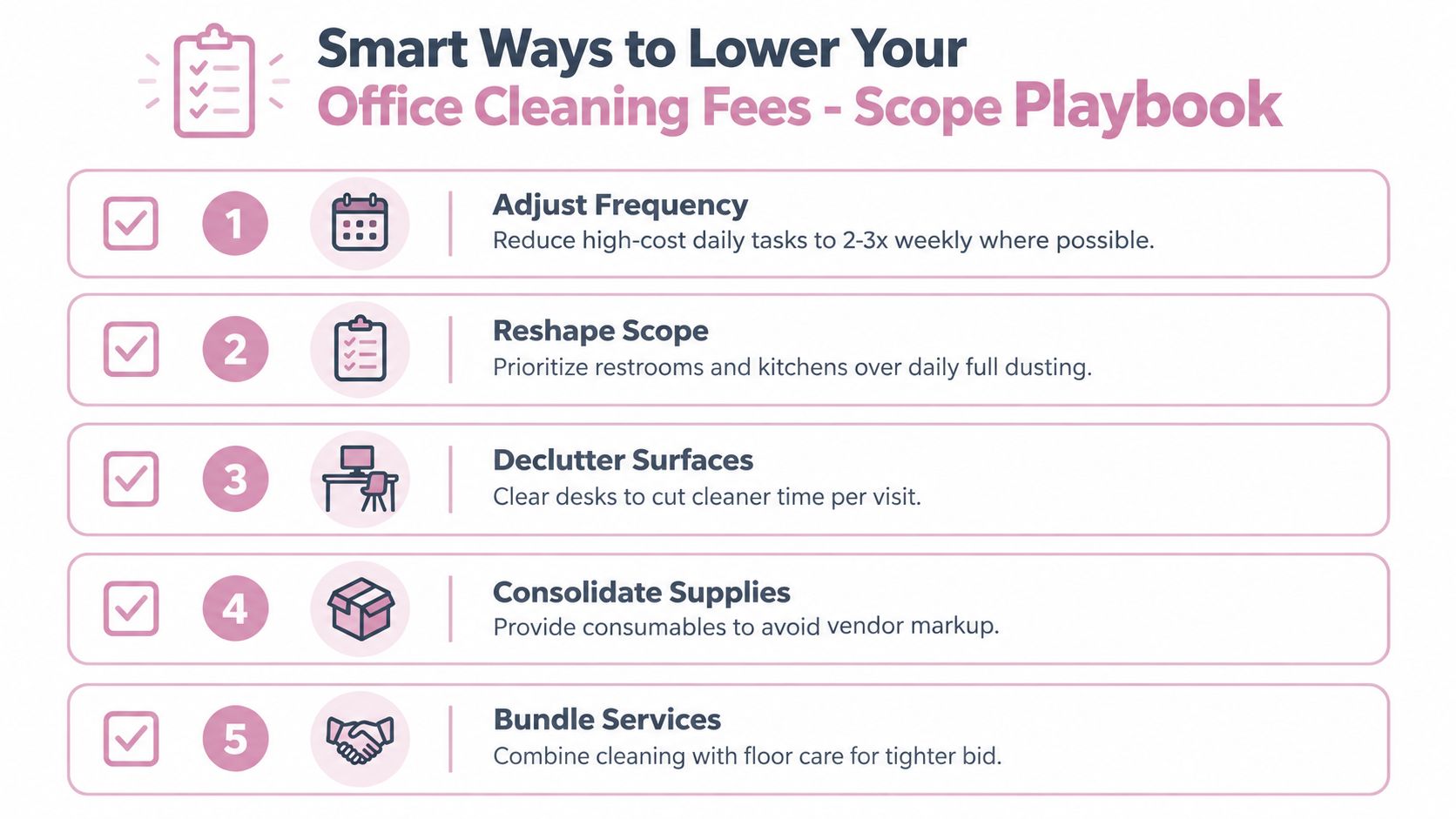
- Consolidate waste points. Move trash and recycling into practical collection locations instead of requiring a cleaner to service scattered desk bins. Fewer stops reduce route time without eliminating waste removal.
- Prioritize high-touch areas. Replace nightly desk sanitizing with a defined high-touch program at a lower frequency if your workplace can support that change. Keep restrooms, kitchens, door hardware, and shared touchpoints prominent in the scope.
- Move interior glass out of routine service. Request a quarterly deep clean for interior glass instead of including it in every recurring visit. This preserves the result while removing a frequent hand-detail task from the base quote.
Adjust the schedule
Frequency is the strongest lever most buyers control. Moving from five nights to three can lower the recurring fee when the reduced schedule matches actual occupancy and soil levels. The supplied pricing guidance describes potential reductions of 10% to 20% for schedule changes, but the exact impact depends on which tasks disappear and how the provider rebuilds the route.
Clean on nights when the office is already closed. A crew that can enter, work without interruptions, and secure the building efficiently has less access friction to price into the job.
Use contract terms intelligently
A 12-month commitment may support a rate hold when the provider can plan staffing and route capacity. Put the rate, service nights, review process, and termination terms in writing.
Bundling multiple locations can also improve operational efficiency when one provider can coordinate routes and supplies. Provide a clean walkthrough packet with floor plans, restroom counts, access instructions, floor types, glass areas, and priority rooms. Better information reduces the uncertainty that providers often build into quotes.
Before signing, compare the cleaning service packages from Maid in America with your actual priorities. Treat every proposed saving as a scope decision, not a free reduction. If you remove interior glass from routine visits, document the replacement cycle. If you reduce frequency, specify which tasks remain on every visit.
Dollar savings should be calculated from your own quote. A schedule change may produce a meaningful reduction, while supplying consumables or clearing desks may only tighten labor time. The best move is the one that lowers the provider's workload without removing the cleaning your building needs.
Reading and Comparing Cleaning Bids Like a Pro
A cleaning bid becomes useful when you can trace the total back to the building. Start with the four drivers: size, frequency, restroom count, and finish level. Each should appear in the proposal as a defined input, not as an assumption hidden inside a lump sum.
Use this audit sequence:
- Verify the area: Confirm the quoted square footage and identify whether storage rooms, shared corridors, kitchens, and reception areas are included.
- Confirm service nights: Check the exact weekly schedule and whether holidays, closures, or missed visits change the monthly fee.
- Count restrooms: Make sure the proposal identifies the rooms and the tasks included in each one.
- Define finish expectations: Ask whether the service is basic maintenance, detailed presentation cleaning, or a higher-standard floor and surface program.
- List exclusions: Look specifically for floors, interior glass, consumables, high-touch disinfection, and periodic work.
- Normalize the price: Convert each recurring quote to a comparable per-square-foot figure using the same service frequency.
- Check protection: Verify insurance, bonding, references, access procedures, and the process for correcting missed work.
Red flags that deserve a response
A proposal needs revision when it uses vague scope language, omits visit frequency, gives no restroom count, hides labor assumptions in a lump sum, or fails to explain supply pass-through charges. “Clean office” isn't an auditable task. “Service restrooms three nights weekly, including fixtures, floors, mirrors, dispensers, and agreed replenishment” is.
Phone quotes are convenient but unreliable for complex offices. Without seeing floor layouts, finishes, access points, glass, and restrooms, a contractor must price uncertainty. That number often rises on the first day when the crew discovers the actual workload.
Request a walkthrough-based estimate. Give every bidder the same information, ask each one to identify exclusions, and compare the resulting scopes line by line. The questions to ask before hiring a cleaning professional can help you test whether the provider understands your priorities before you commit.
Maid in America provides one-time and recurring office and community amenity cleaning, with supplies brought to each appointment and service structured around the space and your priorities. Visit Maid in America to discuss a walkthrough-based cleaning plan for your workplace and request a quote tied to the scope you actually need.



Maid in America provides reliable, personalized cleaning with natural products for homes, offices, and communities across West Georgia. Licensed, bonded, and insured, we’re locally and privately owned.
Get in touch with us today!
info@maidinamericaga.com