Move in Cleaning Service: What to Expect and Checklist

You've got the keys, the rooms are bare, and the truck has either just left or hasn't shown up yet. In Kennesaw and Acworth, that gap is often a single afternoon. Pollen sits on the sills, red clay marks the thresholds, and the closets still hold the last household's dust.
That empty stretch is when a move in cleaning service earns its place. Cabinets, baseboards, closet floors, and the tops of door frames are open. Once beds, sofas, and bins land, those same spots disappear for months.
Renters want a clean start on a new lease. Buyers want the house ready before furniture. Landlords need a unit presentable between tenants. None of those jobs is only about shine. You also need a clear line between soil a cleaner can remove and moisture a cleaner should only write down.
I would schedule the clean while the home is still empty. Humid Georgia summers make a closed, freshly wiped room feel damp fast, and you want time to air it before bedding, pet bowls, or kids' clothes go in.
Table of Contents
What a Move-In Clean Covers, Room by Room
An empty or mostly empty home changes the job. The cleaner can reach shelves, closet floors, and the edges furniture usually hides. Match the table to your own rooms in Woodstock, Dallas, or Hiram before you book, and treat the right-hand column as optional, not automatic.
| Area | Typical tasks included | Common add-ons |
|---|---|---|
| Kitchen | Counters, sink, faucet, appliance exteriors, cabinet fronts, floors | Inside oven or fridge, cabinet interiors |
| Bathrooms | Toilet, tub and shower, sink and vanity, mirrors, floors | Grout, cabinet interiors |
| Floors and baseboards | Sweep, vacuum, damp-mop hard floors, wipe baseboards | Full baseboard detail, upholstery vacuuming |
| Closets and doors | Shelves, rods, interior doors, frames and handles | Interior closet detail |
| Windows and glass | Mirrors, sills, accessible glass | Interior windows |
| High-touch points | Light switches, door handles, stair rails, faucets | None; included in every room |
Start with the standard column
Read the middle column first. Those are the tasks a move-in clean is built to finish when the home is vacant. You should see kitchen work surfaces, bathroom fixtures, a sweep-vacuum-mop pass, closet shelves and rods, accessible glass, and the switches and handles people grab during a handover.
The right column is where the home's condition changes the appointment. A used oven with baked-on film is not the same job as wiping the door. Grout that has darkened over years needs a separate pass and more time on the surface than a routine bathroom wipe. Cabinet interiors matter if you will store plates and pantry goods there on day one.
Add only what the home actually needs
Skip add-ons that don't match the space. A new build with clean grout doesn't need a grout treatment, though floor edges and closet corners may still hold fine dust. A rental with a tired fridge usually does need the interior add-on. Upholstery vacuuming belongs on the list only if a sofa or chairs are staying behind.
Practical rule: Clean the places where food will be stored and hands will land before you spend time on surfaces that only look finished from the doorway.
If you're setting up the kitchen and closets from scratch, the moving advice from Container Self Store is a practical list of what to buy for a new home. Measure shelves after the wipe-down, then shop, so bins aren't sitting on a counter the cleaner still needs.
High-touch points are not an add-on. Light switches, door handles, stair rails, and faucets are part of every room, because movers, agents, and the next occupants all touch them during the handoff.
Who Books Move-In Cleaning and When
A renter in Acworth hands back the keys on Friday. The unit is empty, and the landlord's walkthrough is scheduled for Saturday. Booking the clean between those appointments gives the cleaner access to the oven, tub, and closet floors before anyone brings in furniture.
Homebuyers often choose the same window, before the moving truck arrives. Agents may book a clean before listing photos, while families relocating within Cobb County may schedule it the day before move-in. Retirees moving closer to family and HOA boards preparing a clubhouse between events also use an empty-home appointment. The same timing works for handovers in Cartersville and Powder Springs.

Most of the turnover stays close to home
U.S. Census Bureau data shows that a meaningful share of Americans move each year, with most moves taking place within the same state. That steady movement creates handovers throughout West Cobb, Cherokee, Paulding, Douglas, and Bartow counties, not only on long-distance routes.
Landlords and property managers plan around recurring lease-end dates. Homeowners who have stayed in one place for years may book a clean once, while rental properties cycle through tenants repeatedly. For either kind of move, an empty home also makes it easier to spot dust buildup and record visible moisture concerns before boxes cover walls or floors.
The timing rule you can copy
Schedule the clean after the final move-out and before the next occupant arrives. The house should be empty and clear of boxes, so the cleaner can reach floors and closets. If possible, allow time to air out the rooms and make a written note of any damp spots or water marks noticed during the handover.
Use a week-by-week packing timeline to finish packing before the appointment. Movers, realtors, and property managers can then plan around the same open slot, rather than working around boxes or newly placed furniture.
What Move-In Cleaning Does Not Fix
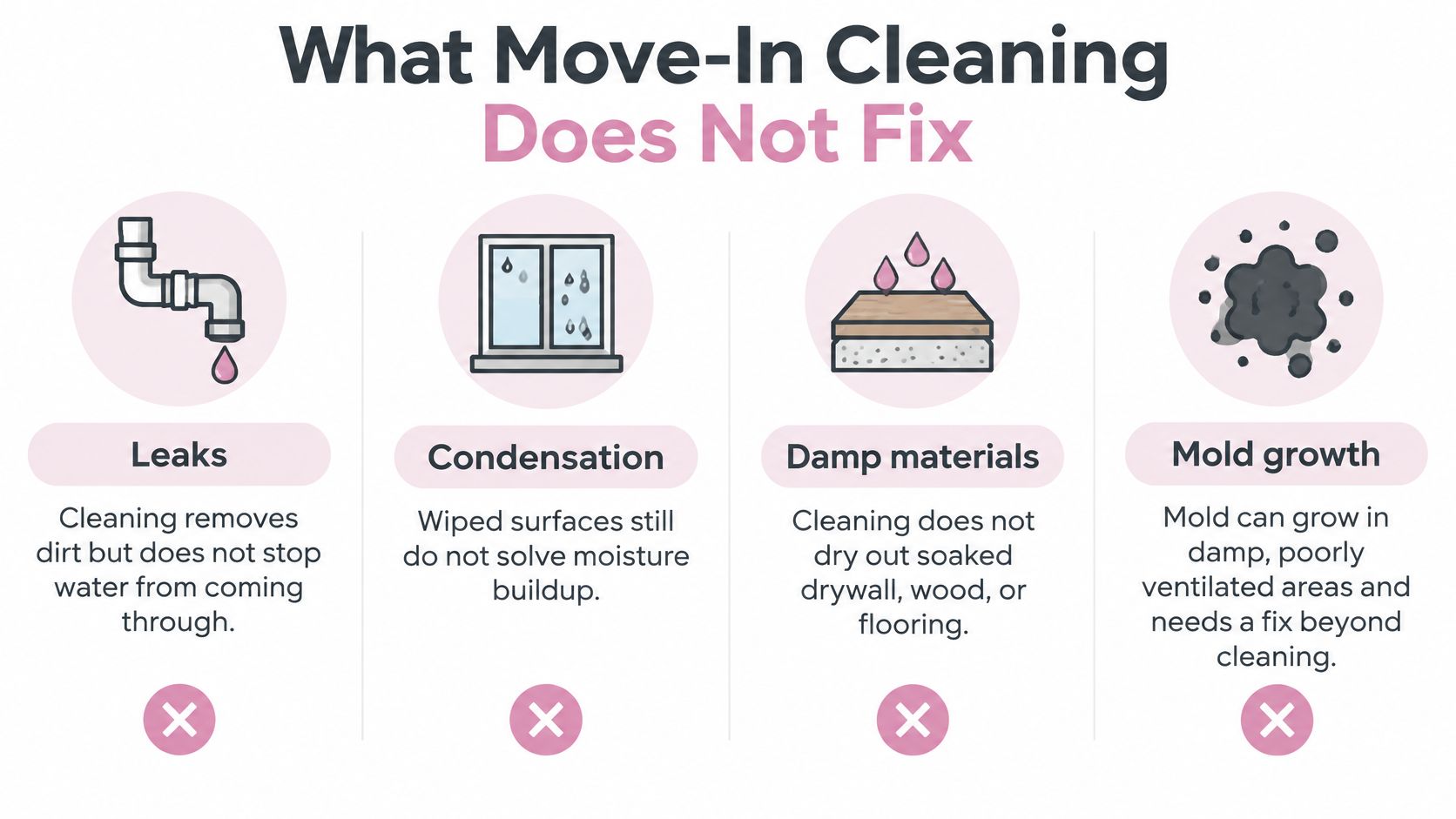
A polished counter can sit over a soft cabinet base. Cleaning lifts soil and dust. It doesn't stop a leak, dry soaked drywall, or end condensation on a cold window.
UK government guidance on indoor airborne allergens notes that mold commonly develops in damp, poorly ventilated areas, can release airborne spores, and needs moisture control and ventilation, not cleaning alone, to keep it from coming back. Public-health instructions also call for protective equipment and containment when mold is cleaned. That puts larger mold work in a different category from a routine move-in visit. A responsible cleaner should decline that part of the job or hand it to someone licensed for it.
What to record before the walkthrough
- Photograph the evidence: Stains, soft spots, and water marks on ceilings, walls, and cabinet bases.
- Note the damp clues: Musty smells, condensation on windows, and corners that stay wet.
- Mark visible mold: Write down where it is and how large the patch looks.
- Ask for a written handoff: A short list of what was cleaned and what was observed.
- Ask about a second pass: Whether the cleaner will re-clean after the room has aired.
Call a licensed remediation or building professional when mold covers a larger area, a leak is still active, or porous material such as drywall, carpet pad, or wood is contaminated. Wiping the face of that material doesn't dry it. In a humid Marietta summer, a shiny baseboard can hide a wall that is still wet behind the paint.
A cleaner should be able to answer two questions without hedging. What will you remove, and what will you document?
If you want a plain split between a maintenance visit and a heavier reset, this comparison of deep cleaning versus regular cleaning keeps those scopes separate from moisture repair.
How a Move-In Clean Runs From Top to Bottom
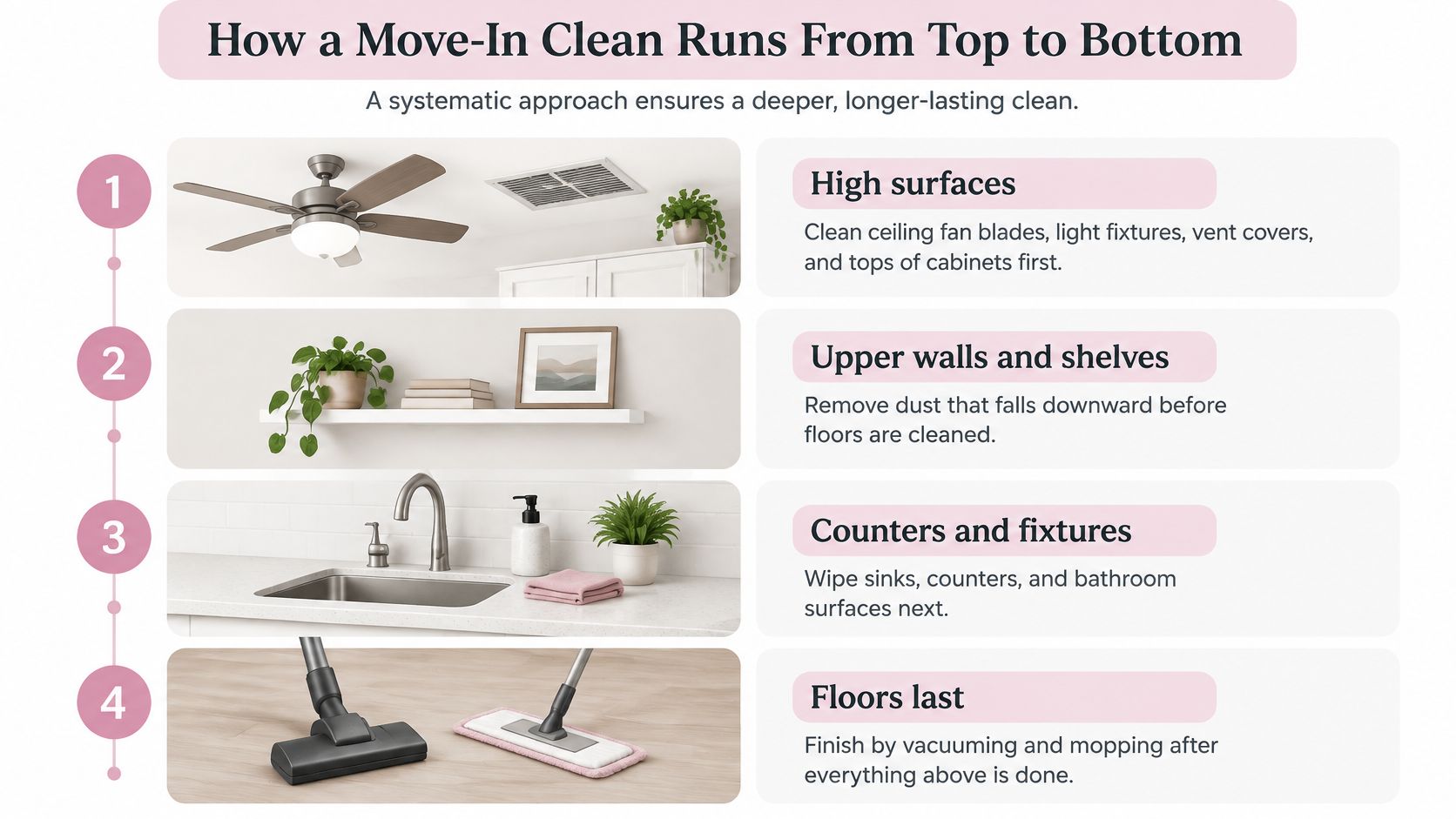
Dust falls. If you mop first, the fan blades you clean next put a film back on the floor. Order is the whole method, especially after a remodel when fine grit hides where you don't look first.
The U.S. Environmental Protection Agency explains that settled indoor particulate matter can become airborne through walking, vacuuming, and cleaning. Damp cloths reduce that resuspension, and HEPA-filtered vacuums help keep collected dust from blowing back into the room. After a renovation, fine construction dust hides in closets, cabinet interiors, and floor edges, so this order matters even more.
The sequence and the reason for it
High surfaces first. Ceiling fan blades, light fixtures, vent covers, and the tops of cabinets and shelves shed dust downward. Dry-dusting these and walking away is the common slip, because loose particles stay in the air and settle again.
Damp-wipe the next layer. Cabinet fronts, trim, window sills, and fixtures should meet a damp microfiber cloth, not a dry duster. Dry dusting before wiping just moves the same grit onto a surface you will have to do again.
Kitchens and bathrooms before any later treatment. Soil, soap film, and grease come off with a suitable cleaner first. Spraying over a greasy backsplash doesn't make the room finished.
High-touch points through the house. Switches, handles, and faucets get a deliberate wipe after the dusty work above them, so you aren't recoating them with fallout from the ceiling.
Floors and upholstery last. Vacuum with a HEPA filter, including carpet edges and any upholstery that is staying, then damp-mop hard floors. Mopping before the vacuum finishes smears grit into the grain. The EPA also advises that people with asthma or allergies leave the area during vacuuming, because dust can be stirred into the breathing zone, and that those homes need more frequent vacuuming once you're living there.
Ventilate before the walkthrough. Open windows where the weather allows and run bath and kitchen exhaust fans so the room isn't closed up on stirred dust.
A heavier reset of this kind lines up with a top-to-bottom deluxe cleaning when the home needs more than a maintenance pass, including after construction dust.
At the walkthrough, sills should be free of dust, floor edges should be clean, and fixtures should wipe without streaks. If a sill still shows a line of pollen, the high work was skipped or done after the floors.
Disinfecting, Product Choice and Ventilation
A vacant home does not always need disinfection. Cleaning removes soil and some germs; disinfection is meant to kill germs that remain. The CDC explains the difference between cleaning and disinfecting, including why visible soil should come off first: grime can reduce a disinfectant's effectiveness. Follow the product label's contact time and keep the surface visibly wet for that long.
A contact-time order that holds up
- Lift the soil. Use a suitable cleaner to remove visible film from switches, handles, stair rails, and faucets.
- Rinse if the label directs you to. Residue from one product can interfere with another.
- Disinfect only where needed. Choose an EPA-registered product suitable for the surface, rather than applying disinfectant throughout the house.
- Allow the contact time. Keep the surface wet for the period printed on the label.
- Ventilate the room. Open windows and doors when conditions allow, or use a fan.
For ordinary household bleach containing 5% to 9% sodium hypochlorite, the CDC's bleach guidance gives a dilution of 5 tablespoons (one-third cup) per gallon of room-temperature water. If the manufacturer lists no contact time, keep the diluted solution visibly wet for at least one minute. Never mix bleach with other cleaners or disinfectants. Open windows and doors or use a fan while disinfecting.
Product choice is part of the handover
A strong smell does not show that a surface is clean. The EPA's indoor air quality report identifies cleaning supplies as a source of volatile organic compounds (VOCs) in indoor air. A scented room can still have residue on surfaces, so judge the cleaning by what remains on the cloth, not by fragrance.
Ask which products will be used and whether the home can be aired during and after cleaning. Maid in America uses natural, low-odor products. Those products can suit households seeking to limit strong odors, but ventilation still matters.
Open windows and doors when weather allows, and run exhaust fans. Let the home air before bringing in bedding or pet bowls. For a clear explanation of the difference between cleaning, sanitizing, and disinfecting, see how each step serves a different purpose.
Book Your Move-In Clean With Maid in America
Maid in America is a locally and privately owned house cleaning company in Kennesaw. The same crews cover Acworth, Woodstock, Cartersville, Marietta, and nearby communities for move-in and move-out cleaning.
The service is licensed, bonded, and insured, with a 4.9-star Google rating. One dedicated cleaner is usually sent to each home, so you often get to know that cleaner by name instead of meeting a different crew every visit.
Before you ask for an estimate, gather a short list:
- The address and whether the home is empty.
- The move date, so the clean can land the day after move-out or the day before move-in.
- Add-ons you need, such as inside the oven, interior windows, or grout.
- Household sensitivities, including children, pets, asthma, or allergies.
Add sparkle and shine with your health in mind. Request your free estimate online or call 770-427-4448.
Maid in America handles move-in and move-out cleaning for empty homes across Kennesaw, Acworth, and nearby West Georgia communities, with natural, low-odor products and a written sense of what was cleaned. If you're between tenants, waiting on a truck, or walking a house before the furniture arrives, request a free estimate from Maid in America online or call 770-427-4448 and book the clean while the rooms are still open.



Maid in America provides reliable, personalized cleaning with natural products for homes, offices, and communities across West Georgia. Licensed, bonded, and insured, we’re locally and privately owned.
Get in touch with us today!
info@maidinamericaga.com