Office Cleaning Checklist: 8 Room-by-Room Tasks for 2026
Monday morning shows up fast. Red clay gets tracked into the lobby after a rainy weekend, the break room sink still holds last Friday's dishes, and somebody left fingerprints on the conference table after the client call. In Kennesaw, Acworth, Marietta, and Woodstock, that kind of start is common enough that a written office cleaning checklist saves real time and real arguments. It turns a messy morning into a routine with assigned tasks, clear cadence, and fewer surprises.
This guide keeps it practical. Each room gets a rhythm, so managers can sort daily, weekly, and monthly work without building a schedule from scratch. That matters in Georgia, where spring pollen, humid summers, holiday hosting, and busy commuter traffic all change how fast a space gets dirty. For teams who'd rather hand it off, you can browse vetted office cleaners near you, then compare that approach with a local, low-odor service like Maid in America in Kennesaw and Acworth.
Table of Contents
- 1. Desk and Workspace Surface Cleaning
- 2. Restroom and Bathroom Sanitization
- 3. Floor Vacuuming and Mopping
- 4. Kitchen and Break Room Cleaning
- 5. Trash Removal and Recycling Management
- 6. Conference Room and Meeting Space Sanitization
- 7. Window and Glass Cleaning
- 8. Lobby and Entryway Presentation
- 8-Area Office Cleaning Comparison
- Make the Checklist Work Before Next Monday
1. Desk and Workspace Surface Cleaning
Shared desks look harmless until you run your hand across one at 4 p.m. and feel the dust. Monitors collect fingerprints, keyboards trap crumbs, and work tables pick up coffee rings, paper fibers, and pollen that rides in on shoes and clothing. In open offices in Dallas or Powder Springs, I'd treat this as a weekly task at minimum, with more frequent wiping in high-traffic teams.
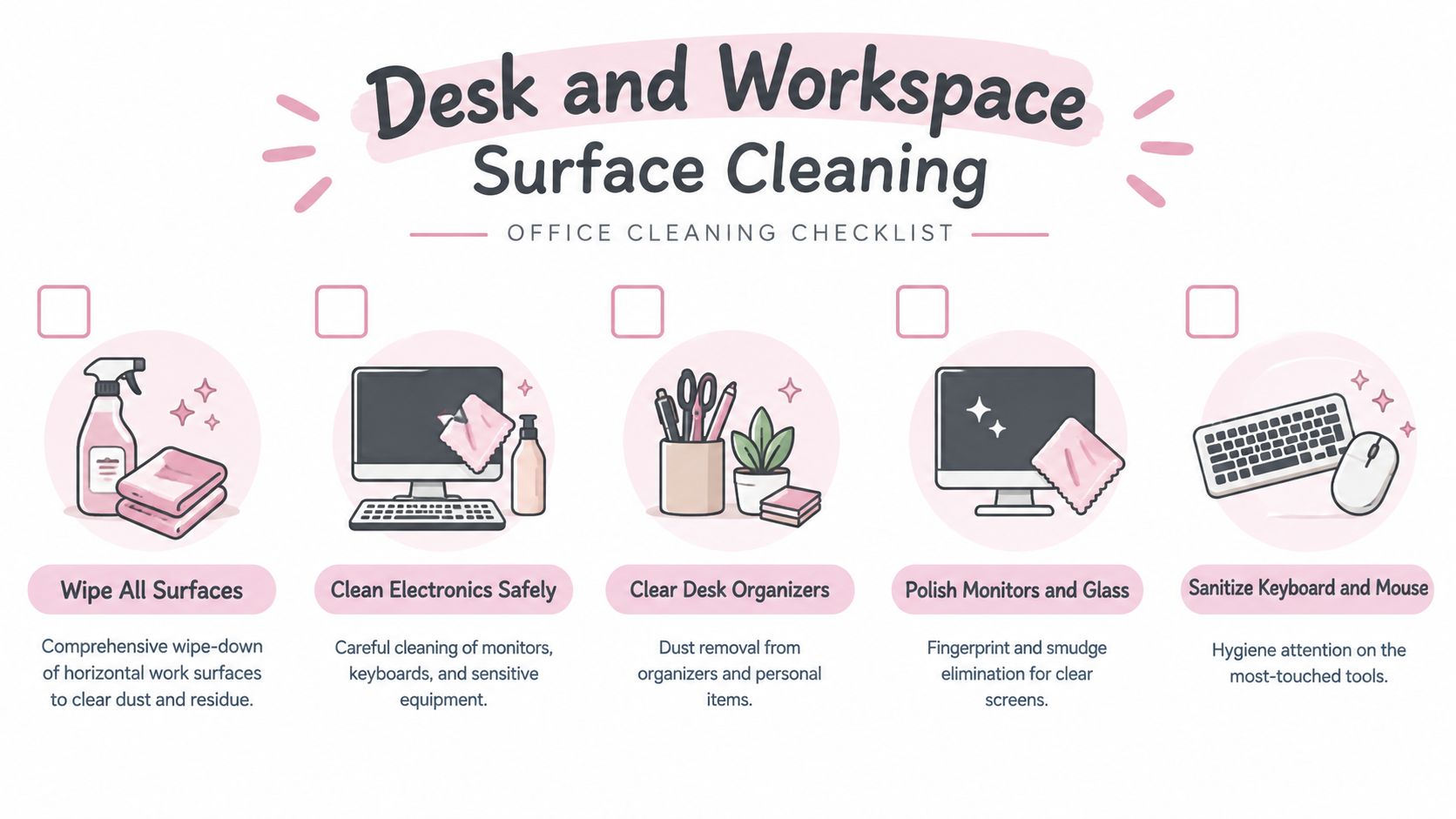
A clean desk area supports a more professional look, but the win is consistency. Use microfiber cloths so you're not streaking glass or scratching screens, and schedule the work after lunch or at day's end when surfaces are clear. If staff leave papers, chargers, and personal items spread everywhere, the cleaner can only work around the clutter.
Practical rule: tell employees to clear their desks the night before service. The cleaner can't do a proper wipe-down if the surface is covered in laptops, files, and coffee mugs.
For offices that want natural, low-odor products, the trade-off is simple. You still need a cleaner that works on electronics and doesn't leave residue, but you also don't want a sharp smell hanging over the work area. A small accounting firm in Marietta can usually keep a weekly desk reset. A medical or legal office in Acworth often benefits from more consistent attention because clients notice the condition of shared spaces right away.
Use a written schedule for who clears what. That keeps the cleaner focused on actual surface cleaning instead of a half-finished pick-up that slows the whole visit. If you're building the routine from scratch, the office cleaning schedule resource is a useful local reference for cadence planning.
2. Restroom and Bathroom Sanitization
Restrooms shape how people judge the whole building. If a sink is spotted, a dispenser is empty, or the floor feels sticky, employees assume the rest of the office is being managed the same way. In Kennesaw and Acworth, where offices often share space with clients, vendors, and staff all day, I'd make restroom checks daily and deeper sanitization a recurring part of the week.
The job needs more than a quick wipe. Toilets, sinks, mirrors, dispensers, door handles, and floors all need attention, and the high-touch points need to be recorded so nothing gets skipped. A restroom that looks neat can still be undercleaned, especially if nobody is checking handles, light switches, and fixtures on a real schedule.
High-use offices usually need a tighter cadence. A growing tech company in Kennesaw may want daily bathroom checks with biweekly deep sanitization, while a quieter professional office can sometimes use a lighter rotation if traffic stays low. The key is to match the frequency to actual use, not to guess.
Clean restrooms are one of the fastest ways to protect your reputation inside a building. People talk about them when they're neglected, and they notice when they're kept up.
Use the difference between cleaning, sanitizing, and disinfecting to your advantage. If the room only needs soil removed, a low-odor cleaner may be enough. If someone has been sick, or if the space sees heavy traffic, the task needs the right disinfecting step and the right product handling. This guide on the difference between cleaning, sanitizing, and disinfecting helps keep that distinction clear for office managers and staff.
For multi-stall restrooms in Marietta, stagger the checks so peak times don't turn into complaints. In shared buildings, the best restroom program is the one that runs smoothly in the background and never leaves employees wondering who was supposed to refill the soap.
3. Floor Vacuuming and Mopping
Floors tell the truth about the building. In Woodstock and Kennesaw, where people track in Georgia clay, pollen, and grit from parking lots, floors get dirty faster than most managers expect. Carpeted spaces need weekly vacuuming in high-traffic zones, and hard floors need mopping on a schedule that reflects how many shoes cross them.
Use the right method for the surface. Carpet needs vacuuming that reaches the edges and corners, not just the center lanes. Hard floors need a mop and solution that lifts grime without leaving a sticky film behind. If the finish feels tacky after cleaning, the wrong product or too much product got used.
A law office in Acworth may want biweekly deep mopping to keep client-facing spaces looking polished. A manufacturing or warehouse office in Cartersville often needs daily sweeping with weekly vacuuming and mopping because dust and debris don't wait politely for the calendar. That difference matters more than the label on the door.
Include mats at every practical entry. Walk-off mats cut down on what gets brought inside, especially in humid summers when dirt clings to shoes and stays visible longer. If the entrance gets ignored, the rest of the floor schedule starts behind.
Here's the trade-off. A frequent light pass keeps the space presentable, but a neglected floor needs heavier restorative work later. That means more labor, more disruption, and more chances for tracked-in residue to spread from the lobby into work areas. The right cadence is usually the cheaper and easier one over time.
For teams that want a deeper explanation of streaking and residue, the local resource on what causes sticky, streaky floors even after cleaning is a practical follow-up. It's a useful reminder that floors can look clean and still be wrong underfoot.
4. Kitchen and Break Room Cleaning
Break rooms get messy in a predictable way. Someone leaves a dish in the sink, crumbs collect around the microwave, and the refrigerator starts holding old food that nobody claims. In a Kennesaw startup with 15 or more employees, that usually means a weekly deep clean for the shared kitchen, plus quick daily resets so the room doesn't slide into a problem.
The order matters here. Wipe counters first, then clean appliance exteriors, then the sink, then the floor. If you clean around open food and sticky spills without clearing the surfaces, you just move the grime around. Use food-safe, low-odor products near prep areas so the room feels fresh instead of chemical-heavy.
For a professional services firm in Marietta, biweekly sanitization may be enough if staff are disciplined about cleanup. In Dallas, where a growing team may use the break room all day, I'd treat daily tidying as essential and schedule a deeper service every week. Refrigerator interiors and expired food removal belong in the deeper cycle, not the quick pass.
Good break-room cleaning depends on habits, not just products. If people rinse dishes and wipe spills as soon as they happen, the cleaner can focus on the work that actually takes time.
A good checklist should also cover cabinets, refrigerator exteriors, and floors. Those surfaces pick up fingerprints, crumbs, and drips fast, especially in humid weather when residue feels worse and odors linger longer. If the office also wants inside oven or fridge service, that fits better as an add-on during a monthly or quarterly deep clean than as a daily task.
Shared kitchens are where office culture shows up in the dirt. If the space is clean, people trust it. If it isn't, they start eating at their desks, which creates a different cleanup problem.
5. Trash Removal and Recycling Management
Trash is one of the easiest tasks to overlook and one of the fastest ways an office starts to smell off. Empty bins should be part of the regular loop, not something someone remembers only when a lid won't close. In Woodstock or Acworth, where busy workweeks can mean fuller bins by midweek, daily removal is usually the safest choice.
A strong trash routine does more than swap liners. It also means wiping down can exteriors, checking for spills at the bottom of bins, and keeping recycling organized so the area doesn't start looking like storage. If the office has multiple break areas or printer stations, each one needs its own attention instead of a single walk-through that misses the corners.
Use clear recycling rules. When paper, cans, and food waste get mixed together, the whole setup gets harder to manage and more unpleasant for everyone who uses it. In multi-tenant offices in Marietta, this also helps keep shared common areas from becoming the place where everyone dumps what they don't want to sort.
For odor control, the simplest fix is faster removal. If trash sits too long, even a decent liner won't mask it. Natural odor-control products can help in active areas, but they work best as support, not as a substitute for emptying the bin on time.
A professional office checklist should name who handles what. That may sound basic, but it keeps waste from becoming the forgotten task that makes the whole building feel behind. In busy offices, the cleaner who handles the trash often sets the tone for the rest of the visit.
6. Conference Room and Meeting Space Sanitization
Conference rooms need to look ready even when no one's inside. Tables collect fingerprints, chairs get pushed off-center, remote controls get handled by everyone, and light switches show every touch. In Kennesaw law and accounting offices, I'd treat these spaces as daily quick-clean areas, with weekly sanitization for shared equipment and a deeper reset as needed.
Start with the items people touch most. Tables, chair arms, phones, whiteboards, door handles, and light switches all need attention. Videoconference equipment and remotes are easy to forget, but they get handled constantly during meetings, which makes them part of the regular checklist rather than an afterthought.
Use microfiber on glass tables and whiteboards so you don't leave streaks. Keep the products low-odor if the room gets used for presentations, because nobody wants a sharp chemical smell in the middle of a client meeting. A corporate office in Marietta often benefits from an early morning clean before the first meeting starts, while a professional services firm in Acworth may prefer a biweekly detailed pass if usage is lighter.
Shared rooms also need a monthly look at baseboards and under-table areas. That's where dust builds up once the visible surfaces are done. If you skip those spots, the room still looks functional, but it won't feel fully cared for.
Practical rule: clean conference rooms before business hours whenever possible. The room should be ready before the first person opens the door, not after the morning schedule is already moving.
The trade-off is speed versus thoroughness. A quick reset keeps the room usable, but a deeper program protects the impression clients get when they walk in. In meeting spaces, that impression matters every single day.
7. Window and Glass Cleaning
Glass shows everything. Pollen, fingerprints, moisture spots, and streaks all jump out on interior windows and doors, especially in bright Georgia daylight. In Marietta and Kennesaw, where spring pollen can coat surfaces quickly, a monthly or quarterly glass schedule keeps the office looking sharper without overdoing the service.
Interior windows, glass partitions, and reflective surfaces should be part of the recurring plan, not a one-off fix when someone complains. If the office depends on natural light, dirty glass dulls the space and makes everything else look less finished. A customer-facing office in Woodstock usually needs front-facing glass attention more often than a back-office suite that doesn't see visitors.
Microfiber cloths and the right cleaner matter here because streaks are the enemy. Clean on cloudy days when possible, since harsh sun dries solution too fast and leaves marks. Window frames and sills should be dusted at the same time, or you'll clean the pane and leave the edge dirty.
Use this as a paid add-on when the basic recurring service doesn't include it. Interior window work is easy to promise and easy to skip if it isn't scheduled. For a financial services office in Marietta, that often means folding it into a quarterly deep clean so the result stays consistent.
If the building has hard water marks or older glass, address them before they become a permanent eyesore. That's especially true in offices that host clients often, because glass is one of the first things people notice on arrival. Clean glass doesn't just look better, it makes the whole lobby feel more intentional.
8. Lobby and Entryway Presentation
A visitor forms an opinion at the front door. Red clay on shoes, fingerprints on glass, and worn mats all read as neglect. In Acworth and Kennesaw, where traffic is steady and weather shifts what gets tracked in, the entry needs daily touch-ups and a weekly deep clean.
Focus on the door glass, entry hardware, seating, and floor mats. The front door is one of the highest-touch spots in the building, so smudges show fast. If the mat is full of grit, it stops catching dirt and starts moving it deeper into the office.
A professional services firm in Acworth may want end-of-day lobby refreshes so the space is ready before morning traffic. A corporate office in Kennesaw might need entrance mats and floor mopping twice weekly if people are moving in and out all day. In Marietta, a customer-facing office often needs a quick reset after business hours so the first impression stays clean.
Exterior glass and entry presentation shape that judgment before a word is spoken, which is why some offices pair routine service with a Cultivate House Detailing commercial service (https://cultivatehd.com/commercial-window-cleaning-creating-a-lasting-first-impression/) for periodic window and facade work. During rainy stretches, use a two-stage walk-off, a scraper mat outside the door and an absorbent mat inside, laundered weekly, when Georgia clay is active. Dry dusting just pushes the problem around. If the entry smells fresh without harsh chemical fumes, visitors notice that too.
The front door is not a place to improvise. If it looks tired, the rest of the office has to work harder to recover the impression.
For offices that also manage HOA clubhouses or shared amenities, the same rule applies. The entry is where people decide whether the space feels cared for. Keep it clean, keep it simple, and keep it on schedule.
8-Area Office Cleaning Comparison
| Service | 🔄 Implementation Complexity | ⚡ Resource Requirements | 📊 Expected Outcomes | 💡 Ideal Use Cases | ⭐ Key Advantages |
|---|---|---|---|---|---|
| Desk and Workspace Surface Cleaning | Low, routine wipe-downs; careful near electronics | Microfiber cloths, natural cleaners, small crew; short per-desk time | Reduced dust/allergens; cleaner appearance and morale | Open-plan offices, client-facing desks, medical/legal settings | ⭐ Quick, low-disruption improvement; low-odor |
| Restroom and Bathroom Sanitization | Medium, detailed, high-touch focus; grout care sometimes needed | Natural disinfectants, brushes, PPE, restocking supplies; moderate time | Fewer germs and odors; improved comfort and hygiene standards | Healthcare, high-traffic offices, customer-restroom areas | ⭐ Strong infection-control benefit; odor reduction |
| Floor Vacuuming and Mopping | Medium, requires equipment and area access; spot treatments for stains | HEPA-quality vacuums, mop systems, floor solutions, mats; moderate labor | Cleaner floors, reduced airborne dust, safer walking surfaces | Offices with heavy foot traffic, multiple entries, clay-prone areas | ⭐ Improves air quality and floor lifespan; removes tracked-in dirt |
| Kitchen and Break Room Cleaning | Medium, food-safe protocols; appliance interiors may need deep cleans | Food-safe cleaners, microfiber, appliance tools; coordination around meal times | Reduced bacteria and odors; more inviting break spaces | Shared kitchens, startups, staff break areas | ⭐ Promotes employee wellbeing; prevents food-related odors |
| Trash Removal and Recycling Management | Low, routine task but may require coordination with pickups | Trash liners, recycling bins, odor-control methods; brief but regular | Prevents odors and pests; maintains professional appearance | High-occupancy offices, multi-tenant buildings, busy common areas | ⭐ Fast, efficient upkeep; helps regulatory compliance |
| Conference Room and Meeting Space Sanitization | Medium, scheduling around meetings; careful tech cleaning | Microfiber cloths, natural sanitizers, AV-safe wipes; varying time by room size | Client-ready presentation spaces; fewer shared-surface germs | Client meetings, boardrooms, high-use meeting spaces | ⭐ Preserves professional impression; protects shared equipment |
| Window and Glass Cleaning | Medium–High, safety for high/exterior panes; technique-sensitive | Ladders or reach tools, microfiber, streak-free solutions; periodic service | Brighter spaces, improved curb appeal, less pollen/haze | Client-facing offices, retail fronts, spaces needing natural light | ⭐ High visual impact; maximizes natural light |
| Lobby and Entryway Presentation | Medium, high-visibility area needing frequent attention | Mat care, floor maintenance, glass cleaning, odor control; frequent touch-ups | Strong first impression; reduced dirt tracking throughout office | Reception areas, customer-facing offices, high-footfall entries | ⭐ Immediate positive impression; reduces tracked-in clay |
Make the Checklist Work Before Next Monday
Pick the three tasks that would be most noticeable if they slipped this week. For most offices in Kennesaw, Acworth, Marietta, or Woodstock, that's usually restrooms, the lobby, and floors, but your building may put conference rooms or the break room higher on the list. Assign each task a cadence, give it a named owner, and post the list where the team can see it.
Don't try to fix everything at once. A good office cleaning checklist works because it's realistic, not because it's elaborate. If the office has spring pollen on the glass, red clay at the entry, and humid-air residue on the floors, build the schedule around those real conditions instead of a generic template. Monthly review is enough for most spaces, as long as the plan changes with the season and the traffic pattern.
If you manage a small office, a shared workspace, or an HOA amenity space in West Cobb, Dallas, Hiram, or Powder Springs, keep the schedule tied to real use. Shared desks, break rooms, and restrooms need more attention when the building is busy, and lighter service when it isn't. That simple rule keeps you from overcleaning empty rooms and undercleaning the ones people really use.
Maid in America is a locally and privately owned cleaning company in Kennesaw and Acworth, and the team is licensed, bonded, and insured. They use natural, low-odor products, send one dedicated cleaner whenever possible, and provide consistent, personalized service for homes, offices, and community amenities across the area. If you want the routine handled instead of rebuilt from scratch, request a free estimate online or call 770-427-4448.
Maid in America handles office cleaning, recurring service, move-in and move-out cleaning, post-construction cleanup, and HOA clubhouse care with natural, low-odor products and trained, carefully selected cleaners. If your office in Kennesaw, Acworth, Marietta, or nearby communities needs a steady checklist-based routine, visit Maid in America to request a free estimate and keep your shared spaces ready for the people who use them every day.



.svg)
Maid in America provides reliable, personalized cleaning with natural products for homes, offices, and communities across West Georgia. Licensed, bonded, and insured, we’re locally and privately owned.
Get in touch with us today!
info@maidinamericaga.com