Licensed Bonded and Insured
You're preparing your Acworth home for sale, arranging a move-out clean in Kennesaw, or scheduling recurring service for an office in Marietta. The company's website says licensed, bonded, and insured, which sounds reassuring until a cleaner accidentally damages a treasured mirror, someone slips on a wet porch, or a property manager needs proof of coverage. At that moment, the three words stop being a trust badge and become practical questions about responsibility.
Those questions matter for homeowners, renters, landlords, busy families, retirees aging in place, offices, and HOA communities across West Georgia. Licensing, bonding, and insurance aren't interchangeable. Each addresses a different part of the relationship between a cleaning company, its workers, the customer, and the property.
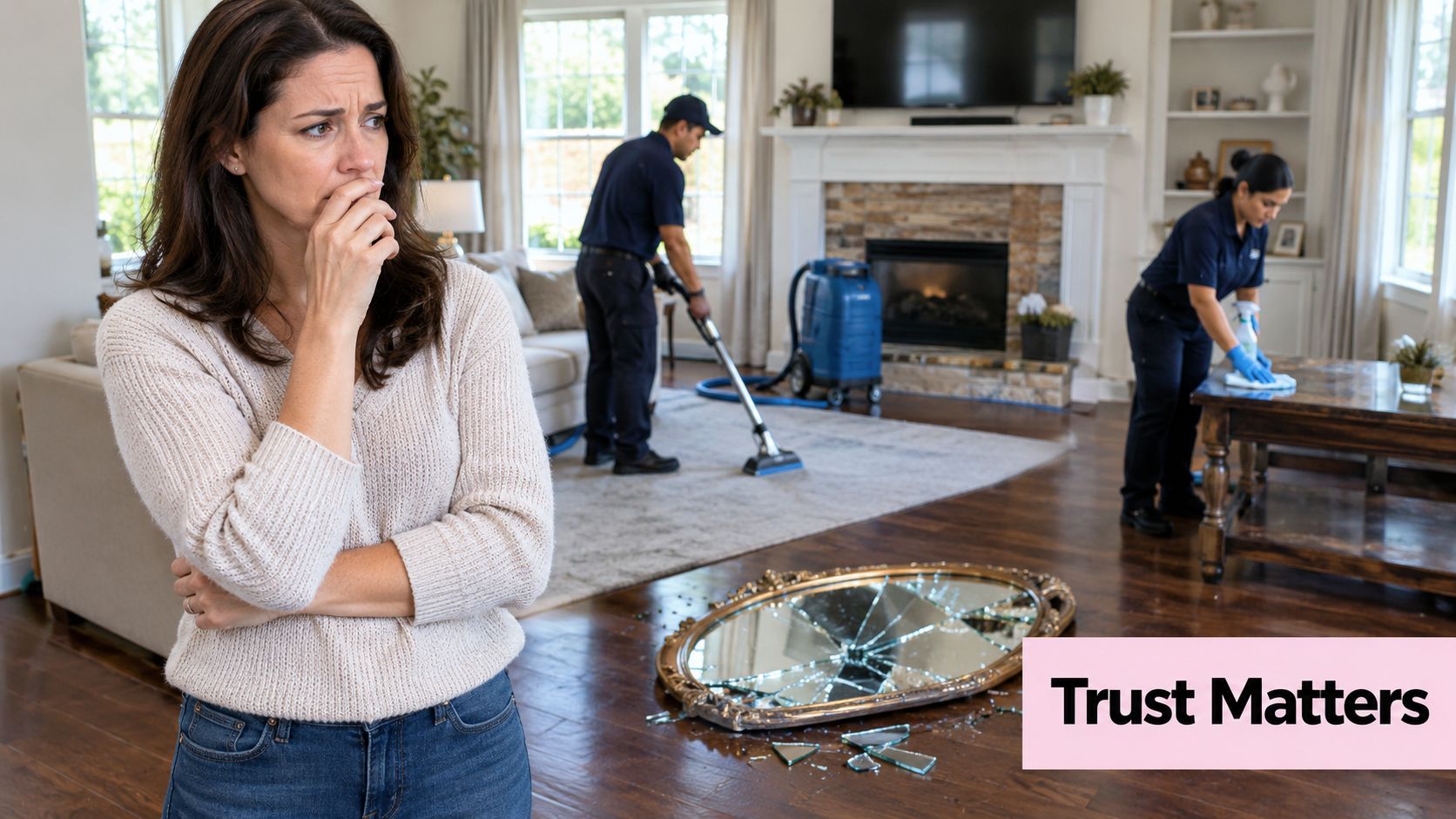
Table of Contents
When Trust Badges Become Critical Questions
A homeowner in Acworth hires a company for a detailed clean before listing the house. During the appointment, a cleaner moves a decorative mirror, it slips, and the glass breaks across the floor. The homeowner reaches for the company's website and sees the familiar phrase, licensed, bonded, and insured. But which part applies to the damaged mirror? Is the customer covered by the bond, the insurance policy, or neither?
A Marietta property manager may face a different concern. A cleaning worker arrives after a contractor has tracked Georgia red clay across a porch and kitchen floor. Someone slips while entering the home. The property manager now needs to know whether the cleaning company carries liability coverage, whether the worker is covered by workers' compensation, and whether the company's credentials apply to the legal entity that accepted the job.
These aren't unusual questions for people arranging basic maintenance cleaning, a Top-to-Bottom Deluxe/deep cleaning, move-in/move-out service, office cleaning, or HOA clubhouse care. They can arise during holiday hosting, a busy family's recurring appointment, or post-construction cleaning after renovation dust has settled.
Practical rule: Treat “licensed, bonded, and insured” as three separate questions, not one universal promise.
The purpose of verification isn't to create suspicion. It's to understand what protection may apply before someone enters your home or shared facility. A locally and privately owned company such as Maid in America, owned by Vicky Bates, can describe its status clearly, but customers should still understand what each credential means and request documentation when the situation calls for it.
What Licensing Actually Means for Your Cleaner
Licensing is a legal-compliance requirement rather than a universal quality rating. The U.S. Small Business Administration's explanation of licenses and permits says businesses may need approvals at federal, state, and local levels, with requirements varying by activity and location. The SBA identifies licenses and permits as a startup requirement and advises owners to determine which approvals apply before operating.
For a cleaning company serving Kennesaw, Acworth, Woodstock, and nearby communities in Cobb, Cherokee, Paulding, Douglas, and Bartow counties, the relevant compliance picture can change as the service area expands. Business registration, local operating authorization, taxation, waste handling, and regulated specialty work may involve different authorities. A company should confirm the requirements that apply to its actual activities and locations rather than assume that one approval covers every community.
What a license tells you
A license generally indicates that a government authority has granted the business permission to operate under stated conditions. That matters because licensing places commercial activity within a public regulatory framework. Authorities can identify operators, establish minimum legal conditions, and respond when violations occur.
It doesn't automatically prove that every cleaner has the same level of training, that workmanship will be superior, or that property losses are covered. Those questions belong to hiring practices, supervision, insurance, bonding, service agreements, and communication.
Georgia also distinguishes between general-contractor licensing and specialty trades. The Georgia Secretary of State's licensing guidance says people performing or offering residential or commercial general-contractor services for compensation must be licensed, while some specialty trades may be exempt. That distinction means homeowners shouldn't assume a residential-contractor license automatically describes ordinary house cleaning.
How this applies to cleaning
For a client booking a post-construction cleaning company, licensing is one part of due diligence. The customer should also ask who will perform the work, whether the company uses employees or subcontractors, what products and methods are used, and what documentation supports insurance and bonding.
A license is useful evidence of legal authorization. It isn't a substitute for checking the protections that address accidents, employee injuries, dishonesty allegations, or contractual performance.
How Bonding and Insurance Protect Your Property Differently
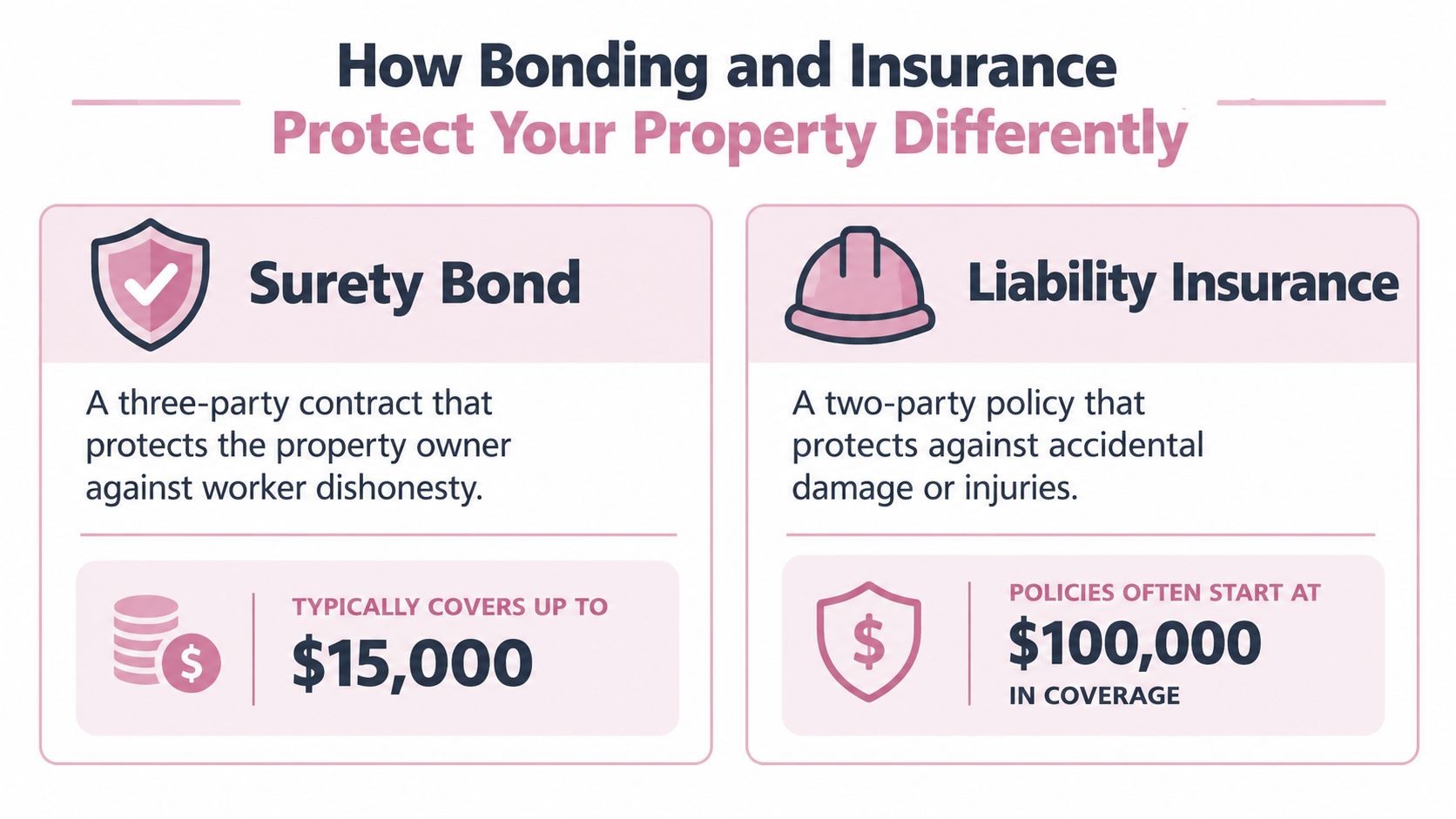
Bonding and insurance address different risks because they use different legal structures. The National Association of Insurance Commissioners' statistical handbook defines a surety bond as a three-party contract. The principal is the business, the obligee is the party protected by the obligation, and the surety provides the guarantee. NAIC materials report that contract bonds account for roughly two-thirds of total surety-premium volume, showing that surety is a substantial insurance-industry function.
Liability insurance generally works as risk transfer. The insured pays for a policy, and the insurer may respond to covered claims according to policy limits, exclusions, deductibles, and claim procedures. A bond usually protects a specified obligee under specific conditions. If the surety pays a valid claim, it may retain rights to recover from the bonded business.
A simple side-by-side view
| Protection | What it generally does | What to ask |
|---|---|---|
| Surety bond | Guarantees a specified obligation for a named obligee under stated terms | Who is the obligee, what type of bond is it, and what conditions apply? |
| Liability insurance | May address covered third-party bodily injury or property-damage claims | Who is insured, what are the limits and exclusions, and when is the policy effective? |
| Workers' compensation | May address qualifying workplace injuries involving eligible employees | Are the workers and any subcontractors covered under the applicable arrangement? |
For example, a performance bond may respond when a contractor fails to complete a contractual obligation. Liability insurance may address a covered accidental property-damage claim or injury claim. Neither one automatically covers dissatisfaction with cleaning quality, every theft allegation, intentional conduct, or a missed appointment.
The phrase bonded and insured can therefore hide important gaps if a customer doesn't ask follow-up questions. A plain-language overview such as understanding licensed bonded and insured can help readers separate the concepts before signing a service agreement.
The practical lesson is simple. A bond isn't a replacement for liability insurance, and an insurance certificate isn't proof that a particular bond protects you.
Understanding Surety Bonds as Three-Party Contracts
A surety bond makes more sense when you name the three participants. The cleaning contractor is the principal. The customer, government agency, or contract owner is the obligee. The surety company provides the guarantee.
The Small Business Administration's explanation of surety bonds distinguishes performance bonds, which guarantee contract completion, from payment bonds, which protect suppliers, subcontractors, and workers. A performance bond can protect a client when a contractor fails to meet contractual obligations. The surety may arrange completion or pay up to the bond's penal amount, then seek reimbursement from the contractor.
That structure doesn't mean every homeowner automatically has a claim. A commercial fidelity or employee-dishonesty bond can address a different exposure from a performance bond. A license or permit bond may focus on legal or regulatory compliance. The name of the bond matters.
Questions worth asking before service begins
Ask for written answers rather than relying on a website badge:
- What type of bond is in force? Is it a performance bond, license or permit bond, fidelity bond, or another form?
- Who is the named principal and obligee? Confirm that the document identifies the operating business and explains who may make a claim.
- What is the penal sum? Ask for the bond limit and the conditions that must be met.
- When does it expire? Request current effective dates and confirmation directly from the issuing surety.
- What does the liability policy cover? Ask about limits, exclusions, deductibles, and accidental property damage.
- Are workers and subcontractors covered? This question matters for both workers' compensation and the company's liability arrangements.
For a home in Kennesaw, an office in Acworth, or a community amenity in Woodstock, the right protection depends on the job and the contract. The bond's certificate and written terms determine what applies, not the word “bonded” by itself.
Georgia Workers Compensation Requirements for Cleaning Services
In Georgia, workers' compensation coverage is generally required when a business regularly employs three or more people, including part-time workers, according to the Georgia State Board of Workers' Compensation. The employee count includes corporate officers or LLC members, even when they exempt themselves from coverage.
Employers must secure benefits through an insurance policy or qualify as an approved self-insurer. Self-insurance requires Board approval, audited financial statements covering three years, and a nonrefundable $500 application fee, as described by the State Board.
Why customers should care
Workers' compensation isn't the same as general liability insurance. It concerns qualifying workplace injuries involving eligible employees. If a cleaner is injured while working in a Kennesaw home, Acworth office, or Marietta community facility, the company's workers' compensation arrangement may become relevant.
Subcontractors require extra attention. Georgia states that a contractor may become liable for a subcontractor's employees if the subcontractor hasn't obtained workers' compensation insurance. A property manager or HOA board should therefore ask whether the people entering the premises are employees or subcontractors and whether the applicable coverage is current.
Three credentials, one practical picture
Consider a move-out clean before a property changes hands. Licensing addresses whether the business has the required governmental authorization. Bonding may address a defined obligation or specified misconduct under the bond terms. Insurance can address covered third-party property damage or bodily injury, while workers' compensation addresses qualifying injuries to covered workers.
Those protections don't guarantee that every dispute will be paid. They create separate layers that must match the actual risk, service agreement, and people performing the work. Business owners who need broader commercial context can review guidance on how to protect your contracting business, while customers should focus on the documents and coverage relevant to their appointment.
Verifying Credentials Before Hiring a Cleaning Company
A trust badge is easy to print. Current, applicable documentation is more useful.
Customers in Kennesaw, Acworth, Dallas, Hiram, and Powder Springs should verify the legal business name, not just the brand name displayed on a website or vehicle. Licensing requirements vary by jurisdiction, and a license or permit bond serves the specific government requirement behind it. It isn't interchangeable with a performance bond or payment bond.
Use a short verification checklist
- Confirm the operating entity: Ask for the legal business name and license number, then check the responsible state or local licensing authority.
- Check business registration separately: Georgia's consumer guidance distinguishes license searches from business-registration searches.
- Request the insurance certificate: Look for the insurer, named insured, policy limits, effective dates, and relevant coverage.
- Review the bond details: Ask for the bond type, principal, obligee, penal sum, expiration date, exclusions, and claim instructions.
- Ask about the actual workers: Confirm whether employees or subcontractors will enter the home and whether they're covered.
- Match the service: A certificate may relate to one operating entity or activity. Confirm that it applies to the cleaning services being arranged.
Remember: A certificate shows evidence of coverage at a point in time. It doesn't promise that every incident, employee act, or property complaint is covered.
The difference between bonded and insured matters especially in residential cleaning. A license bond may address specified legal violations. Liability insurance may respond to a covered accidental injury or property-damage claim. Neither automatically covers poor workmanship, intentional acts, employee disputes, or dissatisfaction with the result.
Before booking, use this list of questions to ask before hiring a cleaning professional. Clear answers protect the customer and give a responsible company an opportunity to explain its process.
Choosing Protected Cleaning Services in West Georgia
Verification should lead to a practical hiring decision, not just a collection of documents. Start with the service you need. A family managing Georgia spring pollen and red clay may need recurring basic maintenance cleaning. A landlord may need move-in/move-out cleaning. A homeowner after renovation may need post-construction cleaning, while an HOA board may need consistent care for a clubhouse or shared amenity.
The credential check should match that setting. For a home, ask who will enter, what products will be used, and what happens if accidental damage is reported. For an office or community facility, ask whether the certificate names the operating entity and whether subcontractors are involved. For recurring service, confirm that coverage remains current over the relationship.
Consider the household and the cleaning method
The Environmental Protection Agency warns that cleaning solutions, air fresheners, and personal-care products can contribute to indoor particulate matter. Pine- or citrus-scented products can react with ozone to form particulate matter and formaldehyde, and some cleaners, fragrances, and air fresheners contain irritants that may worsen asthma. The EPA's indoor air quality guidance recommends following labels, never mixing products unless directed, ventilating with windows, doors, or exhaust fans, and keeping sensitive people away while products are used.
That guidance supports a careful, low-odor approach without suggesting that natural products are automatically harmless. Product labels, ventilation, safe storage, and proper handling still matter in humid Georgia homes with pets, children, retirees aging in place, and people who prefer fewer harsh smells.
Maid in America serves Kennesaw, Acworth, Woodstock, Cartersville, West Cobb, Marietta, Dallas, Hiram, Powder Springs, and nearby communities. Its licensed, bonded, and insured positioning sits alongside carefully selected cleaners, natural low-odor products, personalized service, and one dedicated cleaner usually sent to each home instead of a large team. The company provides basic cleaning, Top-to-Bottom Deluxe/deep cleaning, move-in/move-out cleaning, post-construction cleaning, office cleaning, HOA amenity cleaning, recurring schedules, and add-ons such as inside ovens or refrigerators, baseboards, cabinets, interior windows, grout, laundry, dishes, and upholstery vacuuming.
Before you book: Ask for the documents, read the applicable terms, and choose a service whose staffing and cleaning approach fit your home or facility.
When you're ready to arrange a protected cleaning service, start with Maid in America's Kennesaw cleaning service and ask the questions that matter for your property. Request a free estimate from Maid in America online or call 770-427-4448 to discuss your home, office, or community cleaning needs.



.svg)
Maid in America provides reliable, personalized cleaning with natural products for homes, offices, and communities across West Georgia. Licensed, bonded, and insured, we’re locally and privately owned.
Get in touch with us today!
info@maidinamericaga.com