Office Cleaning Schedule: 8 Practical Templates
A lot of offices already have a cleaning routine. It just isn't written down, evenly assigned, or matched to how the space is used. A quiet office with a handful of people can often stay in good shape with a lighter cadence. A client-facing workplace with constant foot traffic usually can't. A multi-shift operation creates a different problem entirely, because one round of cleaning at night won't hold through the next day.
That's why the right office cleaning schedule depends less on what sounds thorough and more on traffic, shared-space use, operating hours, event demands, and who handles what between professional visits. Staff can manage some reset tasks. They usually shouldn't own restroom sanitation, deep floor care, or detailed work that gets skipped when the day gets busy.
These eight templates match common office patterns instead of forcing one generic checklist onto every business. Pick the one that most closely fits your current operation, then combine it with a recurring maintenance checklist and periodic deep cleaning. If your office needs recurring or one-time support, Maid in America may be relevant for offices that want scheduling built around space details and priorities, with natural, low-odor products.
Consistency and coverage matter more than choosing the most intensive schedule.
If you're also coordinating exterior appearance, office cleaning from Professional Window Cleaning can complement an interior schedule by covering glass and entry presentation.
Table of Contents
1. Daily Touch-Point Cleaning Schedule
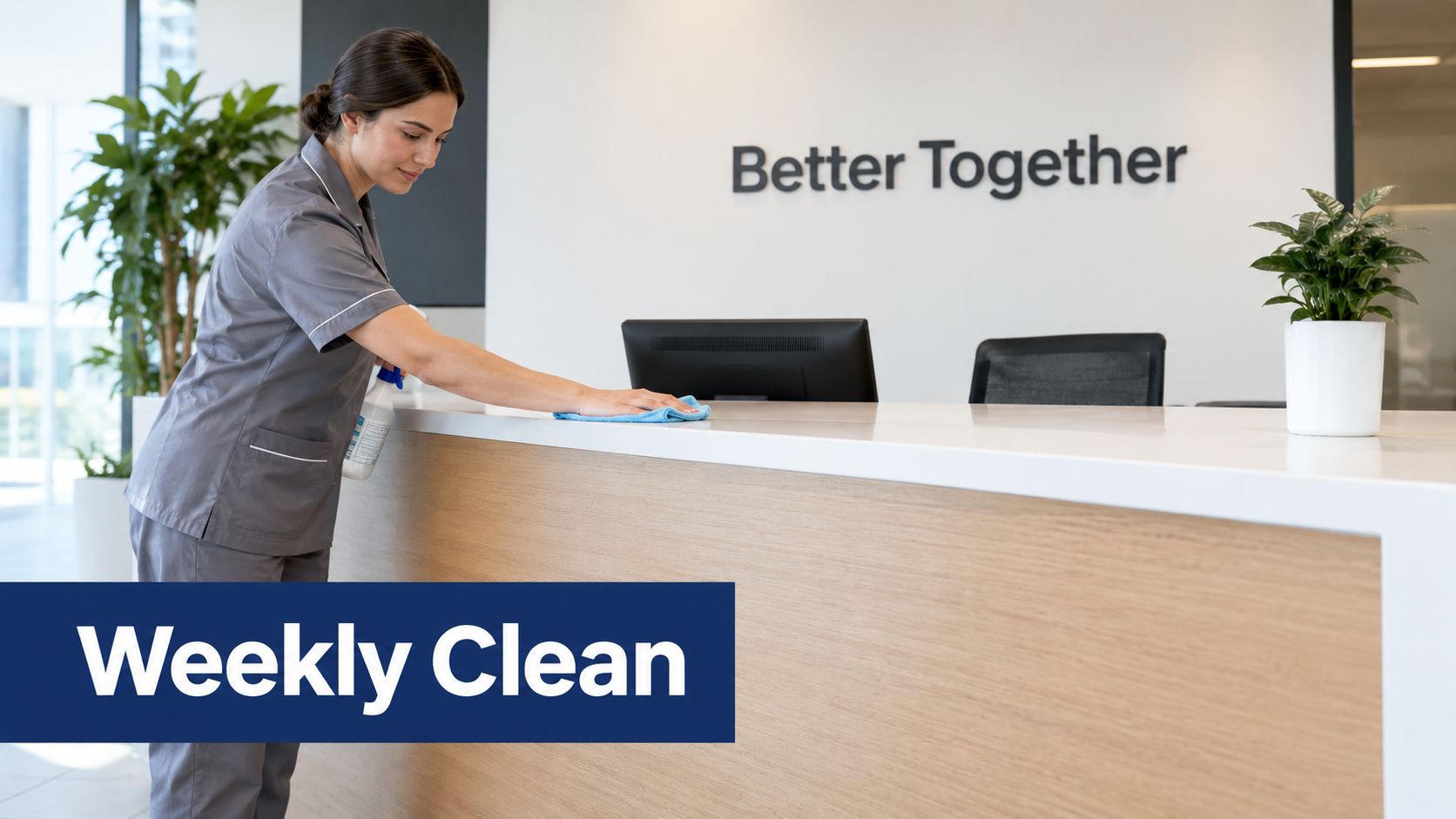
Some offices don't need a full deep clean every day, but they do need the space to look reset by lunch and still feel clean by closing time. That usually means focusing on the surfaces and rooms people notice first: reception, break room counters, restroom fixtures, trash points, and shared desks or conference tables.
This schedule works well for small professional offices in Kennesaw, medical or service offices with frequent visitors, and real estate teams that have clients coming in and out. It's also a good fit when staff productivity matters more than squeezing every task into one weekly visit.
What gets attention every day
CDC guidance says high-touch surfaces should be cleaned at least once a day, including doorknobs, light switches, handles, desks, keyboards, phones, toilets, faucets, and sinks. That's the backbone of this template. You don't waste time detailing low-impact corners while fingerprints, coffee spills, and restroom messes keep reappearing.
A practical daily touch-point schedule often includes:
- Entry reset: Wipe door handles, glass touch areas, and reception counters.
- Break room control: Clean counters, sink fixtures, appliance handles, and table surfaces.
- Restroom service: Sanitize toilets, sinks, faucets, mirrors, and restock paper goods if needed.
- Desk and meeting areas: Wipe shared desks, phones, keyboards, and conference tables.
- Waste removal: Empty trash before odors and overflow become the complaint everyone remembers.
For offices that want this handled professionally, Maid in America office cleaning service can be paired with a weekly or biweekly deeper visit so the visible reset happens daily while detailed work stays on schedule.
Practical rule: If people touch it all day, don't leave it for the weekly cleaner.
The limit of this schedule is obvious. It protects appearance and hygiene, but it won't replace floor care, baseboards, detailed dusting, or periodic appliance cleaning. Daily touch-point cleaning works best when it's intentionally narrow.
2. Weekly Full Office Cleaning Schedule
Tuesday at 3 p.m. is usually when a weekly plan gets tested. Trash starts to build in the break room, the restroom no longer looks freshly cleaned, and tracked-in dirt shows up at the entry. That does not mean weekly service is wrong. It means weekly service only works in offices where the midweek wear stays predictable.
This schedule fits a specific type of workplace. Small offices with limited visitors, low food prep, and employees who keep their own areas in decent shape can do well with one full reset each week. A five-person insurance office has very different cleaning demand from a 25-person sales floor, even if the square footage looks similar.
A published benchmark from Staples notes that most standard offices should be cleaned 2 to 5 times per week, with small private offices often handled 2 to 3 times weekly and high-traffic or customer-facing offices cleaned daily. Weekly service sits below that range, so the trade-off is clear. You save cost and keep scheduling simple, but you need controlled traffic and some in-house discipline between visits.
Here is what a workable weekly setup usually looks like in practice:
- One scheduled visit, often after hours, so floor care, restroom cleaning, and trash removal can be done without interrupting staff.
- Full-room coverage instead of touch-point-only work. Floors, restrooms, kitchen, meeting rooms, and visible dust all get handled in the same visit.
- Light staffing, usually one cleaner in a very small office or a small crew for a midsize suite, because the goal is a complete weekly reset rather than daily upkeep.
- Limited tolerance for surprise demand. Heavy client traffic, catered meetings, or busy break rooms can push this schedule past its limit fast.
Timing matters as much as task list. Friday evening works well for offices that want to start Monday clean and do not see much weekend use. Monday early morning works better for firms that host clients throughout the week and want the front office looking sharp at the start of business. If the office has recurring events, month-end paperwork surges, or hiring days that bring extra foot traffic, the cleaning day should follow those pressure points instead of sitting on the calendar out of habit.
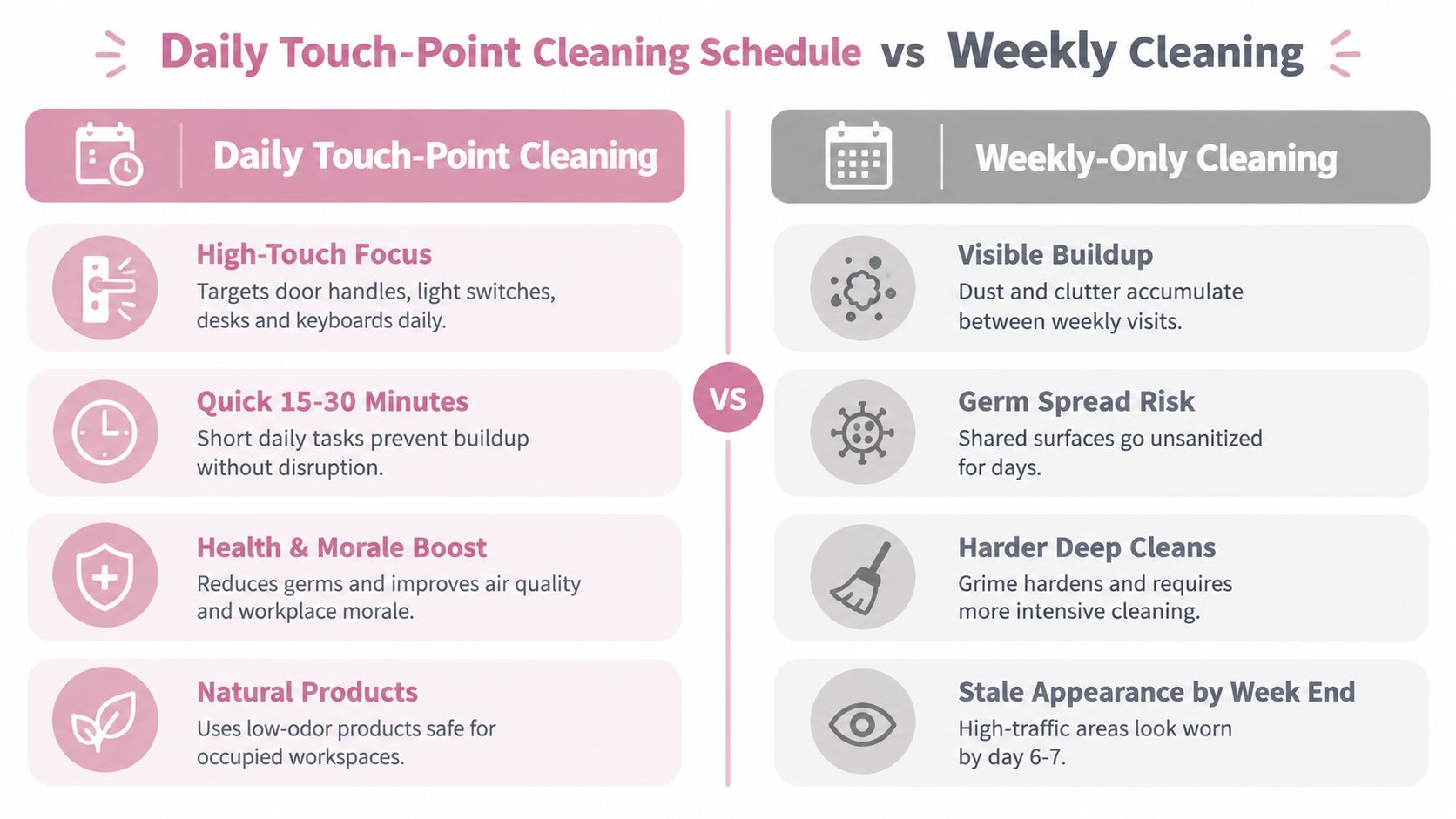
The weak point is coverage between visits. If nobody is assigned to empty overflow trash, wipe obvious spills, or alert the cleaner when a restroom starts slipping, a once-a-week plan makes the office look neglected before the next service date. Weekly full cleaning is a good fit for the right office, but it is a narrow fit, not a default schedule.
3. Biweekly Rotation with Area-Based Deep Cleaning

By the second week, the office usually tells the truth. Smudges build up on glass, chair legs collect dust, the microwave starts to show it, and corners that looked fine after the last service begin to slip. That is the setting where a biweekly plan earns its place. It gives the office a steady maintenance visit, then uses the extra time on alternating visits to clean one area properly instead of rushing through every detail every time.
This schedule fits offices that stay reasonably controlled between visits but still need more than a weekly surface pass. A small legal office, a tax firm during normal season, or an admin suite with moderate client traffic can usually carry a two-week cadence if staff are not leaving spills, food waste, and packed trash for the next cleaner. It is less about office size than operating pattern. A 20-person quiet office may handle biweekly service better than a 6-person sales office with constant walk-ins.
The rotation has to be built around fixed coverage and variable coverage.
Every visit should cover the same baseline: restrooms, trash removal, break room wipe-downs, sink and counter sanitation, visible glass at the entry, and floor attention in the paths people use. Then each second visit should add one deep-focus zone with enough labor time to finish it well. Good examples include blinds and sills, appliance interiors, file room edges, low-touch doors and trim, under-desk dust, or conference room detailing after a heavy meeting cycle.
A simple way to run it is to pair the area focus with how the office gets used:
- Front-office-heavy firms rotate reception, conference rooms, and entry glass more often.
- Staff-heavy offices put more time into break rooms, restrooms, and workstation perimeters.
- Offices with quarterly filing, audits, or recruiting days shift the deep-focus area to match those pressure points.
- Small teams with one cleaner should keep the rotation narrow. Wider coverage sounds good on paper and usually leads to skimmed results.
Older office-cleaning research has documented recurring split-frequency maintenance models for workplaces, including offices cleaned on a twice-weekly or weekly basis in different settings, as discussed in this office cleaning frequency study. The useful takeaway is operational, not historical. Cleaning cycles work when the scope stays stable and the added detail work is assigned in advance.
Here is what that looks like in practice. Week 1 handles the baseline service only. Week 3 repeats the baseline and adds kitchen appliances. Week 5 repeats the baseline and adds conference room edges, interior glass, and trim. Week 7 returns to the baseline and picks up blinds or storage shelving. Over two months, the office gets consistent upkeep plus real depth in places that usually get ignored.
For teams considering this cadence, recurring biweekly cleaning for offices with planned area rotation works best when the task map is set before the first visit. If the crew has to decide the deep-clean area on arrival, high-visibility work will keep winning and low-visibility buildup will keep getting postponed.
The limit is easy to spot. Once restrooms, kitchen mess, or lobby traffic start breaking down before the next visit, the office has outgrown biweekly service or needs a stronger in-house reset between appointments. Biweekly rotation is a narrow-fit schedule, but for the right office, it controls cost without letting detail work disappear.
4. Monthly Deep Cleaning with Weekly Maintenance Checklist
Monday starts clean enough. By the third week, dust is collecting along baseboards, the microwave has splatter baked onto the ceiling, and the restroom corners are telling the truth about the schedule. That pattern usually means weekly upkeep is covering what people see, but no one is reaching the work that needs time, tools, or both.
A monthly deep clean with a weekly maintenance checklist fits offices that stay relatively controlled between visits. Small administrative offices, back-office support teams, owner-occupied professional suites, and nonprofit spaces often land here. The model only holds if traffic is light, staff use shared areas with some discipline, and leadership is willing to assign simple reset tasks instead of assuming they will happen on their own.
The split has to be clear. Staff handle the mess they create. A cleaning crew handles the buildup that staff either miss or avoid.
Here is the practical version:
Weekly in-house maintenance
- Empty trash and replace liners
- Clear food from refrigerators and desks
- Wipe break room counters, sink areas, and table surfaces
- Check restroom supplies and address visible mess
- Keep entry glass, reception surfaces, and conference tables presentable
Monthly professional deep clean
- Detail restroom fixtures, partitions, and floor edges
- Clean baseboards, corners, and under-furniture dust
- Remove buildup from kitchen appliances and splash areas
- Clean interior glass beyond quick spot removal
- Address vents, ledges, trim, and other surfaces that get skipped during weekly resets
A published office checklist from Janiking shows how weekly and monthly cleaning categories are commonly separated for offices, lobbies, lunchrooms, and conference rooms. The useful point is the division of labor. Monthly service works when the monthly scope stays narrow and staff coverage stays consistent.
This schedule is a fit for one specific office type, not a universal answer. It belongs on the lower-traffic end of the eight-schedule range in this article. If the office has frequent visitors, heavy restroom use, daily kitchen traffic, or client-facing conference rooms in constant rotation, monthly detail work plus weekly maintenance will start slipping fast.
Set ownership by zone, not by vague team effort. Give one office lead the weekly check of trash, kitchen surfaces, and restrooms. Require each employee to clear their own workstation and food items before that check. Keep a short log of repeated misses. If the same issue shows up three or four weeks in a row, either assign it to a named staff role or move it into the paid cleaning scope.
That trade-off matters. This schedule saves money because the crew is not doing full-service weekly work. It also shifts reliability risk back to the office. If staff follow-through is weak, the monthly visit turns into recovery work, and that is usually the point where an office manager should move up to weekly service instead of trying to patch the gap with reminders.
5. Shift-Based Cleaning Rotation
At 2:00 p.m., the day team leaves a full break room, two restrooms are low on paper, and the evening shift walks into the mess. By 6:00 p.m., the next handoff is worse. In offices that run long hours, cleaning has to follow the operating rhythm, not just the calendar.
This schedule fits the higher-traffic end of the eight-template range in this article. It works for call centers, dispatch floors, support teams with staggered staffing, clinics with office-style admin space, and any site where desks, phones, restrooms, and kitchens stay in use across multiple shifts. A single nightly visit can keep up with detail work. It usually cannot keep shared areas stable all day.
CDC environmental cleaning procedures set stricter standards for healthcare than for standard offices, but the frequency logic still applies. Areas with heavier use need more frequent attention, and some clinical spaces require at least daily or twice-daily cleaning according to the CDC environmental cleaning procedures.
The practical question is coverage.
Instead of building this schedule around room types alone, build it around handoff points. Each shift should leave the space in a defined condition for the next one. That means assigning a short reset at transition times, then reserving heavier work for the lowest-occupancy window.
A workable rotation often looks like this:
- Between shifts: Empty overflowing trash, restock restroom and kitchen supplies, wipe shared desks, phones, counters, and door hardware, spot mop entries if weather or foot traffic calls for it.
- During the busiest block: Check restrooms, clean visible spills fast, wipe break room tables, and keep reception or waiting areas presentable if visitors are still coming through.
- After the final shift: Do the full close, including waste removal, restroom cleaning, floor care, kitchen reset, and the touchpoints that need a more thorough pass.
Staffing should follow the pressure points, not a fixed idea of what a cleaning crew looks like. Some offices need a porter or utility worker for short daytime rounds plus a janitorial close at night. Others can assign light reset tasks to supervisors or facilities staff between shifts and keep the contracted crew focused on the last shift. The trade-off is simple. The more cleaning responsibility you push onto operating staff, the cheaper the service plan looks on paper and the less consistent the handoff usually becomes.
If your office is trying to decide how much service each shift needs, office cleaning fees and scope considerations are easier to discuss after you define which tasks must happen every handoff, which ones can wait until close, and which areas need daytime coverage because appearance affects operations.
One rule keeps this schedule from failing: assign by trigger, not by good intentions. If the restroom is checked at 11:30, name the role. If the evening team must clear and disinfect shared headsets before clock-out, write it into the closeout routine. Shift-based rotation succeeds when ownership is attached to a time, a zone, and a person or vendor.
6. Seasonal Deep Cleaning Schedule with Quarterly Focus Areas
A seasonal schedule earns its keep in offices that look fine week to week, then slip all at once. Spring pushes dirt and pollen into entrances. Summer increases lobby wear when traffic picks up. Fall exposes dust on vents, ledges, and storage edges. Winter puts more pressure on restrooms, floors near entries, and anything people touch all day.
Use this format if your office runs steadily most of the year but has predictable environmental shifts. Keep the regular cleaning cadence in place, then book one heavier quarterly project that targets the areas most likely to show wear first. Analysts at the National Cleaning Alliance note a 2 to 5 visits per week operating range, with smaller low-traffic offices often needing 2 to 3 cleanings weekly and customer-facing offices moving to 5 nights per week. The quarterly work sits on top of that baseline. It does not replace it.
Instead of treating each quarter as a generic deep clean, assign a seasonal purpose:
- Spring: interior glass, blinds, baseboards, vent covers, and winter buildup near entrances
- Summer: entry mats, lobby floors, upholstered guest seating, and exterior-facing glass
- Fall: storage rooms, shelf tops, return-air grilles, and other high-dust surfaces
- Winter: restroom detail, disinfecting on shared touchpoints, and entry floor care where moisture and salt collect
This schedule fits mid-size professional offices, client-facing firms with predictable busy seasons, and smaller suites in buildings where outside conditions affect appearance fast. It is less useful for offices with constant heavy traffic or multiple daily shifts. Those usually need more frequent coverage year-round, not just a quarterly reset.
The staffing logic is simple. Put the seasonal work on a separate work order, crew, or extended service window so the nightly team is not trying to add vent dusting and interior glass to a standard close. If the office manager wants this plan to hold, each quarter needs three decisions in advance: which zones get priority, when access is easiest, and what can wait until the next cycle without creating complaints.
The failure point is usually timing. Offices often remember seasonal cleaning only after the lobby glass looks dull or dust starts showing on vents. At that point, the work still helps, but it stops being a schedule and turns into catch-up.
7. Pre-Event Deep Cleaning Schedule
A board meeting at 9:00 a.m. changes the cleaning standard for the entire front half of the office. Smudged conference room glass, a coffee ring in reception, or a restroom that looks fine at noon but tired by 4:00 p.m. suddenly becomes visible risk. That is why this schedule works best as a planned surge, not as an improvised add-on the day before.
Use it in offices where appearance matters in bursts. Law firms, consulting teams, real estate groups, investor-facing companies, and executive suites usually fit that pattern. The office can run on lighter recurring service between events if traffic stays controlled and the space does not drift.
The schedule only works if the event types are mapped in advance.
Instead of one generic pre-event checklist, set up a few event triggers with different scopes. A client pitch usually needs a route clean. Focus on the entry, reception desk, conference room, guest restroom, and pantry. A recruiting event pulls people through more of the office, so break rooms, hallways, and secondary restrooms need coverage too. A board meeting often calls for higher-detail work in a smaller footprint, including table edges, chair arms, screen areas, interior glass, and a final reset just before arrival.
A useful benchmark from facility management reporting is consistency. As noted in this janitorial cleaning quality inspection checklist, facilities that use formal inspections score better on tenant satisfaction than those that do not. For event cleaning, that matters more than adding random extra tasks. One route check by an internal contact often prevents the last-minute misses that create complaints.
Here is the practical staffing logic:
- If the event is morning-only, clean the visible route the night before and send a small touch-up crew or day porter in early.
- If the event runs all day, add midday restroom checks, trash pulls, and lobby spot cleaning.
- If guests will circulate beyond the front corridor, expand coverage instead of over-detailing one conference room.
- If the office already has heavy daily traffic, this schedule should supplement a stronger baseline, not replace it.
The trade-off is cost versus precision. Paying for a full-building deep clean before every event is usually wasteful. Cleaning only the obvious room is risky if guests pass through neglected side areas. The workable middle ground is route-based coverage with one level up in detail on guest-facing spaces.
Failure usually comes from timing or scope creep. Teams book the clean too late, stack event work onto the nightly crew without adding labor hours, or ask for full-detail service in every room because a VIP is visiting. A pre-event schedule holds up when the office manager makes three decisions early: which event types trigger extra cleaning, which spaces guests will see, and whether the job needs after-hours detail, early-morning touch-up, or both.
8. Move-In and Move-Out Focused Transition Cleaning Schedule
Relocations and renovations create mess that normal recurring service isn't designed to handle. Dust settles inside cabinets. Vents carry fine debris. Window treatments hold construction residue. Appliance interiors, door frames, and restroom grout suddenly matter because the space is being handed over or occupied fresh.
That's why transition cleaning should be scheduled as its own office cleaning plan, not squeezed into a routine visit. Real estate offices, landlords, small professional firms changing suites, and businesses taking over renovated space all run into the same issue. The old scope isn't enough.
Sequence matters more than effort
A move-out clean should happen after furniture and equipment are removed whenever possible. A move-in clean should happen before desks, chairs, and boxes block access. If there was renovation work, leave time for final dust to settle and for the cleaned space to air out before staff return.
Flexible scheduling matters here because office occupancy isn't static anymore. Newer guidance on hybrid and variable-use workplaces notes that schedules should be reviewed over time, with some providers recommending quarterly reviews and annual updates, while a hybrid model may pair nightly cleaning for deeper tasks with day porters for ongoing upkeep as discussed in this office cleaning checklist overview. Transition projects push that idea further. You often need a temporary schedule that doesn't resemble your normal one at all.
If a move is already in motion, this kind of support can complement relocation planning. Reworx Recycling moving services may be relevant for the moving side while cleaning handles turnover readiness and occupancy prep.
Before and after examples are easier to understand visually, so this walkthrough helps frame the scope many offices overlook during transitions.
For recently renovated or newly leased offices, this template should include cabinet interiors, appliance interiors if needed, vents, trim, fixtures, windows, and restroom detail. Otherwise the office may be technically empty but still not ready.
8-Point Office Cleaning Schedule Comparison
| Schedule | 🔄 Complexity | ⚡ Resources / Frequency | ⭐ Expected outcomes | 📊 Ideal use cases | 💡 Key advantage / tip |
|---|---|---|---|---|---|
| Daily Touch-Point Cleaning Schedule | Low, simple checklist, daily consistency required | Minimal: 15–30 min/day; one staff or brief pro visits; low-cost supplies | ⭐⭐⭐⭐, maintains surface hygiene, reduces germ spread; not a substitute for deep cleaning | Small to mid-size offices (5–15 people); client-facing desks, break rooms, high-touch areas | Assign owners and post a checklist; pair with weekly/biweekly deep clean |
| Weekly Comprehensive Office Cleaning Schedule | Moderate, organized routine, predictable tasks | Moderate: 1–2 hrs/week; professional weekly appointment | ⭐⭐⭐⭐, consistent professional appearance and sanitation for most offices | Small–medium offices (1–30 employees) needing reliable weekly upkeep | Schedule same day/time weekly; request consistent cleaner for continuity |
| Biweekly Rotation with Area-Based Deep Cleaning | Medium, requires rotation planning and communication | Moderate: two-week cycle; 1–2.5 hrs/visit alternating light and deep work | ⭐⭐⭐⭐, better deep coverage than monthly at lower cost than weekly | Offices (5–40 employees) wanting periodic deep focus without weekly cost | Publish a rotation calendar; designate a point-of-contact for handoffs |
| Monthly Deep Cleaning with Weekly Maintenance Checklist | Moderate, depends on staff compliance and coordination | Low pro cost: 1×/month (2–4 hrs) + staff 15–30 min/week | ⭐⭐⭐, strong monthly deep results; variable baseline depending on staff diligence | Budget-conscious offices (5–20 employees) with engaged staff | Use a simple rotating checklist and monthly audits during pro visit |
| Shift-Based Cleaning Rotation (24-hour ops) | High, complex scheduling and handoff protocols | High: multiple short windows per shift (20–45 min); recurring daily across shifts | ⭐⭐⭐⭐, continuous cleanliness; prevents buildup in 24/7 facilities | Call centers, dispatch, medical offices, 24/7 operations | Create shift sign-off logs and assign dedicated cleaners per shift |
| Seasonal Deep Cleaning Schedule with Quarterly Focus Areas | Medium, planning ahead by season required | Moderate: quarterly deep sessions + ongoing weekly/monthly maintenance | ⭐⭐⭐, strategic seasonal improvements; addresses seasonal allergens/issues | Offices with seasonal client peaks or event cycles | Schedule quarters 3–4 months ahead; align tasks with seasonal needs |
| Pre-Event Deep Cleaning Schedule (Event-Based) | Low–Medium, reactive scheduling around events | Variable: baseline weekly/biweekly + 1 deep clean 1–3 days before events | ⭐⭐⭐⭐, high impact for client-facing events; cost-efficient when events are infrequent | Sales teams, real estate, law firms, client-facing presentations | Maintain event calendar; use an event-specific checklist and standing agreement |
| Move-In / Move-Out Transition Cleaning Schedule | High, detailed walkthroughs and coordination with movers/contractors | High one-time: 3–8+ hours depending on condition; specialized tasks/tools | ⭐⭐⭐⭐, prepares space for occupancy/return; removes construction residue | Relocations, post-renovation readiness, lease turnovers | Schedule clean relative to move dates; document before/after with photos |
Turn the Template Into a Repeatable Plan
Start with the building you have, not the one most office checklists imagine. Count the spaces that create work: restrooms, break rooms, conference rooms, reception, shared desks, and any entrance that drags dirt inside. Then look at how people use them. A low-traffic office with disciplined staff can run well on a lighter cadence. A client-facing office with constant visitors usually can't.
Next, mark the zones that carry the most consequence when they're missed. Restrooms, break rooms, entry paths, and high-touch shared surfaces create complaints fast. Lower-risk tasks such as deeper floor treatment, windows, storage areas, and detailed edge work can often be rotated without harming day-to-day operations. That distinction keeps the office cleaning schedule practical instead of bloated.
Published guidance varies, but it generally converges around occupancy-based scheduling. Office cleaning schedules are often set by occupancy, with low-use offices commonly cleaned 2 to 3 times per week, mid-size offices 3 to 5 times per week, and high-traffic or large offices cleaned daily or 5 nights per week, sometimes with daytime touch-ups for busy shared areas. Use that as a reality check, not a rigid rule. If your office is hybrid, the right answer may be fewer full cleanings and more targeted touchpoint work on busy days.
That's usually the best way to build a durable plan. Choose a baseline cadence first. Then layer in what the office needs: daily touch-ups, weekly or biweekly maintenance, monthly detail work, and seasonal, event-based, or transition cleaning when circumstances call for it. These aren't competing schedules. They're parts of the same operating system.
Review the plan after a few weeks of real use. If tasks are being missed, if visible buildup appears before the next service, if cleaning disrupts staff, or if occupancy changes, the schedule needs adjustment. The same is true after layout changes, staffing growth, or heavier client traffic. A written plan should evolve with the office.
Document the schedule in plain language. List the tasks, timing, responsible party, and trigger points for deeper service. If you want outside support, create an office cleaning schedule as a working draft, then use that to request an estimate based on your square footage, shared-space use, and priorities. Maid in America is one local option for offices that want recurring or one-time cleaning scheduled around the way the space is used.
Maid in America provides recurring and one-time office cleaning in Kennesaw, Marietta, Acworth, Woodstock, and nearby West Georgia communities, with scheduling built around your office layout, traffic, and priority areas. If you want help turning one of these templates into a workable routine, visit Maid in America and request an estimate based on your space details and cleaning goals.





Maid in America provides reliable, personalized cleaning with natural products for homes, offices, and communities across West Georgia. Licensed, bonded, and insured, we’re locally and privately owned.
Get in touch with us today!
info@maidinamericaga.com