How to Bleed a Baseboard Radiator: Safe DIY Steps
You turn up the thermostat on a chilly Georgia morning, but one section of the living room baseboard stays cool while the rest of the house warms. In a Kennesaw or Acworth home, that uneven heat can be caused by trapped air in a hot-water heating loop, but it can also point to a pressure, circulation, or valve problem.
Knowing how to bleed a baseboard radiator starts with identifying which situation you have. A safe bleed can remove air from a manual vent. It can't repair a leak, purge a complex zone, or fix an electric heater that contains no circulating water.
Table of Contents
Why Your Baseboard Radiator Needs Bleeding
A baseboard that heats at one end but stays cool at the other may have air trapped in its water loop. Hydronic baseboards receive hot water from a boiler through finned-tube or convector units, releasing heat through radiation and natural convection. ASHRAE identifies baseboards, radiators, convectors, and finned-tube units as equipment used in low-temperature and steam-water heating systems.
Air collects at high points in the piping and restricts water movement. Gurgling or rushing sounds, uneven heating, and a cold far end can support that diagnosis. They do not confirm it. Poor circulation, a closed valve, low system pressure, or a failed component can produce similar symptoms.
What bleeding does
Bleeding opens a manual air vent briefly so trapped air can escape. Close the vent once water flows steadily. Removing air may restore circulation through the affected part of the loop.
Practical rule: A baseboard without a water-filled loop cannot be bled. Electric baseboards require a different diagnosis.
Confirm the equipment type before touching a fitting. Hydronic units have piping connected to a boiler, while electric models contain heating elements and electrical wiring. A manual vent makes careful DIY bleeding reasonable. If there is no vent, water leaks, or the problem affects several rooms, stop and arrange professional service. Covenant Aire Solutions HVAC care provides background on professional heating-system upkeep.
Gathering the Right Tools and Preparing Your System
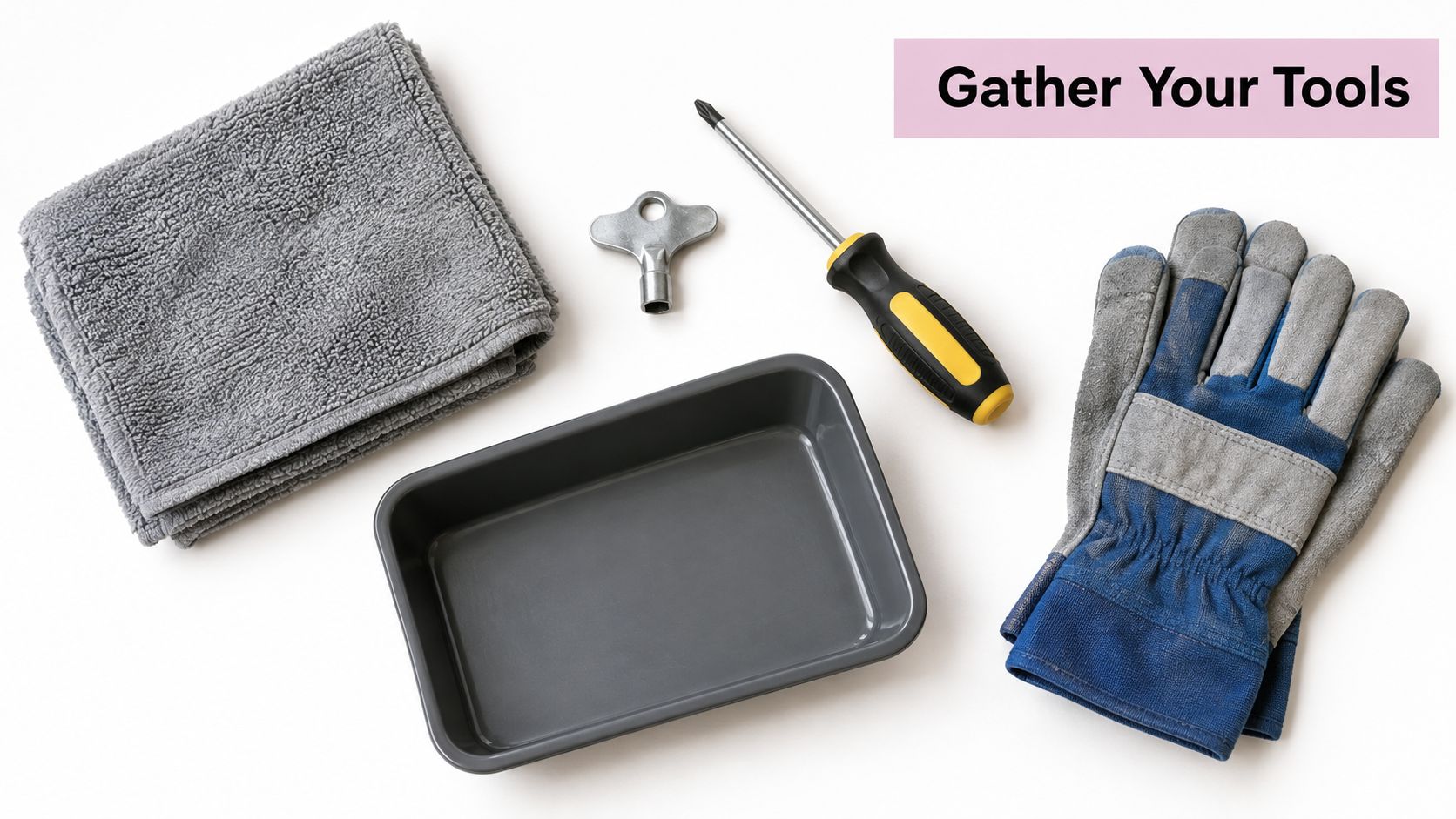
A cold room can tempt you to start immediately, but preparation prevents two common service-call mistakes: opening the wrong fitting and working near dangerously hot water. Gather a small container, an old cloth or towel, work gloves, and the tool that matches the valve. Some vents accept a radiator key, while others use a flathead screwdriver.
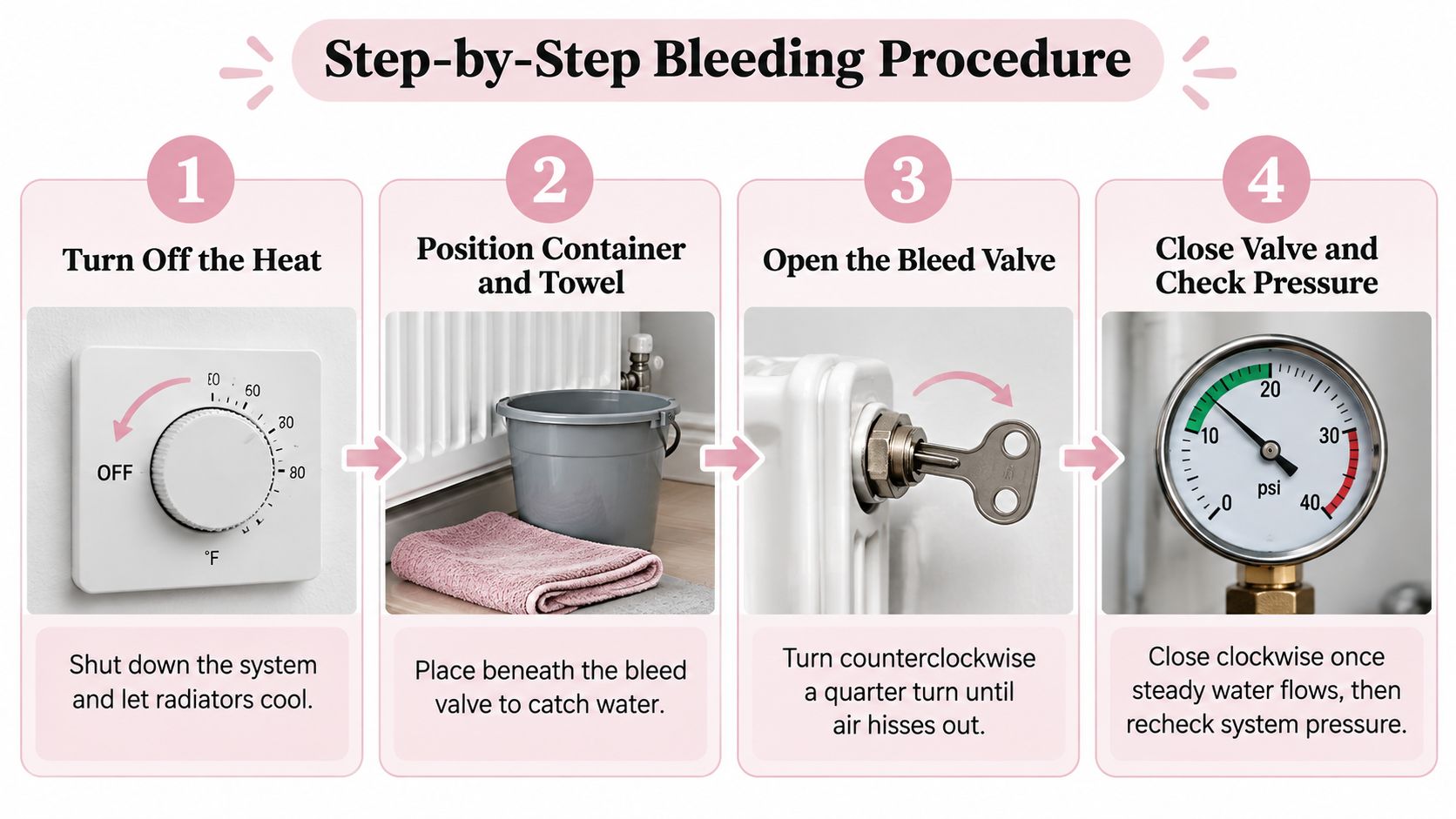
Set the thermostat to its lowest setting, then switch off the boiler or heating system at its service switch or circuit breaker. The circulator should not start while you are working. Wait until the boiler, nearby piping, and water have cooled fully before approaching the valve.
Establish a safe starting point
Check the boiler pressure gauge before bleeding and record the reading. A common cold residential reference is approximately 12 to 15 psi, although the correct pressure depends on the system's design and the building's height. Treat that range as a reference, not a universal setting.
Protect finished flooring with the towel and position the container directly below the vent. Wear eye protection and gloves if available, but remember that gloves do not make hot water safe. If you are helping an older family member prepare a home, clear cords, tools, and loose items from the work area. Cleaning services for seniors may also help reduce trip hazards while maintenance is underway. Stop if the baseboard has no identifiable bleed valve, shows active leakage, or connects to an unfamiliar fitting.
Step-by-Step Bleeding Procedure
Start by identifying the correct manual bleed valve. It may be at the top or end of a baseboard enclosure, on nearby piping, or at another high point in the loop. Many baseboards contain only finned tubing, so don't loosen a random cap, drain, union, or plumbing fitting.
Place the container under the outlet and put the cloth beneath it. Insert the radiator key or screwdriver gently, then turn the valve slowly counterclockwise. Keep your face and hands to the side of the outlet.
Listen and watch the discharge
A trapped air pocket usually produces a hiss or sputtering sound. Let the valve release air without removing the screw or forcing it farther than its normal operating range. As the sound changes to a continuous stream of water, turn the valve clockwise and close it gently.
Don't use the bleed valve as a drain. The objective is to release air, not empty the loop. Afterward, restart the heating system and let the zone run long enough to check whether the baseboard heats more evenly along its length.
Stop when water flows steadily. Continuing to hold the valve open only releases more water and can lower system pressure.
Check the boiler gauge again after the procedure. If the reading has fallen materially below the system's normal cold range, follow the boiler manufacturer's instructions before adding water. Never operate an over-pressurized system. For another perspective on recognizing the limits of a simple bleed, when to call Encano Plumbing can help frame the decision.
Common Troubleshooting Situations
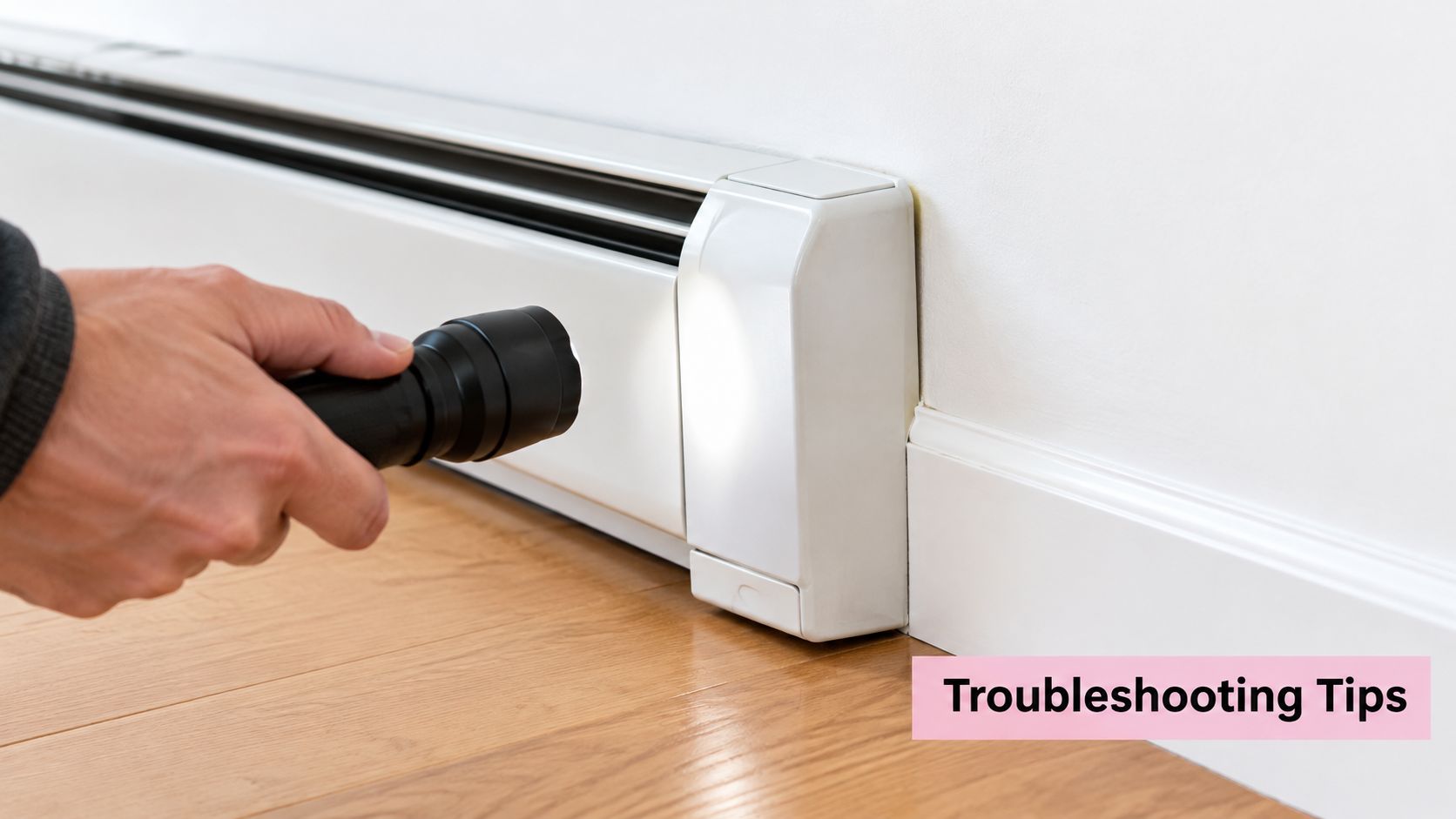
The most important diagnostic question is whether the baseboard has a bleed valve. If it doesn't, the air-removal point may be on a nearby radiator, at an air separator, near the boiler, or at a zone manifold. A boiler-side purge is different from bleeding one emitter. It may require controlled valve operation and should not be attempted by opening unfamiliar fittings.
Match the symptom to the likely cause
| What you observe | What it may mean |
|---|---|
| No bleed valve on the baseboard | The system may vent elsewhere |
| Air returns after bleeding | Low pressure, a leak, a faulty automatic vent, or an expansion-tank issue |
| Pressure falls after venting | The system may need manufacturer-approved refilling or leak diagnosis |
| Water appears immediately, with no air | The problem may involve circulation, a closed valve, inadequate flow, or blockage |
| One end remains cold | Air may not be the issue, or the zone may have a flow problem |
Cold residential pressure is commonly discussed around 12 to 20 psi, with the exact requirement depending on elevation and system design. One technical rule uses approximately 12 psi for a single-story building and about 0.43 psi for each foot of elevation above the boiler. Hydronic troubleshooting guidance also notes that pressure shouldn't fall below about 5 psi anywhere in the system, including high points.
If pressure keeps dropping, don't repeatedly add water and bleed again. Fresh water can bring more air into the system, while the underlying issue may be a leak or component fault. If the heater stopped for a different reason, fix a heater that stopped is a useful troubleshooting reference, but persistent hydronic problems still need system-specific inspection.
When to Call a Heating Professional
A straightforward manual vent can be manageable when the system is cool, the valve is clearly identified, and the symptom matches trapped air. The decision changes when the same air returns, the pressure declines again, or water appears around the boiler, piping, or valve.
Repeated bleeding isn't normal routine maintenance by itself. It can signal a leak, a malfunctioning automatic air vent, or an expansion-tank problem. A professional can also determine whether the circulator, zone valve, isolation valve, or piping is preventing flow when the baseboard releases water immediately without air.
Stop the DIY process when
- The valve isn't identifiable: Don't open a fitting just because it's near the baseboard.
- The system leaks: A small drip can reduce pressure and introduce more air.
- The baseboard stays cold: Continued bleeding won't correct a blocked or poorly circulating zone.
- The boiler behaves abnormally: Unusual cycling, noises, or error codes call for broader diagnosis.
- The home has complex zones: Multiple loops, manifolds, and boiler-side purge points can require a professional sequence.
The same caution applies if you're uncomfortable working around a boiler or pressurized piping. Licensed, bonded, and insured service providers are especially important when work could affect water, electrical controls, or combustion equipment. The distinction between routine home upkeep and technical repair is similar to choosing a dependable cleaning provider, where licensed, bonded, and insured service matters.
Quick Reference Checklist and Next Steps
Keep this short checklist near the boiler or in your home-maintenance notes:
- Confirm the equipment: Make sure you're working with a hydronic baseboard system, not an electric heater.
- Shut down the heat: Lower the thermostat and switch off the boiler or heating system.
- Wait for cooling: Don't open a valve while the water and piping remain hot.
- Find the correct vent: Check the baseboard, nearby piping, or designated air-management point.
- Protect the room: Place a towel and container under the outlet.
- Open gently: Turn the correct key or screwdriver slowly and listen for hissing.
- Close promptly: Stop when air ends and water flows in a steady stream.
- Check pressure: Compare the post-bleed reading with the system's normal cold range.
- Test the zone: Restore heat and look for even warming.
- Escalate recurring faults: Call a heating professional if air, leaks, low pressure, or cold spots return.
Seasonal attention helps you catch uneven heating before a cold snap. Georgia homes also accumulate spring pollen, red clay, and household dust around baseboard covers, so keep the enclosure clear and avoid blocking the finned tubing with furniture, drapes, or stored items. Cleaning the accessible surfaces can support airflow, but it won't remove air from the hydronic loop.
For a broader room-by-room maintenance list, use this home cleaning checklist. Maid in America is a locally and privately owned cleaning service in Kennesaw, serving Acworth, Woodstock, Cartersville, West Cobb, Marietta, Dallas, Hiram, Powder Springs, and nearby communities. Its licensed, bonded, and insured cleaners provide basic maintenance cleaning, top-to-bottom deluxe cleaning, move-in and move-out cleaning, post-construction cleaning, office cleaning, and HOA clubhouse and amenity cleaning with carefully selected, low-odor products.
If bleeding leaves dust, debris, or construction residue around the heater, Maid in America can provide a one-time deep clean, recurring weekly, biweekly, every three weeks, or monthly service, plus baseboard and interior-window add-ons. Request a free estimate online or call 770-427-4448 to arrange practical, personalized cleaning for your Kennesaw, Acworth, or nearby West Georgia home.




Maid in America provides reliable, personalized cleaning with natural products for homes, offices, and communities across West Georgia. Licensed, bonded, and insured, we’re locally and privately owned.
Get in touch with us today!
info@maidinamericaga.com