Cleaning Services for Seniors: A Safety Guide
Your mother's counters look wiped down, but the pill bottles are crowded together, the bathroom floor stays damp after a shower, and she's still trying to lift laundry baskets she shouldn't be carrying. That's the moment most families realize cleaning services for seniors are not really about sparkle. They're about keeping an older adult safe enough to stay home without turning every chore into a risk.
The best senior-focused cleaning is quiet, predictable, and built around the way an older person moves through the house. It protects balance, breathing, and routine at the same time. If you treat it like a standard maid visit, you miss the point.
Table of Contents
Understanding the Need for Senior Cleaning Support
A daughter calls after noticing her father has started skipping vacuuming and leaving dishes in the sink because “it's just too much now.” That sounds like a housekeeping problem, but it's really an independence problem. When routine cleaning starts to outrun someone's strength, the home becomes harder to manage and easier to neglect.
Cleaning support is part of aging in place
Older adults need help with the unglamorous jobs that keep a house functional. The NIH frames housecleaning alongside laundry, grocery shopping, and yard work as part of the support older adults may need to remain at home, and that's the right lens to use. The work isn't about making a home look staged, it's about keeping daily life manageable.
That's why cleaning services for seniors should feel more like care coordination than a generic booking. A good provider notices the hard parts of the house, the bathroom that gets slippery, the hallway clutter that narrows a walker path, the kitchen floor that stays dusty because no one wants to bend down again.
Practical rule: If a chore makes a senior safer, steadier, or less exhausted, it's not “just housekeeping.” It's part of the aging-in-place plan.
There's also a real service gap here. Many families think they need a one-time deep clean, when what they need is recurring support that keeps the home consistently workable. For a practical example of how routine home care helps, see the benefits of a home cleaning service.
Fall Prevention and Home Safety Protocols
A senior home can look clean and still be unsafe. Wet tile, loose rugs, extension cords, buckets, and cluttered walkways all raise the chance of a fall, especially when someone moves slowly or uses a cane, walker, or rail. The CDC's fall-prevention guidance is blunt about the basics, remove trip hazards, add grab bars in showers and next to toilets, put railings on both sides of stairs, and improve lighting (CDC fall prevention guidance).
Safety has to be built into the workflow
A senior-focused cleaner should work room by room, not race through the whole home at once. Dry floors promptly, keep walkways open, and never leave a wet path between the bathroom and the hall. The CDC's home safety checklist also calls out keeping objects off stairs, fixing loose or uneven steps, and using a non-slip rubber mat or self-stick strips in the tub or shower (CDC home safety checklist).
That matters because routine chores involve bending, reaching, carrying water, and stepping across freshly cleaned surfaces. For someone with unstable balance, those movements create the hazard if the workflow is sloppy. A good service plans around the resident's mobility, the surface being cleaned, and the route back through the house.
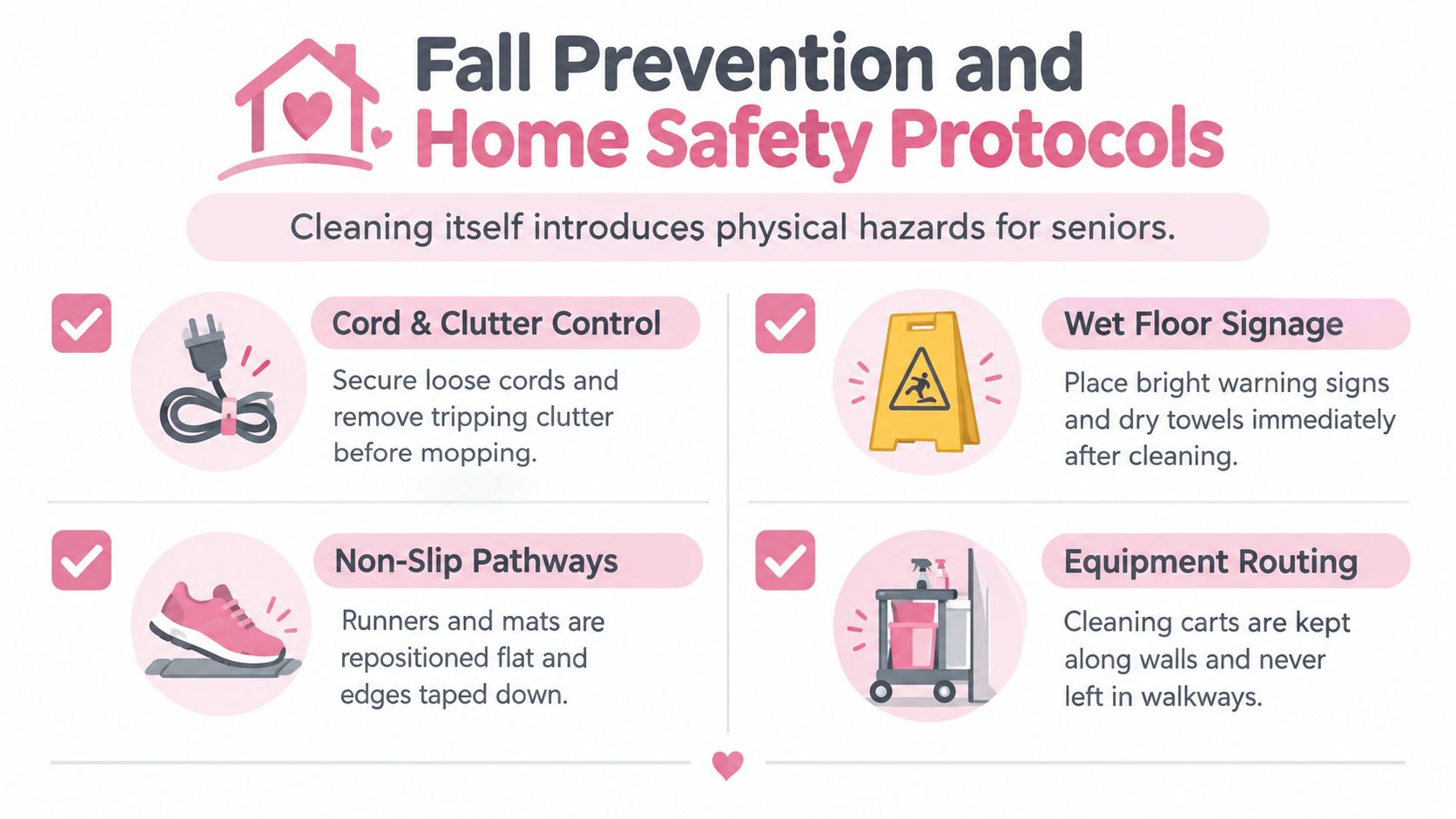
Here's the standard I'd use: clutter comes out first, and our guide to decluttering for your health covers how to clear a room without exhausting the person living in it. Moisture comes off fast, and the highest-risk zones, bathrooms, stairs, and hallways, get the most attention. That is also where Velma tips for senior fall safety fits well, because in a senior home fall prevention is the core of safe cleaning, not an add-on.
For a cleaner home and fewer hazards, keep the workflow tight and the equipment out of the way. A cart parked in the hallway is a trip hazard. A mat bunched at the bathroom threshold is a trip hazard. A freshly mopped floor without a clear drying plan is a trip hazard.
Health-Conscious Products for Respiratory Safety
Older adults are more vulnerable to household chemicals than most families realize. An EPA fact sheet says people over 60 accounted for less than 3% of reported poisoning incidents, but they were twice as likely as children and younger adults to have a serious outcome and 10 times as likely to die from household chemical exposure (EPA-related senior chemical-risk summary). That's not a small detail. It changes what “clean” should mean in a senior home.
Product choice matters as much as technique
The safest service spec is simple. Use low-odor, non-aerosol cleaners. Prefer liquid or solid formulations over sprays. Keep ventilation active. Never mix bleach with ammonia or acids. And don't linger in small enclosed spaces longer than needed, because bathrooms and kitchens trap airborne residue faster than open rooms.
Rule for senior homes: Short-duration cleaning with good airflow beats aggressive scrubbing with strong fumes.
This is especially important for clients with asthma, COPD, or reduced lung function. Repeated exposure to irritating products can make breathing worse, so the cleaner's method has to reduce intensity across the whole job, not just swap one bottle for another. A helpful outside reference on product selection is cleaning solution for healthier air, which aligns with the kind of low-exposure thinking families should expect.
What families should ask for
Ask whether the provider brings fragrance-free or low-toxicity products, whether they avoid aerosolized sprays, and whether they open windows or run fans when appropriate. Ask how they handle bathrooms, where strong chemical smells can linger longest. If they can't answer plainly, they're not thinking like a senior-focused service.
For families who've already dealt with odor issues at home, the broader problem often starts with air fresheners and similar products. The truth about toxic air fresheners is worth reading because scent isn't the same thing as safety.
Scheduling Flexibility and Consistent Staffing
Trust matters more in a senior home than in almost any other setting. Older clients don't want a rotating cast of strangers who have to relearn where everything is, which room is sensitive, and which chair must never be moved. They want someone who shows up on time, knows the layout, and works the same way each visit.
Familiarity lowers stress
The strongest cleaning arrangement is usually the simplest one, the same experienced cleaner whenever possible, on a regular schedule. That predictability helps older adults relax, especially if they're anxious about someone entering their home. It also cuts down on explanations, which matters when a client moves slowly or tires easily.
Recurring service works better than improvised visits for another reason. Senior homes don't reset themselves between appointments. Dust, clutter, and bathroom moisture build up gradually, and a steady schedule keeps small problems from becoming unsafe ones.
Predictable staffing is not a luxury for senior households. It's part of the service standard.
Families should look for weekly, biweekly, or monthly maintenance that fits the older adult's routine instead of forcing the older adult to adapt to the cleaner's convenience. When appointments keep the same rhythm, the home stays easier to manage and the client feels less disruption.
There's a practical side too. A cleaner who knows the house can spot changes faster, a new spill pattern, a hallway that's getting crowded, a bathroom setup that needs more careful handling. That kind of continuity is hard to fake.
Adapting Services for Mobility and Accessibility
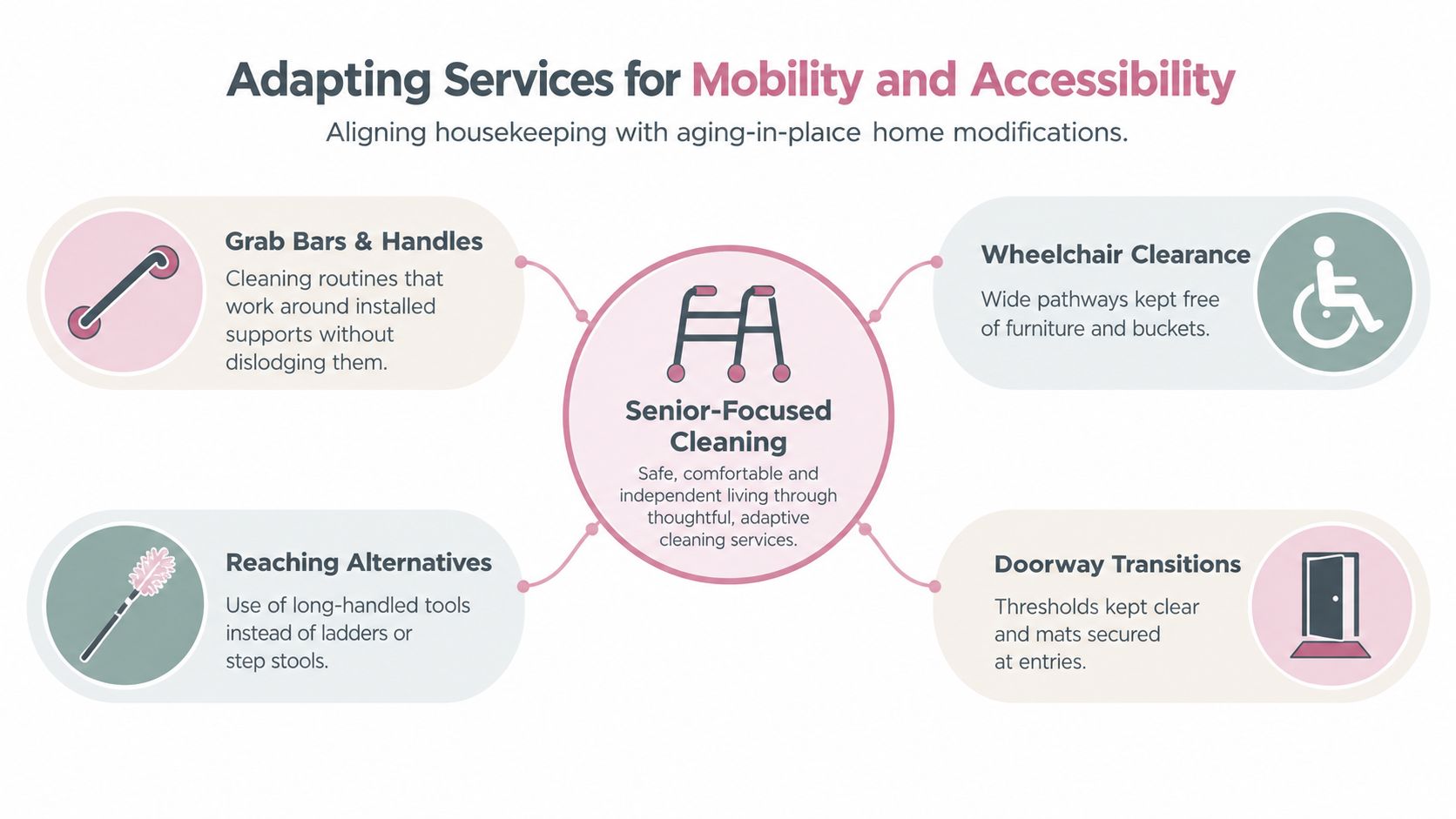
A senior-focused home is often full of useful modifications that also affect cleaning. Grab bars, walk-in showers, wider paths, raised seats, walkers, and rollators all change how a cleaner should move through the space. The job is no longer just surface care, it becomes support work around an aging-in-place layout.
Clean around mobility aids, don't work against them
The right approach is to preserve clearance. Keep doorways open, leave wide paths to the bedroom and bathroom, and don't shift equipment out of habit. If a walker or wheelchair is part of daily life, the cleaner should treat that route like a permanent circulation path, not something to tidy up later.
Home safety and housekeeping overlap. A home modification such as a grab bar only works if the surrounding area stays usable. If a cleaner places a bucket in front of the bar, stacks supplies in a threshold, or leaves a mat half-folded at the entrance, the safety feature is compromised.
For a practical planning resource on how home changes support mobility, the step-by-step aging in place guide is worth using as a companion reference. The key idea is straightforward, the cleaner should respect the same accessibility logic that the remodel was built around.
Bathroom and doorway habits have to change
Bathrooms deserve special handling. Clean one zone at a time, keep floors dry, and don't block access to the toilet or shower while working. Door thresholds should stay clear, and mats need to sit flat, not curl at the corners.
If you want the clearest rule of all, use this one: the safest cleaning service is the one that makes moving through the house easier after the visit than before it.
Navigating Costs and Medicare Coverage Realities
Families often assume routine housekeeping is folded into health coverage. It usually isn't. Medicare does not pay for routine housekeeping or homemaker services when they're unrelated to a care plan, and that misconception causes a lot of bad planning.
Separate medical support from household support
Cleaning for a senior home sits in a strange middle space. It's not medical care, but it can absolutely affect safety, independence, and the ability to stay home. That's why families need to decide whether they're buying a private household service, support tied to a broader care arrangement, or some combination of both.
The smartest way to think about it is simple. Medical care addresses diagnosis and treatment. Senior cleaning addresses the daily conditions that make home life safer and easier. Those are different services, and they should be budgeted separately.
If the goal is aging in place, recurring cleaning is a stability expense, not a luxury extra.
That matters because the value of a private-pay model is continuity. Families pay for low-disruption visits, familiar staff, and a home that doesn't fall into neglect between appointments. In practice, that's often more useful than a one-time overhaul that looks great for two days and then disappears under daily life again.
Finding Reliable Local Cleaning Support
Start with the basics, and don't compromise on them. For a vulnerable client, licensed, bonded, and insured should be essential. Then ask how the company handles staff consistency, what products they bring, and whether they know how to work around fall-prevention and mobility needs.
What to ask before you book
- Staff continuity: Ask whether the same cleaner can be assigned whenever possible, because older clients do better with familiar faces and consistent routines.
- Product safety: Ask what kind of cleaners they use, especially if anyone in the home has sensitivity to odor, asthma, or respiratory irritation.
- Workflow discipline: Ask how they prevent wet floors, manage clutter, and keep paths open while cleaning.
- Local fit: Ask whether they serve your part of town reliably and can keep to a recurring schedule without constant rescheduling.
If you're in or near Kennesaw, GA, that local fit matters even more because nearby coverage can make recurring visits far more dependable. Kennesaw is associated with ZIP codes 30144 and 30152, and some directories list additional ZIPs tied to the city, which makes neighborhood-specific service knowledge useful when you're choosing a provider (Kennesaw ZIP reference).
Choose the company that thinks like a care partner, not just a cleaner.
If you want senior cleaning done with low-odor products, reliable scheduling, and real attention to safety, Maid in America is built for that kind of home care. Visit Maid in America to set up a service that supports aging in place instead of getting in the way of it.
Maid in America provides reliable, personalized cleaning with natural products for homes, offices, and communities across West Georgia. Licensed, bonded, and insured, we’re locally and privately owned.
Get in touch with us today!
info@maidinamericaga.com