Maid Service Dallas GA: Packages and Schedules Explained
The entry floor has red clay footprints, the bathroom needs attention, and you're expecting company before you've caught up on laundry. You want help, but choosing between maintenance cleaning, a deep clean, and a handful of extras can feel harder than it should.
Choosing a maid service in Dallas, GA starts with the condition of the property, not the longest checklist. Routine soil, renovation dust, and damp bathroom walls need different responses. A useful cleaning plan separates them before anyone arrives with a mop.
Table of Contents
- Dallas, GA Maid Service Options at a Glance
- Maintenance doesn't mean blanket disinfection
- When a detailed reset makes sense
Dallas, GA Maid Service Options at a Glance
A lived-in home due for its monthly reset and a rental that turned over last week need different visits. Match the service to the property's current condition before you pick a schedule.
Maid in America is a locally and privately owned house cleaning and maid service based in Kennesaw, Georgia. It serves homeowners, renters, and businesses in Dallas and the surrounding Paulding County communities.
Dallas is the Paulding County seat, approximately 30 miles northwest of downtown Atlanta, according to Paulding County's history page. Occupied homes, rental properties, workplaces, and shared facilities each call for a different scope of work.
Maid service options by situation
| Service | What It Covers | Best For |
|---|---|---|
| Basic maintenance cleaning | Kitchens, bathrooms, floors, furniture, mirrors, accessible surfaces, trash removal | Busy families, commuters, retirees aging in place |
| Deep cleaning | Detailed top-to-bottom treatment of the whole home | First visits, seasonal resets, special occasions |
| Move-in and move-out cleaning | Empty or mostly empty homes, including cabinets, closets, baseboards, appliance interiors and exteriors as specified, and accessible surfaces | Renters, landlords, real estate agents |
| Post-construction cleaning | Fine dust and job residue on floors, fixtures, cabinet exteriors, kitchens, bathrooms, mirrors, and windows | Homeowners and property owners after renovation |
| Recurring maid service | Basic maintenance weekly, biweekly, every three weeks, or monthly | Households wanting steady upkeep |
| Office cleaning | Routine care for workplaces | Small offices and workplaces in the Dallas area |
| HOA clubhouse and community amenity cleaning | Routine care for shared facilities and amenities | HOA boards and property managers |
The same menu runs across the company's West Georgia service area, including Acworth, Woodstock, Marietta, Hiram, Powder Springs, and Cartersville. Office managers and HOA boards should describe facility use and access requirements rather than treating shared spaces as extra household rooms.
One situation sits outside every row. A home with visible mold or an active moisture problem needs a remediation specialist before any cleaner arrives; routine cleaning picks up again after that work is done.
Selection rule: Match the service to the property's current condition first. Choose the frequency after you've agreed on what the visit needs to accomplish.
What Basic and Deep Cleaning Actually Include
Basic cleaning is like the regular upkeep that keeps a car running well. Deep cleaning is the full detail: more involved, useful periodically, and unnecessary every time.
Basic maintenance cleaning covers kitchens, bathrooms, floors, furniture, mirrors, accessible surfaces, and trash removal. High-touch points such as countertops, doorknobs, light switches, faucets, sinks, and toilets receive attention during the visit.
Maintenance doesn't mean blanket disinfection
Routine cleaning is generally sufficient in most homes. Illness or a household member at higher risk changes the conversation, so disclose those circumstances before the appointment rather than expecting automatic whole-house disinfection.
When disinfection is appropriate, the CDC's home cleaning guidance says to clean with soap and water first, then use an EPA-registered disinfectant or another appropriate product with ventilation and label-directed application. Spraying disinfectant onto dirt and immediately wiping it away isn't a substitute for that process.
Tools matter, too. HEPA vacuuming captures dust from floors and textiles, while damp wiping and damp mopping collect residue rather than throwing it back into the air. A feather duster or dry broom can make a room look briefly better while leaving particles to settle elsewhere.
When a detailed reset makes sense
Top-to-Bottom Deluxe deep cleaning is a thorough, detailed pass suited to a first professional visit, seasonal reset, holiday hosting, or a stretch of heavy household use. It gives cleaners time to address buildup that a maintenance appointment isn't designed to absorb.
It still needs an agreed scope. Deep cleaning doesn't automatically mean every appliance interior, cabinet interior, or specialized stain treatment is included.
- Choose basic cleaning when the home is maintained and ordinary kitchen, bathroom, surface, and floor care will keep it manageable.
- Choose deep cleaning first when accumulated buildup has overtaken routine upkeep or the home hasn't had a full professional clean.
- Clarify the details with the deep cleaning vs. regular cleaning comparison, especially if you're expecting detailed work beyond accessible surfaces.
Staff arrive with supplies and follow a published checklist. That shared checklist keeps recurring visits consistent while leaving room to identify your household's priorities.
How Often to Book Recurring Cleaning
Recurring cleaning frequency and best fit
| Option | Visit Pattern | Best Fit |
|---|---|---|
| One-time visit | Top-to-bottom first clean, seasonal reset, or special occasion | Homes not yet on a schedule |
| Weekly | Basic maintenance every week | Busy families, pets, frequent hosting |
| Biweekly | Basic maintenance every two weeks | Households wanting steady upkeep between deeper cleans |
| Every 3 weeks | Basic maintenance every three weeks | Homes that stay fairly tidy between visits |
| Monthly | Basic maintenance once a month | Lighter use or a baseline between deep cleans |
Weekly visits suit kitchens and bathrooms that get heavy daily use. Biweekly service leaves more responsibility for quick household upkeep, while every three weeks works when rooms remain fairly tidy. Monthly cleaning is a lighter-use option, not a reliable substitute for frequent care in a heavily used home.
Dallas had 5,454 households during 2019–2023, according to the U.S. Census Bureau's city profile. Those households don't all need the same schedule: a renter preparing to move and a homeowner maintaining occupied rooms have different goals.
Judge the gap between visits
One dedicated cleaner is usually sent to each home instead of a large team. That continuity helps clients get to know their cleaner by name and communicate preferences without starting over each appointment.
The recurring house cleaning services guide helps compare the available intervals. Choose the longest gap that keeps the home at your family's preferred standard.
If the house repeatedly becomes uncomfortable to live with before the next visit, shorten the interval rather than asking a maintenance appointment to become a rescue clean.
Add-Ons Worth Booking and When They Help
Add-ons should solve a specific problem, not become automatic purchases. Choose them when visible buildup or an upcoming occasion justifies the extra work.
Food residue and lower-wall buildup
- Inside the oven or fridge: Add this after holiday cooking, a busy stretch, or before moving. Skip it when interiors are already maintained and there's no spill or buildup to address.
- Baseboards: Add them when tracked-in red clay and pet hair collect along lower walls. Skip the extra when a quick inspection shows they're still clean.
- Cabinets: Add cabinet cleaning for fingerprints or grease near the stove, specifying fronts versus interiors. Skip it when doors are clean and storage areas don't need attention.
Presentation and bathroom detail
- Interior windows: Add them after spring pollen season when indoor glass looks hazy, or before listing photos or a gathering. Skip them if the dirt is outside, since interior cleaning won't correct exterior glass.
- Grout: Add it for soap film and ordinary kitchen or bathroom residue. Skip harder scrubbing when grout stays damp or develops recurring dark spotting; that needs a moisture check first.
Household workload and furniture
- Laundry: Add it when household routines or hosting leave an unmanageable backlog. Skip it when your own laundry routine is keeping pace.
- Dishes: Add them when a busy period leaves the kitchen difficult to use. Skip them when the sink is clear and the standard kitchen visit can proceed unobstructed.
- Upholstery vacuuming: Add it for sofas and chairs used by pets or children. Skip it when the actual issue is a set-in stain that needs a carpet and upholstery specialist rather than vacuuming.
Booking advice: Buy the extra task when it addresses something you can identify. Don't expect an add-on to repair damage or guarantee that a stain will disappear.
How Move-Out, Move-In and Post-Construction Cleaning Work
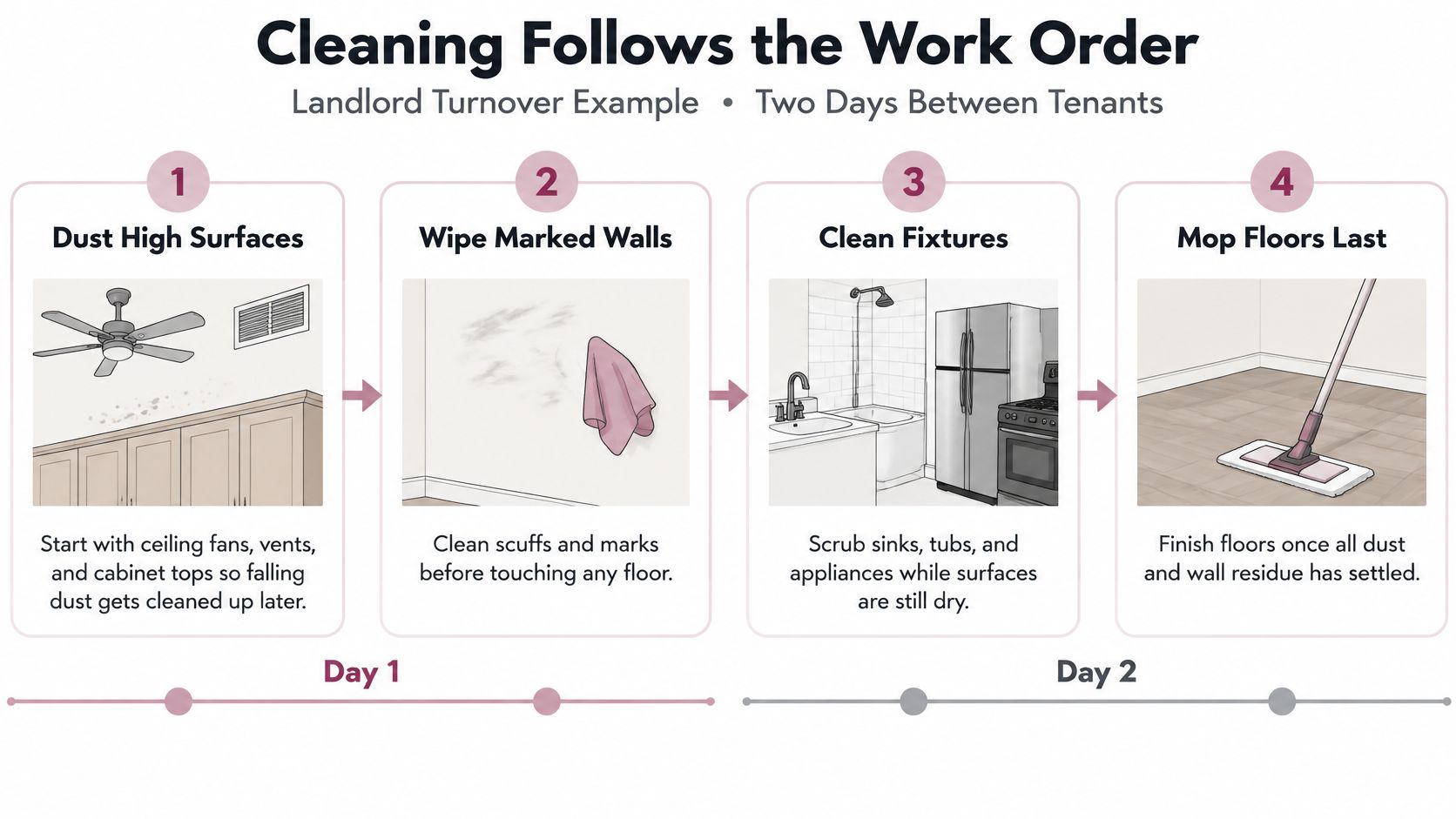
Example: A landlord has two days between tenants, an empty house with dusty surfaces, and marked walls. The cleaning should follow the work order, not a room-by-room dash that leaves freshly mopped floors underneath falling dust.
Move-in and move-out cleaning covers empty or mostly empty homes, including cabinets, closets, baseboards, accessible surfaces, and appliances as specified. Post-construction cleaning targets fine dust and job residue on floors, fixtures, cabinet exteriors, kitchens, bathrooms, mirrors, and windows.
The turnover workflow keeps dirty work ahead of finished floors.
Follow a controlled dust-removal sequence
- Divide the home into zones, cleanest to dustiest. Containing dusty areas limits the amount carried into rooms that are already ready for occupancy.
- HEPA-vacuum walls, fixtures, furniture, and remaining surfaces. Work from high surfaces downward so loosened particles don't land on finished areas.
- Damp-wipe noncarpeted surfaces. This collects the film vacuuming leaves behind. Use a finish-compatible cleaner and test painted surfaces before attempting scuff removal.
- Wet-mop hard floors last. Floors collect fallout from the work overhead, so cleaning them early creates avoidable repeat work.
- Walk the home for kitchens, bathrooms, mirrors, and windows. Check corners, edges, and viewing angles for residue before treating the property as ready.
Dry sweeping can re-aerosolize fine dust. Use suitable HEPA equipment, maintain filters according to the manufacturer, and don't use an ordinary household vacuum for unidentified construction debris.
Know when the trades must finish first
For homes built before 1978, renovation can disturb lead-based paint, and the EPA's renovation safety booklet describes containment, HEPA vacuuming, and wet cleaning precautions. Ordinary housekeeping isn't lead abatement; certified renovation procedures and clearance testing may be required.
Marked walls also deserve realistic expectations. Removable scuffs are a cleaning question, but damaged paint belongs with a painter. Construction debris removal and unfinished repairs should be resolved before the cleaning visit.
Schedule after the final haul and last trade visit, preferably before unpacking. Tell the cleaner which rooms were renovated and what materials were disturbed.
For rental handovers, use the move-out cleaning checklist for tenants to agree on appliance interiors, cabinet interiors, and inspection priorities. Cleaning can prepare the property, but it can't promise a particular deposit decision.
Where Cleaning Ends and Moisture Problems Begin
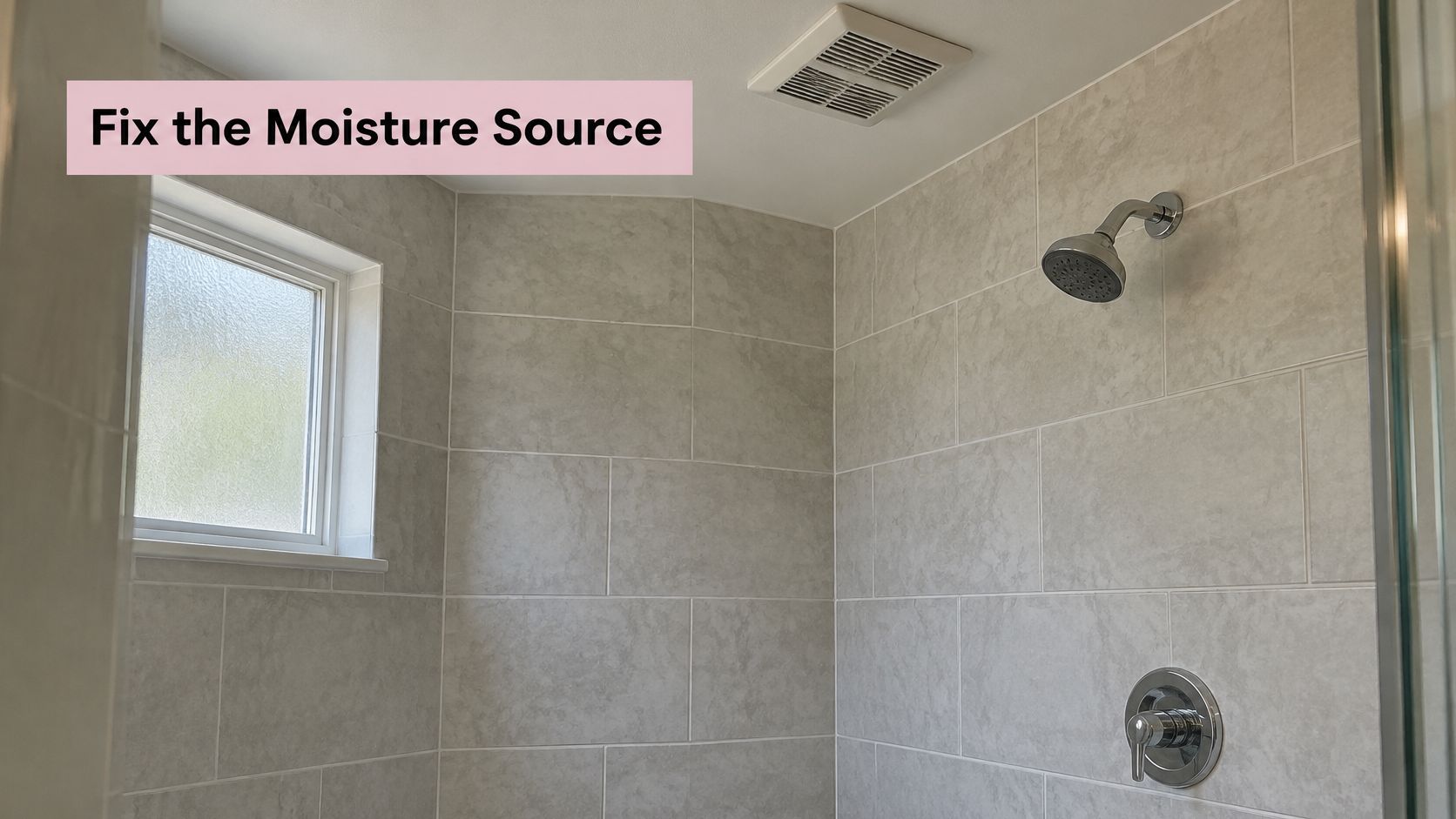
A shower wall can look clean and still stay damp enough for mildew to return. Routine maid service removes soil, soap film, and ordinary mildew from hard, nonporous surfaces; it does not find the leak, dry wall cavities, or correct ventilation.
Georgia's mold guidance keeps the prevention basics simple: hold indoor humidity around 30–50%, repair leaks, ventilate bathrooms and kitchens, and dry water-damaged materials within 24–48 hours. In humid Georgia summers, those habits matter because wet materials dry slowly; a cleaner still cannot repair a pipe, seal a failing grout line, or dry material hidden behind tile.
Ventilation belongs to moisture control. Treat weak exhaust fans and steam that lingers as building issues to correct before the next cleaning.
Use the right trade for the material
Carpet, drywall, and upholstered furniture are porous. Once growth reaches those materials, the question shifts from housekeeping to evaluation, drying, or disposal.
What cleaning can handle and when to call a specialist
| Situation | What a Maid Service Can Do | When to Call a Specialist |
|---|---|---|
| Dust, pet hair, and tracked-in red clay on floors | Remove ordinary soil with vacuuming and damp mopping | Usually unnecessary; investigate if a recurring damp source keeps the area dirty |
| Ordinary mildew on bathroom tile or sealed surfaces | Clean hard, nonporous surfaces within the agreed scope | If staining returns within days, investigate and repair the moisture source |
| Visible mold on drywall, carpet, or upholstery | Outside ordinary maid-service work; porous materials need evaluation | Contact a remediation specialist |
| Recent water damage or a leak | Cleaning cannot dry the structure or fix the source | Contact a plumber and drying specialist first |
| Persistent dampness or a musty smell | Surface cleaning only | Arrange a moisture assessment |
| Asthma, allergies, or chemical sensitivity | Reduce dust and residue, ventilate during work, and use suitable low-odor products | Consult health care providers for medical conditions; cleaning isn't treatment |
For dry carpet with persistent staining, a professional carpet cleaner is the appropriate complementary trade. That differs from water-damaged or mold-affected carpet, where surface work can spread contamination or hide a wet pad.
Product choice isn't a mold solution
Natural or low-odor products do not make mold safe to handle. Maid in America uses natural, low-odor products, which means attention to comfort and fewer harsh chemicals, not treatment for asthma, allergies, or other conditions.
Disclose sensitivities before booking, ask about ventilation, and keep sensitive occupants and pets out of rooms during intensive dusting. Never mix cleaning chemicals, and treat recurring odor as a moisture clue, not a fragrance problem.
If a bathroom needs supplemental humidity control, Home Dehumidifier Reviews explains drainage options for bathroom dehumidifiers. Plan how collected water will be removed, and use the appliance to support drying, never to postpone leak repairs.
The boundary is practical: clean what is cleanable, fix what is wet, and call a specialist for what is porous, hidden, or spreading.
Request a Free Estimate for Your Dallas Home
Before booking, settle the essentials: the service type, a realistic frequency, and add-ons that address identifiable work. If walls, floors, or grout stay damp, arrange a moisture assessment before scheduling ordinary cleaning, since that work sits outside a maid service's scope.
Maid in America is licensed, bonded, and insured, and assigns one experienced cleaner to a home whenever possible for continuity. It holds a 4.9-star average across 400+ public reviews. Estimates and scheduling are built around space details and client priorities, so the more specific you are upfront, the tighter the quote.
Prepare the details that shape your estimate
- Describe the property. Note the home type, rough size, occupants, pets, sensitivities, and any move or construction date. Businesses should include facility use and access details.
- Request a free estimate. Use the online estimate option or call 770-427-4448 to discuss the work.
- Agree on the scope. Confirm the service, frequency, and add-ons before the first appointment.
- Prepare access and surfaces. Clear counters and floors of personal belongings, secure valuables, and point out rooms that were under construction or need extra attention.
Service extends to Kennesaw, Acworth, Woodstock, Marietta, Cartersville, Dallas, Hiram, and Powder Springs, with coverage defined by specific ZIP codes across Cobb, Paulding, and Bartow counties. Homeowners, renters, office managers, and HOA managers can request a plan based on how their space is really used.
Maid in America offers maintenance, deep, move-in/move-out, and post-construction cleaning, along with office and community amenity care. For a cleaning scope and schedule that fit your Dallas property, visit Maid in America to request a free estimate online or call 770-427-4448.


Maid in America provides reliable, personalized cleaning with natural products for homes, offices, and communities across West Georgia. Licensed, bonded, and insured, we’re locally and privately owned.
Get in touch with us today!
info@maidinamericaga.com